Bridges 2026 Short Film Festival
Brian Carter, Shanna Dobson
Filmmakers
Brian Carter
Associate Professor, Film
ArtCenter College of Design
Pasadena, California, USA
Shanna Dobson
Assistant Professor of Mathematics
ArtCenter College of Design, H&S Department
Pasadena, CA
Statement
What does it mean to think in structures that cannot be seen? A mathematician immersed in p-adic geometry and a musician composing in parallel confront the same problem: how to bring structure into form. In a space where equations gather on glass and extend into a larger, invisible architecture, mathematics becomes an interior landscape—at once isolating and expansive, felt as much as understood. As musical phrases from an original score unfold in time, mirroring the movement and development of thought, both move through persistence and fracture, arriving at a moment of resolution—not as conclusion, but as alignment within a larger structure—revealing mathematics and music as parallel acts of composition shaped by tension, structure, and release.
Films
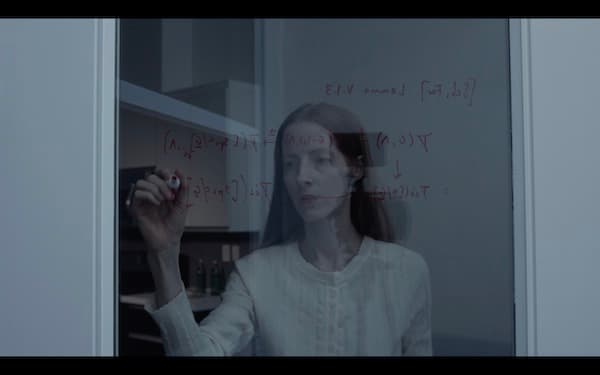
The Sound of Resolution
00:03:05
Directors: Shanna Dobson & Brian Carter Cinematography: Brian Carter Original Score: Brian Carter Performer: Shanna Dobson
2025