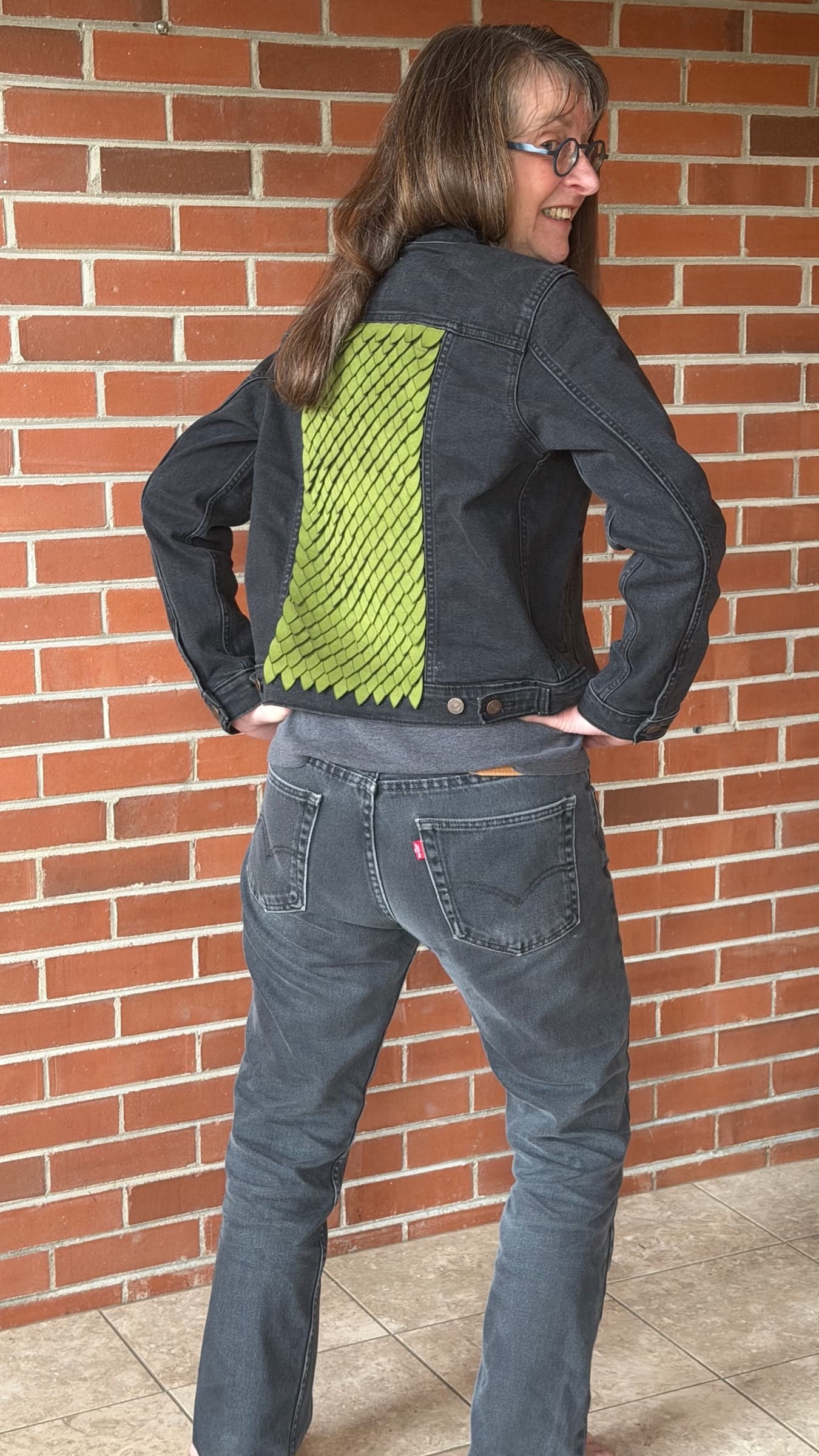
With a 40+ year career as an academic engineer, fiber arts has been a parallel passion from an early age. Perhaps my earliest fashion design experience was as a preteen, when I wanted to enter a local skating competition. Not owning the requisite skating outfit, I scrounged around the house for yarn and crocheted myself a skating skirt to wear over a leotard. Now that I am an emerit professor of engineering, I have the luxury of giving fiber crafts my full attention. I particularly enjoy 2D patterns and tilings and the realization of a fiber vision made possible using machine technology and my rudimentary programming skills.
This entry is a denim jacket for the fashion conscious serpent. The embellished panel of scales is knitted, using a modular kirigami technique. The math here is in the making. In a conventional knitted fabric, strands of yarn bend into a serpentine shape that interlocks with neighboring rows. The serpentine shape is recreated computationally here to produce precisely engineered rows of knit stitches, fabricated in Ultrasuede® using a laser cutter. The serpentine Ultrasuede strands are knitted together by hand to produce a fabric panel. The panel is knitted in stockinette stitch with the purl side facing outward, and with the lower purl bar of each stitch extended downward to form a scale. A slip stitch knitting technique was employed to position the scales in the diamond pattern widely favored by serpents and dragons, and the size and shape of each stitch is mathematically tailored to produce a knitted panel that perfectly fits in the location of the central back panel of the purchased jacket.
The panel to be knitted is represented by a quad mesh that defines stitch location. We use a baseline stitch based on a rectangular mesh cell, and with cutting paths determined by Bézier curves (cubic polynomials with shape established by a set of four control points) , defined here relative to the four corners of the cell. A rectangular quad mesh is deformed to match the outer perimeter of the panel, and each cell of the distorted mesh defines either a knitted or slipped stitch. The cells of the distorted mesh are no longer rectangular, but because the Bézier control points are defined relative to the cell vertices, the individual stitches may be mathematically stretched and bent in a systematic way that ensures that each connects smoothly with its neighbors and that neighboring rows interlock perfectly with one another. The result is a drapey fabric of articulated scales, using a new technique that can be adapted for the construction of any garment.
Smith-style Truchet tile rainbow block printed on black t-shirt
photograph: Amy Wendt
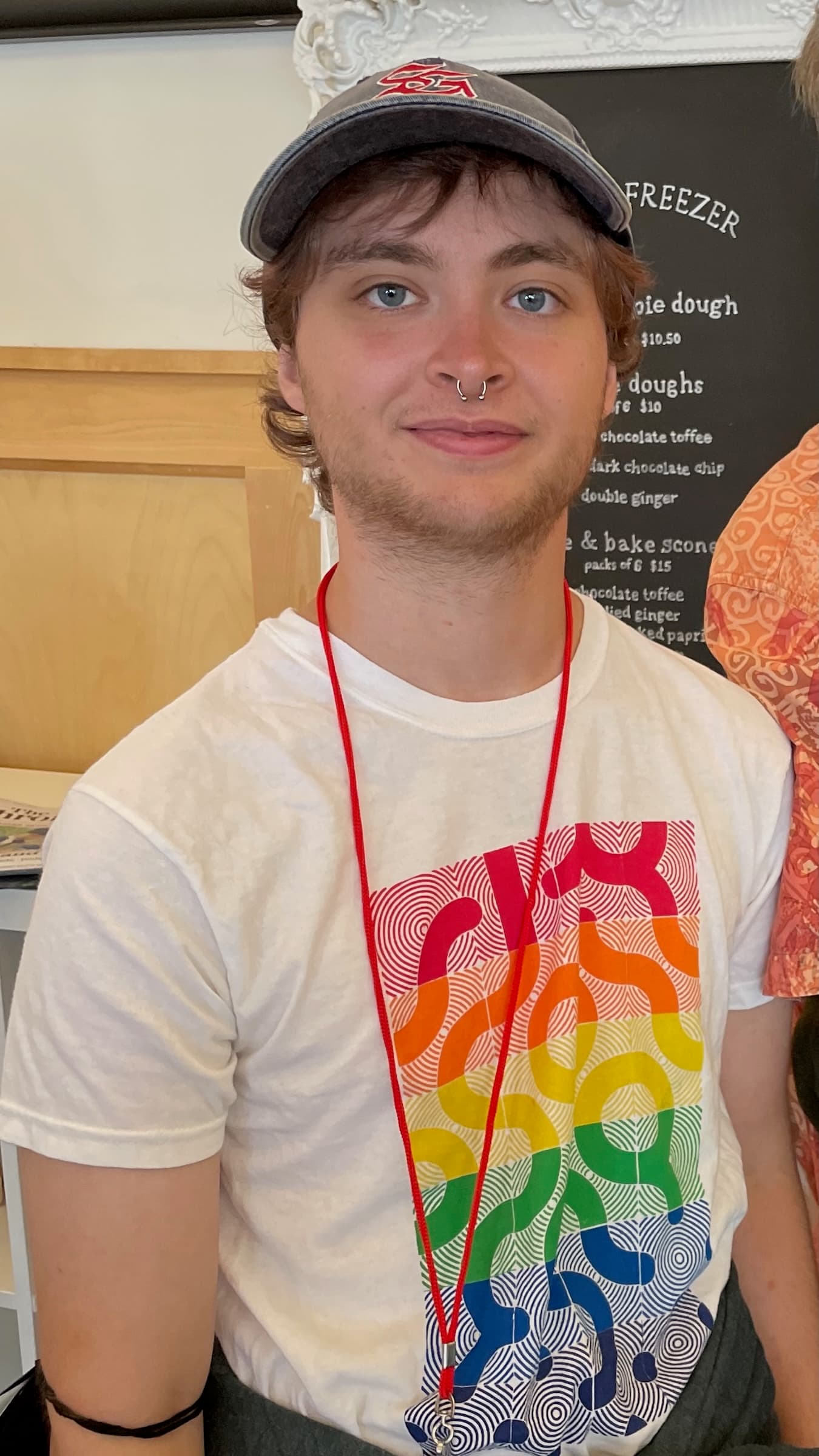
Smith-style Truchet tile rainbow t-shirts - each is printed from a different arrangement of tiles
photograph: Amy Wendt
About the look
Rainbow Truchet Tile Everyday Wear
Block print, oil-based inks on cotton t-shirts
2023-2026
Smith-style Truchet tiles feature motifs that connect from one tile to the next to make abstract mosaic images. Birch tiles, each laser engraved with a different motif, were individually inked and then assembled for relief printing onto t-shirts. Different arrangements of tiles create unique mosaics that span across the rainbow-colored stripes on each t-shirt, telling a story of unity and individuality.
My vision for the fashion show is that a group of at least 5-6 models from across the Bridges community will walk the runway together, each wearing one of the t-shirts.