Cicely Henderson is a PhD candidate at the University of Waterloo in the Combinatorics & Optimization Department, where she studies an area of discrete math called "graph theory." As a graduate of an arts-based high school turned STEM graduate student, she feels most at home at the intersection of mathematics and creativity. She uses this to further her passion for making math a more welcoming community for all by writing about math to broad audiences and organizing events with the UWaterloo Women in Mathematics Committee. When she isn't puzzling over a research question, you can find her daydreaming about future outfits, learning to swing dance, or conjuring up new math-inspired garments on a borrowed sewing machine.
Looks
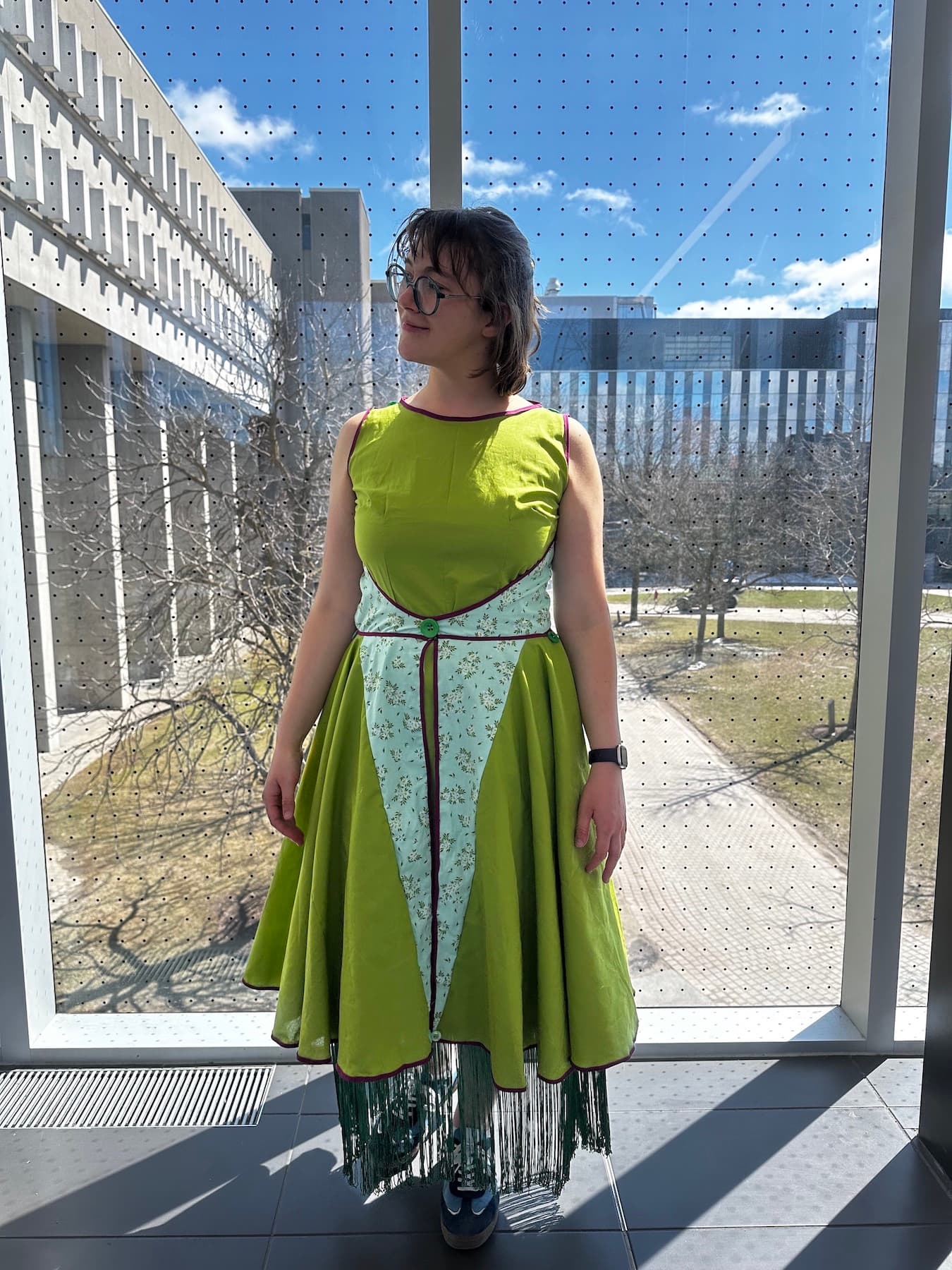
Front view of the Absorption Attire.
Back view of the Absorption Attire.
Front details of the Absorption Attire.
Right side view of the Absorption Attire.
Left side view of the Absorption Attire.
Sketch of the Absorption Attire.
The absorber A represented by the Absorption Attire.
About the look
Absorption Attire
Stitched fabric (cotton), buttons (plastic)
2026
I use math to promote mingling at dinner parties. An event gets dull when you're stuck talking only to those seated next to you. By switching places after each course, guests get more opportunities to chat. In my research, I show when we can devise seating arrangements where everyone gets to converse. This work also applies to testing medication, playing Sudoku, and solving storied mathematical conjectures. This dress, fit for such a dinner party, is inspired by a core concept of this research: the Absorption Method.
Let's reformulate our dinner party problem: draw a dot for each guest and a line between each pair of guests. This structure is a graph, the dots are vertices, and the lines are edges. Let's say each table seats three. In a graph, a triangle is three vertices with all edges between them. We want a collection of triangles in our graph that meet two conditions: first, we can divide the triangles into groups where each vertex is in exactly one triangle per group. This guarantees that each guest is at one table per course. Also, every edge in the graph is in exactly one triangle. This ensures each pair of guests is seated together once. I use the Absorption Method to find such "triangle decompositions:" we first partially decompose a graph, then complete that to a full decomposition using an "absorber." A graph A is an absorber for a graph L if both A and $A\cup L$ admit a decomposition. In other words, if L is included in the partial decomposition, A decomposes itself. If L is excluded, then A helps L to decompose.
This dress represents one such absorber (Image 7). The top is the decomposition of A, the skirt is the decomposition of $A\cup L$, the vertices are buttons, the seams are edges, and the floral pieces are the triangles in the decomposition. The fringe represents the triangle consisting of the space beyond the skirt. Also, the buttons are color-coded to show the equivalence of the vertices on the top and bottom decompositions.