2026 Bridges Conference Math + Fashion
Lorelei Koss
Designers
Lorelei Koss
Professor of Mathematics
Dickinson College
Carlisle Pennsylvania USA
Biography
I enjoy using mathematical ideas in crafts and wearable art, creating work that makes abstract structures visible in everyday objects. For this piece, I researched meander frieze patterns and hand-painted nineteen patterns onto a linen outfit. The wearer carries these mathematical paths along their travels.
Looks
_300dpi.jpg&w=1536&q=75)
About the look
Meander
Linen garment, hand-painted with fabric paint
2026
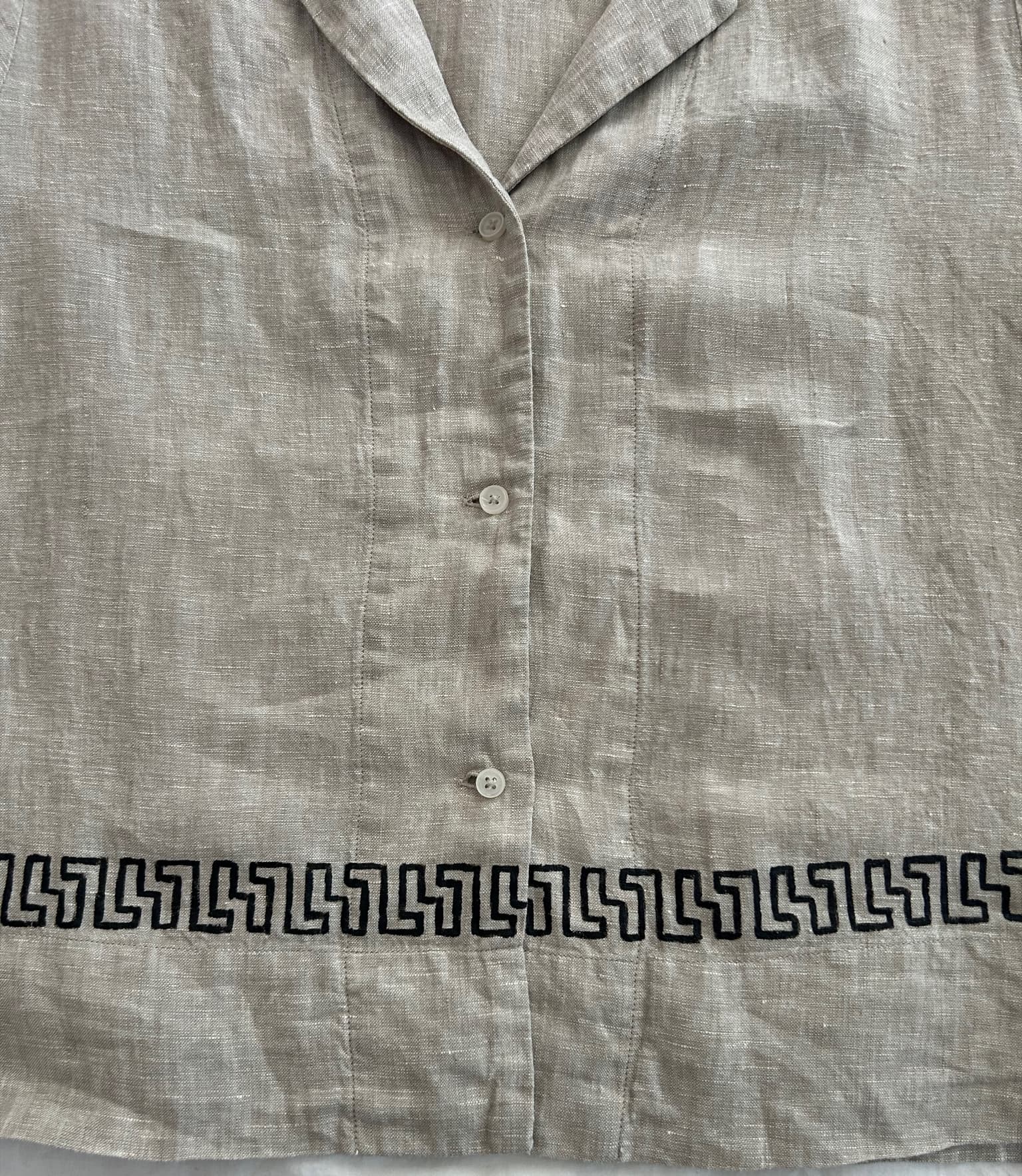
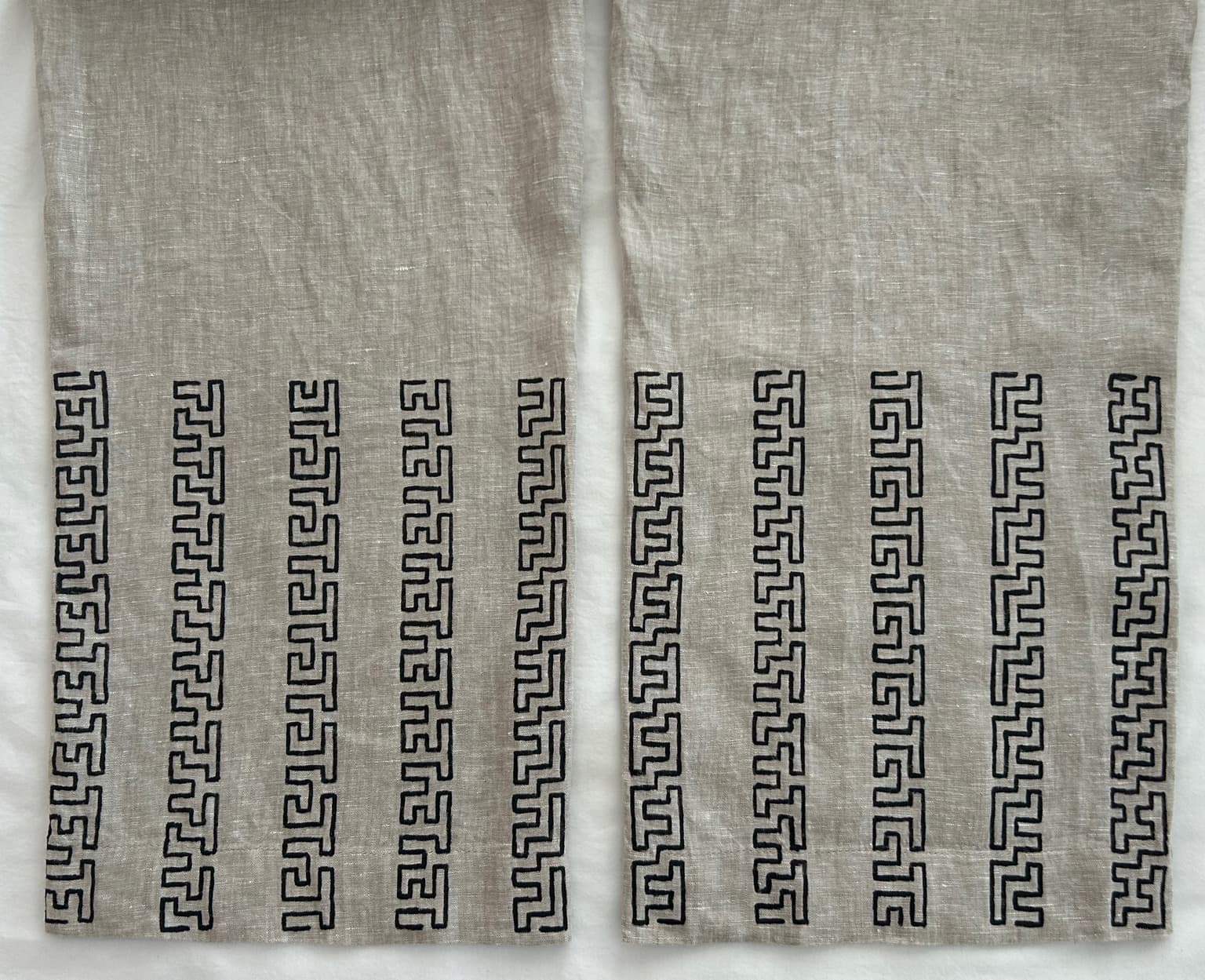
This hand-painted linen outfit is decorated with wandering paths inspired by the mathematical idea of a meander. The motifs come from a collection of nineteen meander frieze patterns described by Kappraff, Radović, and Jablan. Each pattern arises from a simple rule: draw a path through a 5×5 grid that visits every point exactly once without crossing itself. Such a path is called a Hamiltonian path. In their construction, the path enters the grid from the left in the middle row and exits on the right at the same height, allowing the motif to extend naturally into a repeating frieze. All nineteen patterns from the paper appear in this garment: eighteen along the cuffs of the pants, where the designs rise upward like wandering routes across the fabric, and the nineteenth on the shirt.
The work also plays on the dual meaning of the word meander. In mathematics it refers to a class of winding paths; in everyday language it suggests wandering without hurry. Linen, a fabric valued for its breathability, texture, and movement, provides a natural surface for these lines. The wearer quite literally carries these meanders along their travels.
Kappraff, Jay; Radović, Ljiljana; Jablan, Slavik. "Meanders, knots, labyrinths and mazes." Journal of Knot Theory and Its Ramifications 25.09 (2016).