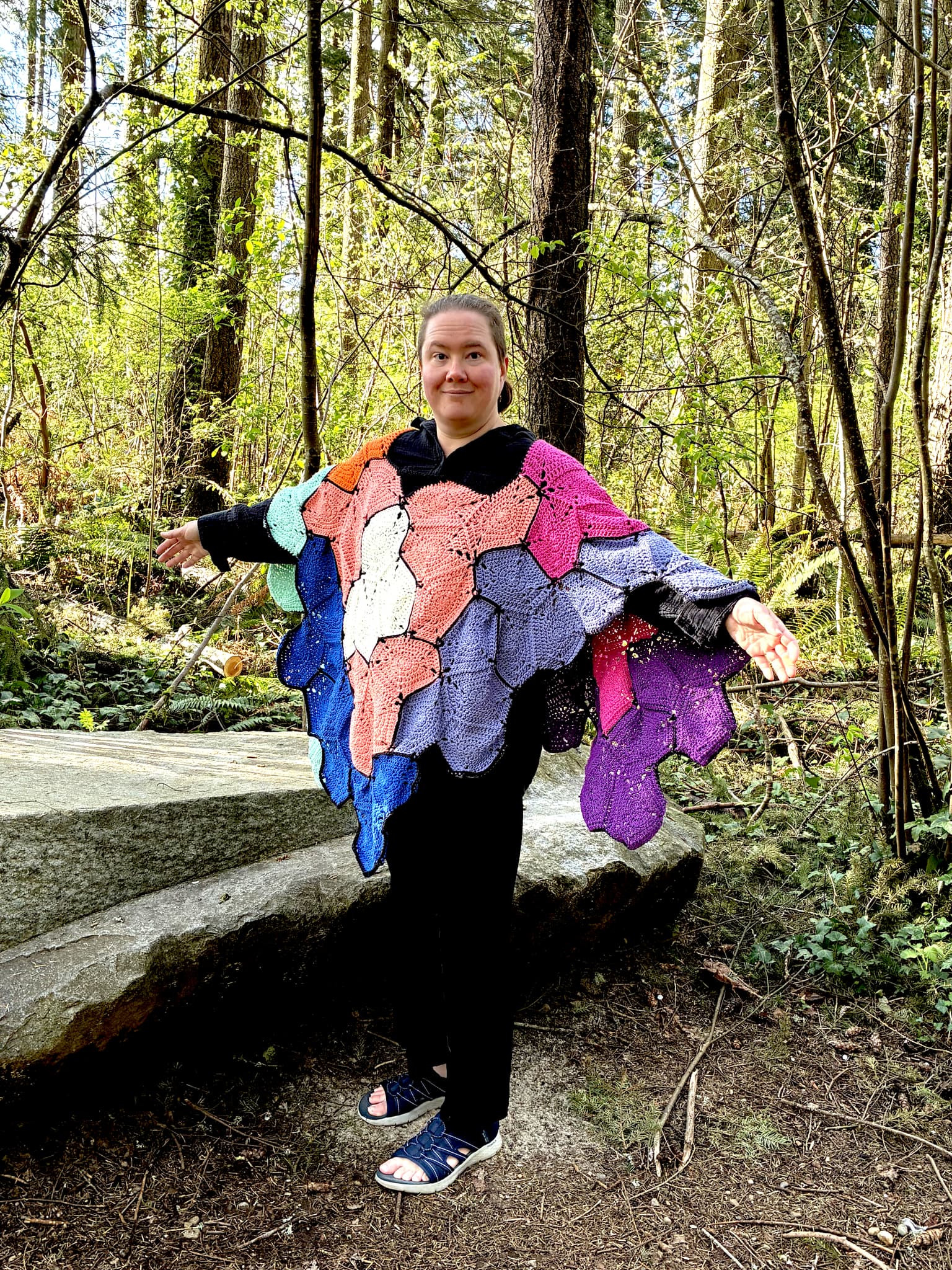
I learned to crochet in grad school and continue to use it as a creative outlet and a way to relax. I like expressing mathematical patterns and shapes with crochet because I can create the surface stitch by stitch and literally get a feel for the math. For this piece, I created a crochet pattern for the "hat" aperiodic monotile and stitched 27 of them together, leaving a hat-shaped hole in the center, to make a poncho.
Looks
Front view of the hat poncho
Modeled by the artist. Photographed by Vincent Schumacher.
Back view of the hat poncho
Modeled by the artist. Photographed by Vincent Schumacher.
The poncho laid flat so all the hats can be seen, including the empty hat-shaped space in the middle for the wearer's head
Photographed by the artist.
About the look
Hat Poncho
Cotton yarn
2026
Larger crochet pieces are often made by stitching together many motifs of the same shape. I wanted to make crochet motifs in an irregular shape, and I chose the "hat" aperiodic monotile because it can tile a plane and it seemed like an interesting challenge to create. I broke the hat shape into four identical pentagons and made each pentagon by working in rounds from the center outwards. This is a common crochet technique for making regular convex polygons; granny squares and granny hexagons are typical examples. With this technique, the corners are created by leaving a gap where new stitches will be added in the next round to make the shape larger. Since the pentagons that form the hat are not regular, I had to experiment with different stitch heights and different numbers of stitches on each side of the pentagon to get the correct side lengths and angles. In order to tile the plane with hats, some of the hats must be mirrored. By connecting the pentagons in different ways, you can make mirrored or un-mirrored hats. I made the mirrored hats in white yarn so they would stand out, and used colorful yarn for the other hats.