Ralf Jacobs: Interdisciplinary Designer at the Intersection of Mathematics, Textiles, and Fashion
Ralf Jacobs is a designer and artist whose practice bridges the precision of mathematics with the tactile poetry of textiles and fashion. Based in Eindhoven, Jacobs explores the interplay between technical rigor and folk aesthetics, creating works that challenge conventional boundaries between art, science, and craft.
Jacobs’ projects often incorporate radio technology, knitted copper antennas, and laser-deformed materials—each piece a meditation on time, symmetry, and the hidden structures that govern our world. Their work includes the mathematical radio, a fusion of formulaic tuning and textile craftsmanship, and laser cyanotype postcards that broadcast time signals through crystal radios. These projects reflect a deep engagement with both the theoretical and the handmade, where equations and stitches coexist.
Looks
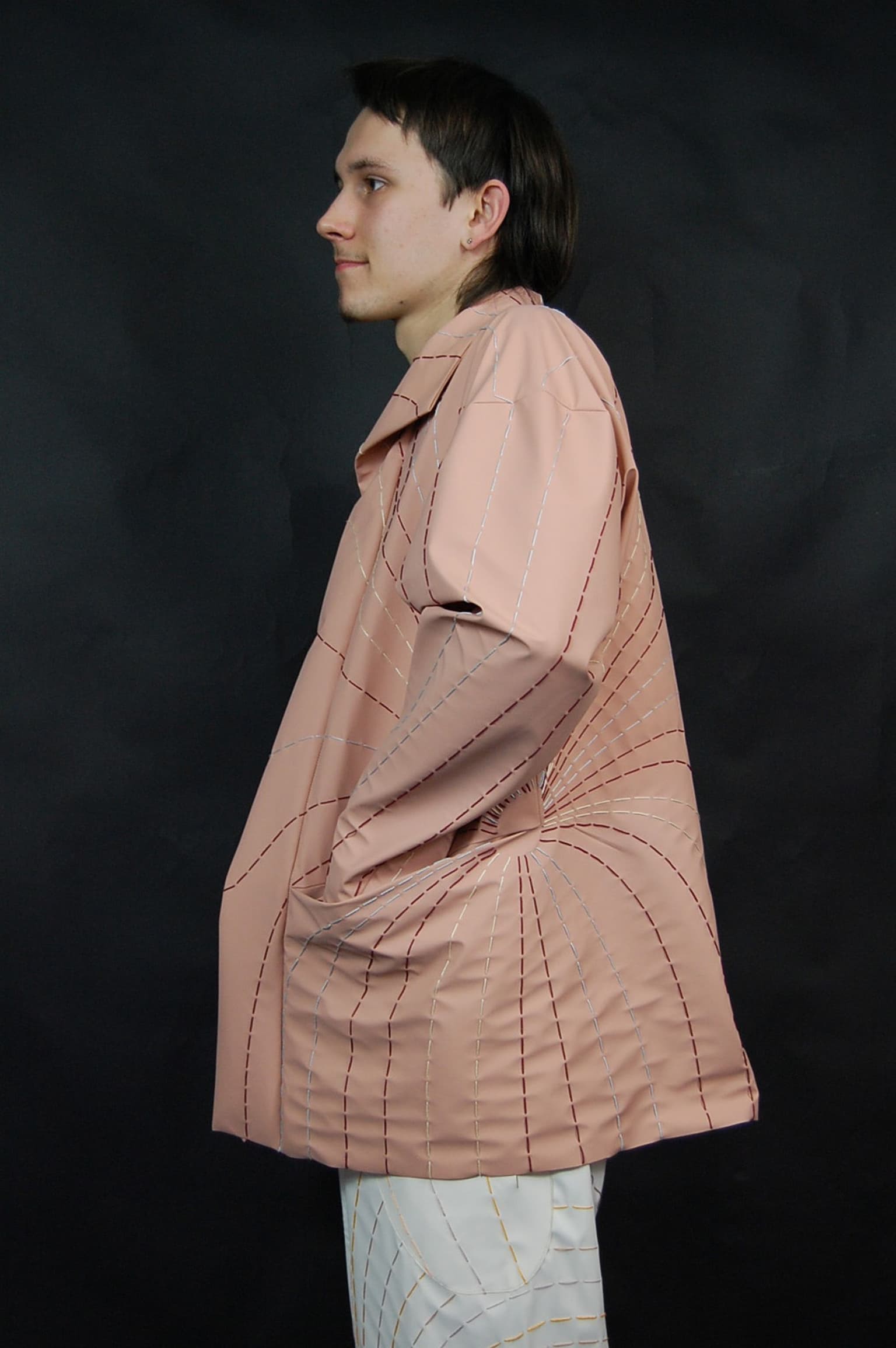
Electric field lines outfit
Designed by Ralf Jacobs, Marina Toeters and Loe Feijs. Manufactured at FasionTechFarm
in Eindhoven, the Netherlands. Worn by Rens Kwakkenbosch.
Electric field lines outfit
Designed by Ralf Jacobs, Marina Toeters and Loe Feijs. Manufactured at FasionTechFarm
in Eindhoven, the Netherlands. Worn by Rens Kwakkenbosch.
Electric field lines outfit
Designed by Ralf Jacobs, Marina Toeters and Loe Feijs. Manufactured at FasionTechFarm
in Eindhoven, the Netherlands. Worn by Rens Kwakkenbosch.
Electric field lines outfit
Designed by Ralf Jacobs, Marina Toeters and Loe Feijs. Manufactured at FasionTechFarm
in Eindhoven, the Netherlands. Worn by Rens Kwakkenbosch.
Electric field lines outfit
Designed by Ralf Jacobs, Marina Toeters and Loe Feijs. Manufactured at FasionTechFarm
in Eindhoven, the Netherlands. Worn by Rens Kwakkenbosch.
Electric field lines outfit
Designed by Ralf Jacobs, Marina Toeters and Loe Feijs. Manufactured at FasionTechFarm
in Eindhoven, the Netherlands. Worn by Rens Kwakkenbosch.
Electric field lines outfit
Designed by Ralf Jacobs, Marina Toeters and Loe Feijs. Manufactured at FasionTechFarm
in Eindhoven, the Netherlands. Worn by Rens Kwakkenbosch.
Electric field lines outfit
Designed by Ralf Jacobs, Marina Toeters and Loe Feijs. Manufactured at FasionTechFarm
in Eindhoven, the Netherlands. Worn by Rens Kwakkenbosch.
About the look
Electric field lines outfit, jacket.
PU Coated textile, laser cut and engraved embroidery, cotton embroidery yarn.
2026
You're absolutely right—I see the discrepancy now! Let me tighten it up while keeping the essence and mystical dimension intact:
Electric Field Jacket: Wearing the Unseen
This jacket began with a question: What if you could wear the invisible? Electric field lines surround us—silent, unseen forces shaping energy, bending around obstacles, connecting everything in a hidden web. I wanted to pull that invisible layer into the tangible, to craft something you could touch, something that makes the unseen felt.
Made from raincoat PU fabric, its subtle sheen catches light like a faint circuit glow. But the soul of the piece is the embroidery: field lines, calculated and stitched across the pattern pieces, flowing seamlessly over the body. They’re not decoration; they’re a direct trace of physics, a map of invisible energy stitched into cloth.
There’s something magical in that. Field lines are the silent architecture of the universe, always present but never seen. By wearing them, you become a conduit—a living diagram of forces that hum just beyond perception. The jacket is practical (durable, water-resistant) yet mystical, a talisman for the unseen.
For me, it’s deeply personal. Straddling math and fashion, I’ve always felt like an outsider in both. This jacket dissolves that divide. Math isn’t just numbers—it’s a way to see hidden patterns. Fashion isn’t just aesthetics—it can reveal what’s invisible.
In the end, it’s a quiet invitation: the world is full of forces we can’t see but can feel. Wear this, and you carry that mystery with you.
Electric field lines outfit, pants
PU Coated textile, laser cut and engraved embroidery, cotton embroidery yarn.
2026
These pants grew out of a different kind of challenge: How do you turn a flat, mathematical space into something you can move in? Unlike the jacket, which traces field lines across cut pattern pieces, these pants start with a single, unbroken rectangle of fabric—a zero-waste design where every scrap has a purpose. The legs aren’t just sewn; they’re wrapped, with triangular panels spiraling around the thighs so the fabric hugs the knees. That’s where the electrodes sit, not as decoration, but as active points in the system.
The idea was to create a wearable projection screen. The field lines aren’t stitched this time—they’re drawn by the space between the electrodes, turning the fabric into a dynamic surface where the math happens in real time. When activated, the lines radiate outward from the knees, bending and stretching as the legs move, like a live sketch of the wearer’s motion. The zero-waste pattern isn’t just sustainable; it’s intentional. The flat rectangle becomes a frame for the field, a blank space where physics and movement intersect.
What makes these pants unique is how they turn the body into part of the equation. The jacket visualizes static fields, but the pants generate them, shifting with every step. The electrodes at the knees aren’t arbitrary—they’re placed where the body bends, where energy naturally focuses. The result is a garment that’s both a tool and a statement: fashion doesn’t have to just represent ideas; it can demonstrate them.
There’s a raw honesty to them, too. The zero-waste design means every seam and fold is visible, just like the field lines. No hidden stitches, no wasted fabric—just a direct translation of concept to form. They’re a reminder that even the most abstract theories have a physical presence, and that clothing can be more than just covering. It can be a medium, a conversation between the body and the forces around it.