2026 Bridges Conference Math + Fashion
S. Louise Gould
Designers
S. Louise Gould
Professor Emerita
Department of Mathematical Sciences, Central Connecticut State University
Connecticut USA
Biography
S. Louise Gould uses all kinds of technology to illustrate mathematics using fiber. She works with weaving, knitting, machine knitting, spinning, sewing, machine embroidery and more. Her work usually starts with a geometric idea. She then explores what kind of textile medium would best illustrate the idea. She makes miniature paper models before moving to full size fiber realizations.
Looks
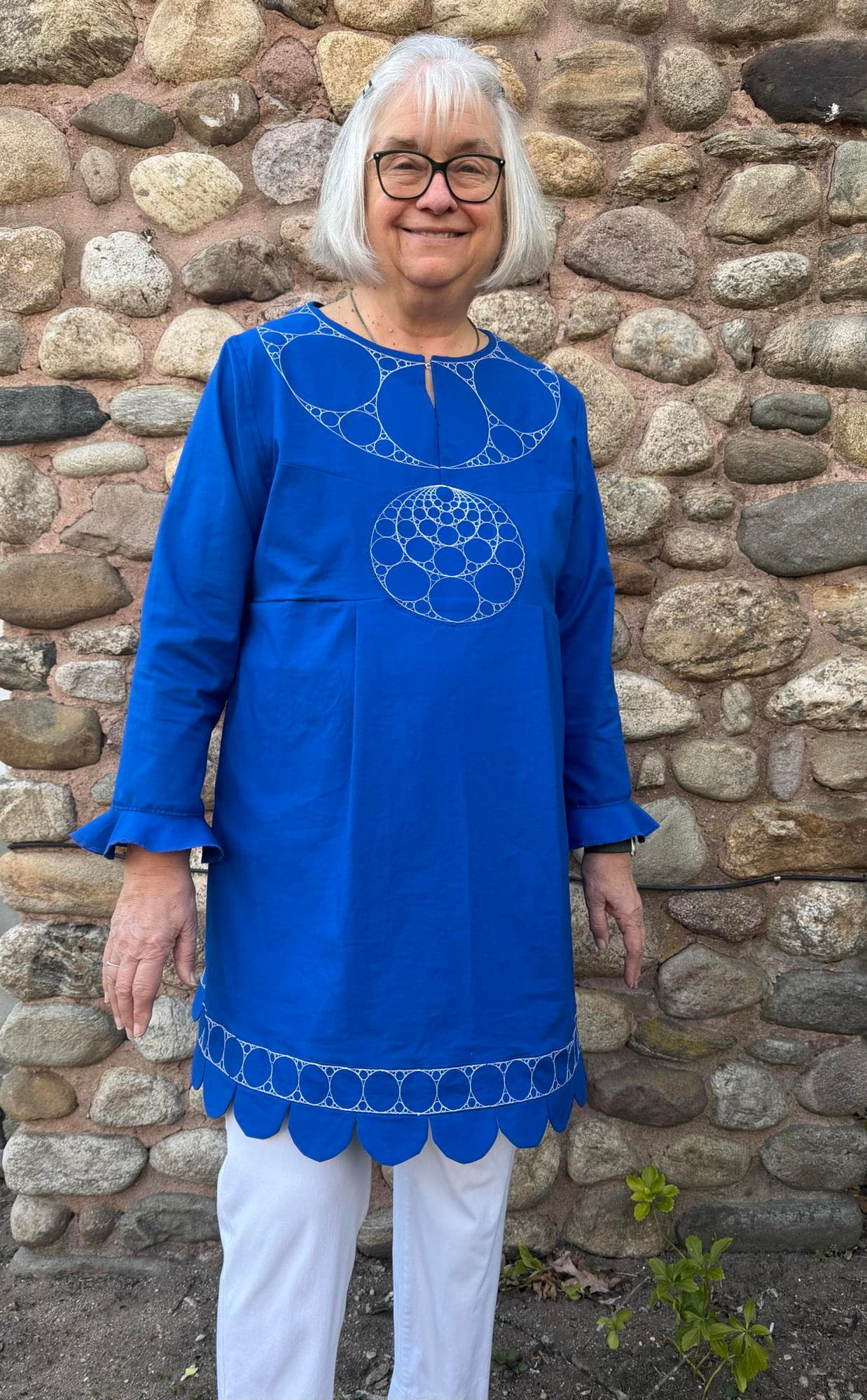
Front view of the garment.
Shown on the designer by photographer Joel Gould.
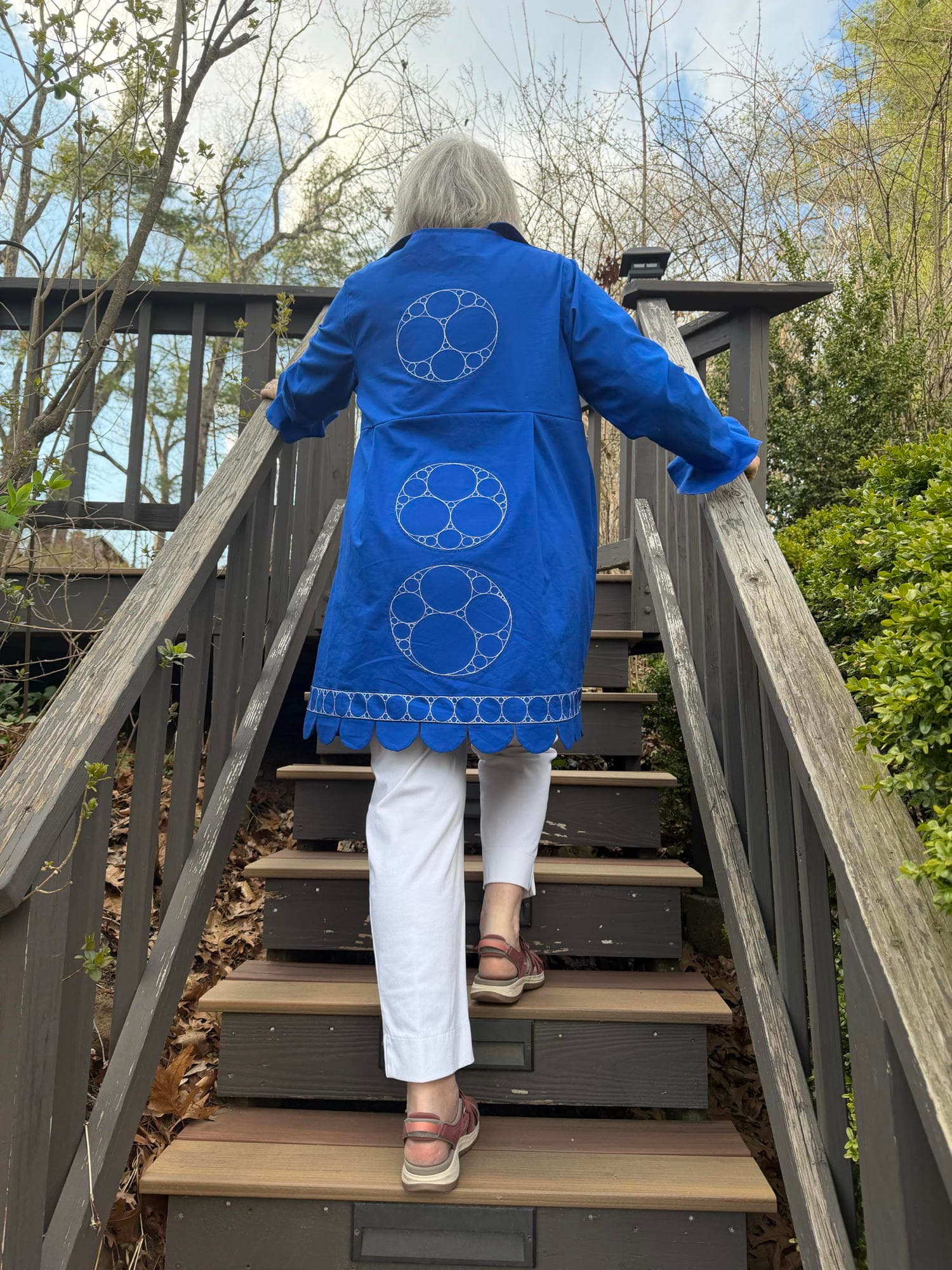
Back view of the garment.
Shown on the designer by photographer Joel Gould.
About the look
A Celebration of Circles
Designer digitized machine embroidery on cotton broadcloth.
2026
A silver necklace with a sample of an Apollonian Gasket inspired me to explore these circular constructions. Apollonius of Perga was a student of Euclid’s students in Alexandria. Following the tradition of the ancient Greek geometers, he looked for order in plane geometry. He observed that anytime that you have three circles that are each tangent to the others (but not in the same point) there are usually two more circles tangent to each of the three circles. Using these new circles you can repeat this process adding 2x3n circles at each stage for a total of 3(n+1)+2 circles at each new nth iteration. These constructions became known as Apollonian Gaskets. Descartes observed a pattern in the curvatures $\left (\frac{1}{r_1} + \frac{1}{r_2} + \frac{1}{r_3} + \frac{1}{r_4} \right )= $
$2 \left ( \frac{1}{{r_1}^2} + \frac{1}{{r_2}^2} + \frac{1}{{r_3}^2} + \frac{1}{{r_4}^2} \right ) $ (reciprocals of the radii) of the tangent circles that permits you to find the curvature of the tangent circles at each iteration. Historically geometers favored circles with integer curvatures and explored their symmetries. This garment features gaskets that demonstrate no symmetry other than the identity, bilateral symmetry, a set of nested gaskets, a gasket with 120 degree rotational symmetry which does not have integer curvature, and the limit case where two of the circles are represented by parallel lines, that is circles with no curvature.