When I was a math teacher, students convinced me that my nice-looking calculus graphs could qualify on their own as art. I now spend my time trying to bring the joy and visual beauty of mathematics to an unsuspecting audience. In each piece I create, there is always an underlying math principle that I try to infuse with color, depth, and purpose.
Math is commonly perceived as being separate from art, and people often cry "I'm not a math type, I'm creative!" But as makers and viewers of math art, we enjoy using both halves of our brains! My art displays mathematical relationships and visual patterns in a way that makes people stop and say, "That's cool! That's math?"
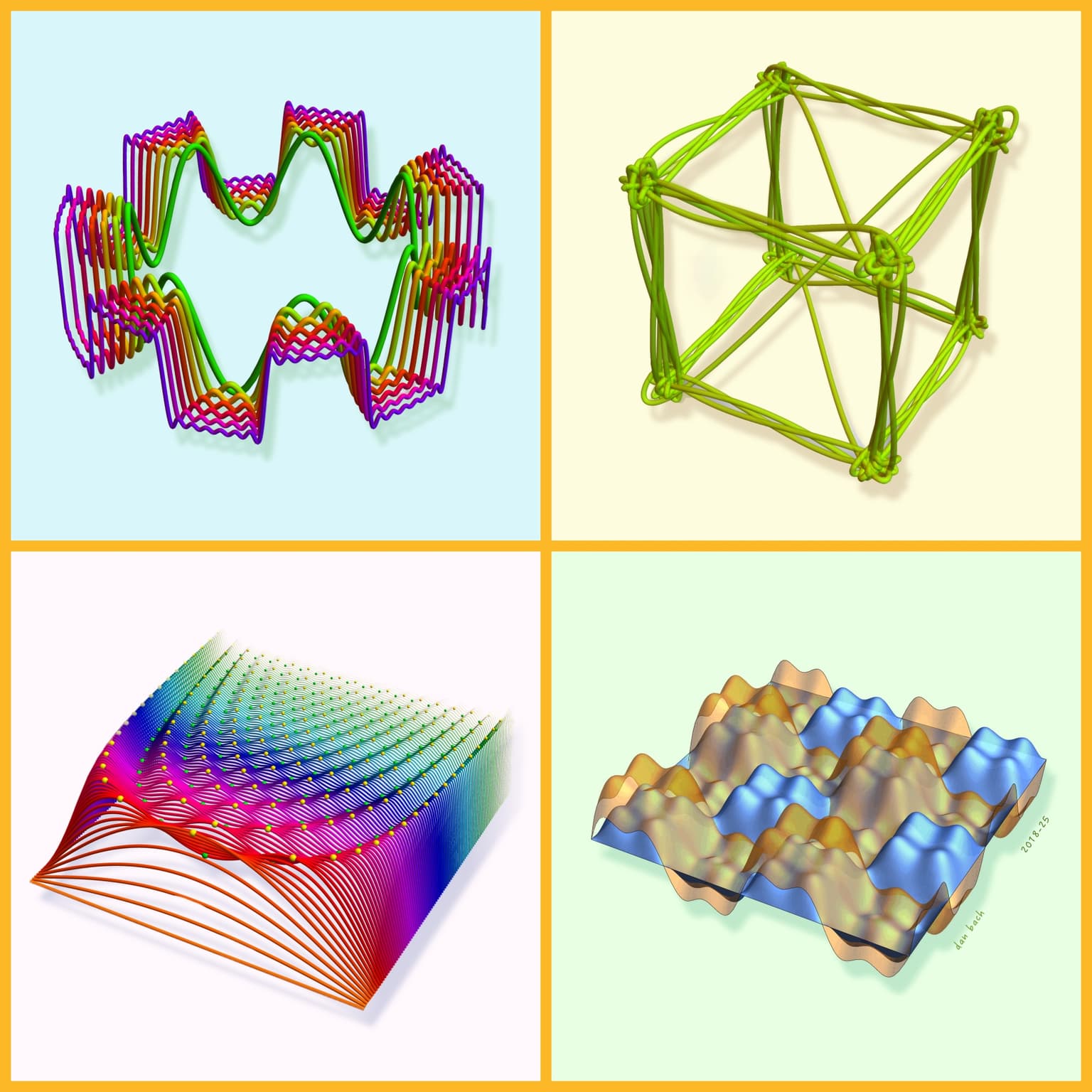
Function approximation comes in many forms, and visualizing the increasing accuracy is my goal here. Using the first few terms of the Fourier Series of a square wave (sum of 1/k sin(kt), with k odd), you can see that the more terms we use, the squarier the result.
Four artworks are shown here; from upper left, clockwise: Fourier Wave Ring, using the first seven terms; Sloppy Cube, where coordinates x, y, z each follow square-sine functions (with different periods) that spend most of their time at 1 or -1; Square Mountains, with two surfaces: a) z = the product of sin(x) + 1/3 sin(3x) and sin(y) + 1/3 sin(3y), and b) the sum of those two; and finally Sine Squared, a morph from sine to square with beads at the peaks and valleys.
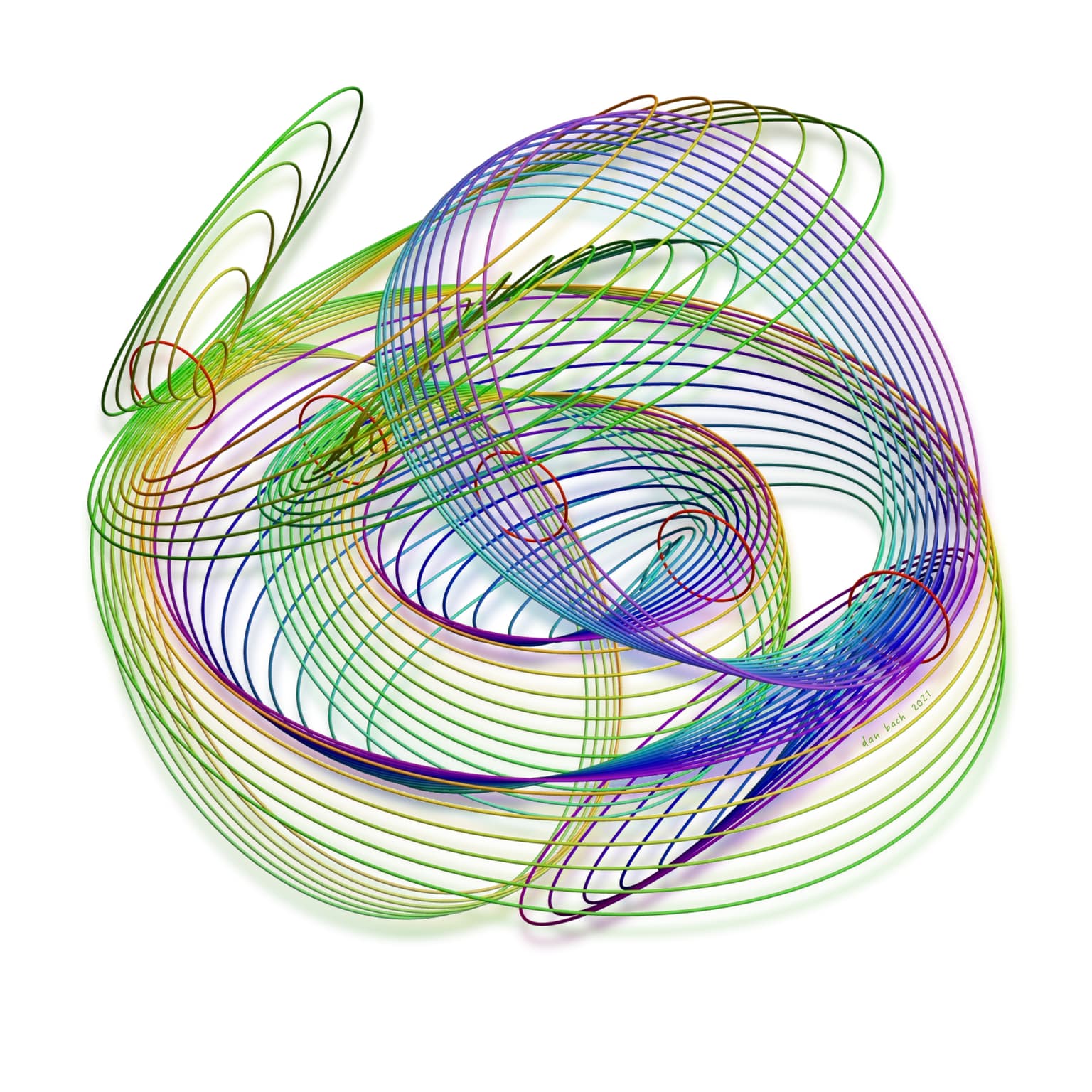
There is a clever way to fill all of 3-space with disjoint circles of positive finite radius, arranged by spherical shells centered at the origin. That covering also defines a new "Circular Coordinates" system, based on (R, m, t) where R = radius of a spherical shell, m = slope of an intersecting plane, and t = angle around the circle of intersection.
Each shell minus any two points can be covered by a fan of circles. The present artwork is a view of just a few dozen of these circles, made to avoid the two intersection points of the vertical red rings with the spherical shells. This method was inspired by a very short paper by Andrzej Szulkin (American Math Monthly, Nov 1983, pp 640-41).