2026 Joint Mathematics Meetings
Jean Constant
Artists
Jean Constant
Researcher
Hermay NM
Santa Fe, NM, USA
Statement
My selection for the JMM26, Bridges MathArt exhibit is extracted from two separate, year-long research projects at the intersection of mathematics and art. The precision and accuracy of geometry defined in mathematical terms are an unending source of inspiration for art. One of the most surprising findings from these projects is not only that mathematics permeates our environment, big and small, but is also an ongoing discovery of Nature’s visible and invisible expressions. This selection pays tribute to the timeless permanence of forms created by mathematical minds.
Artworks
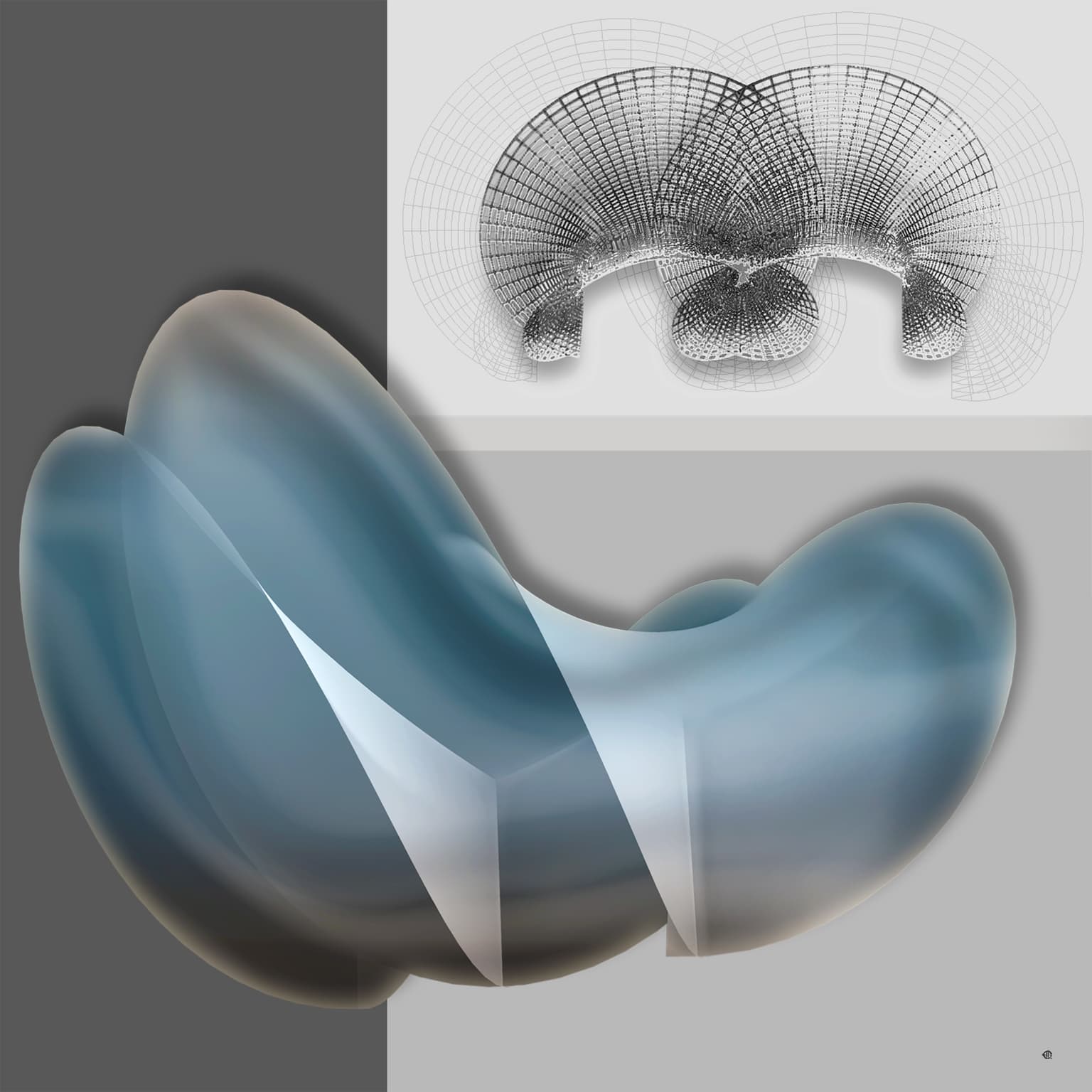
Two perspectives of the same surface, discovered by Belgian mathematician Eugène Catalan in 1855.
One obtains a minimal surface with simple planar cross sections. It starts with a planar curve and a normal vector perpendicular to the curve and the plane, and can contain an entire family of paraboloids.
Architect Eero Saarinen used this surface’s geometry to design the roof structure of the main terminal building at the Washington Dulles International Airport.
The original artwork, part of a 2020 research project on minimal surfaces, has been reprocessed using more recent technology to add depth and definition to the image.
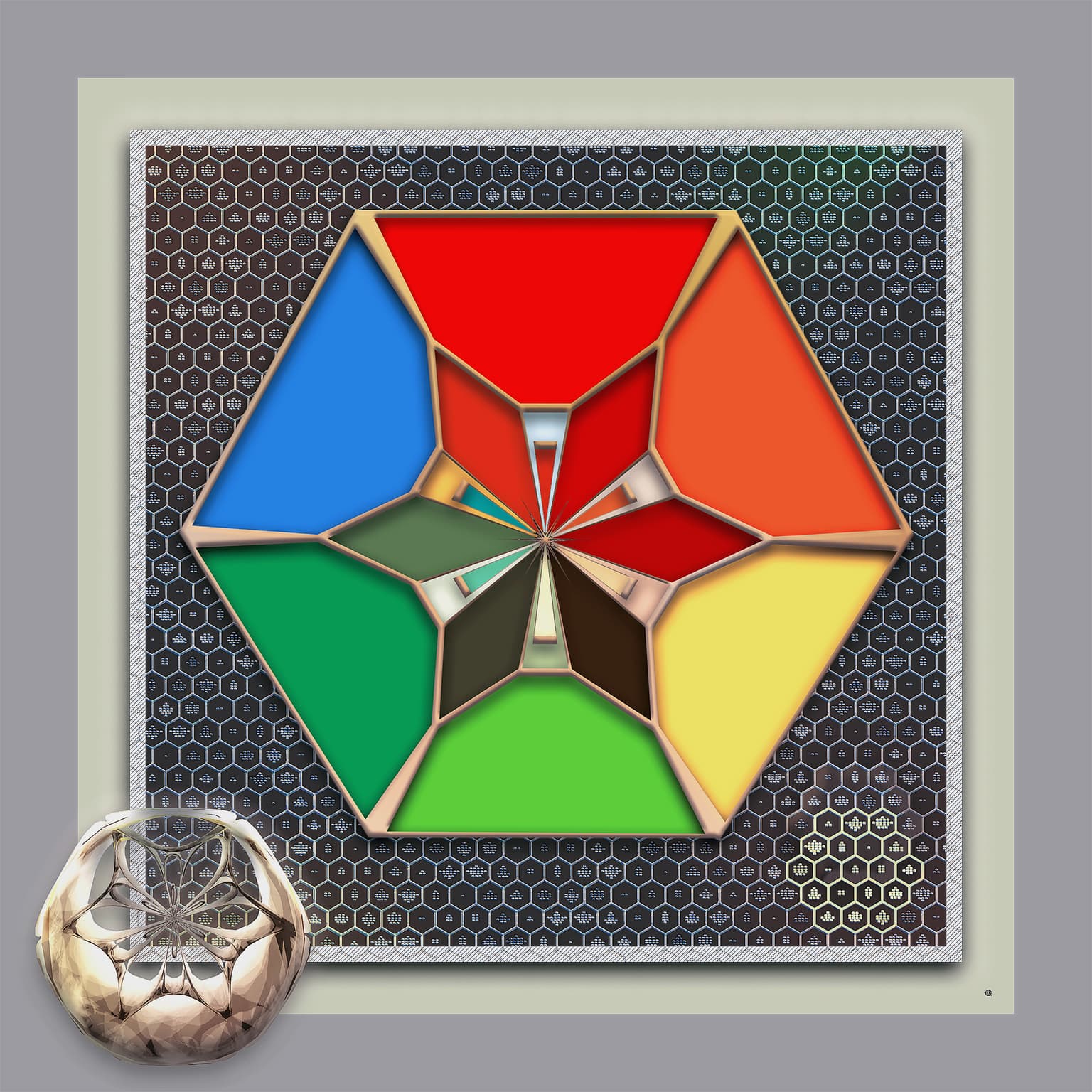
This diagram transitions from a circular shape to an hexagonal one. The outer sets are enclosed within an octagon and do not overlap; instead, they converge toward the center. The inner star outlines the transformation of hue and concept as the surfaces begin to overlap.
Hexagonal diagrams mirror natural structures such as honeycombs, crystals, and snowflakes, as well as technological innovations like the James Webb Telescope mirrors, graphene, and hexagonal software architecture. They represent efficient packing of interconnected components, making them ideal for visualizing complex systems or natural patterns.