I enjoy exploring the possibilities for conveying ideas in new ways, primarily visually. I express mathematical concepts through attributes such as color, geometric forms, and patterns. One theme I have explored recently is experimenting with different formats for displaying my math/art imagery. For example, a string of integers, color-coded as stripes according to their membership in various numerical sequences, can become a linear “snake” book. Or, alternatively, the string of stripes can be packed into a square envelope. Using differing formats can lead to new juxtapositions and result in interesting observations.
Artworks
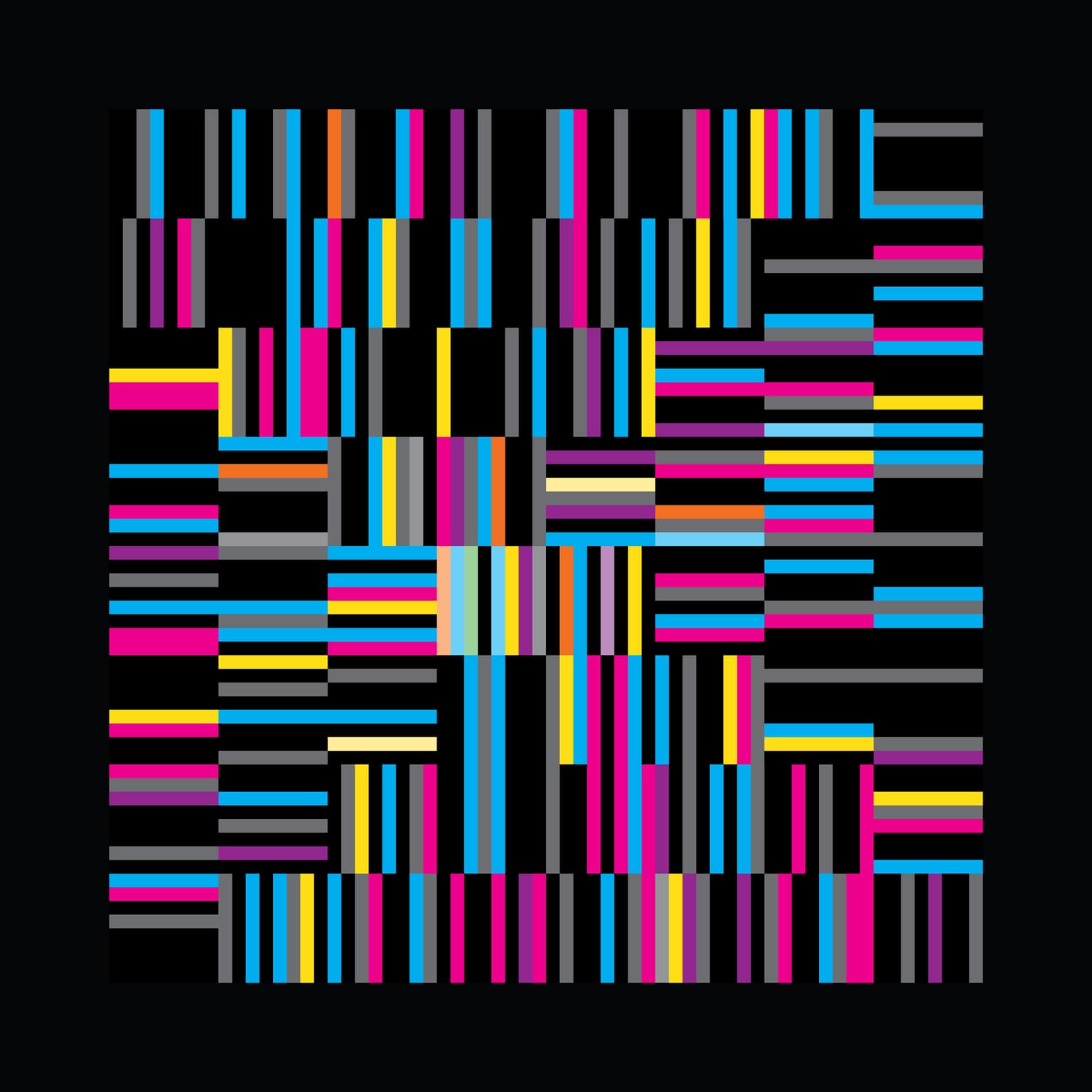
Snake in a Crate
50.0 x 50.0 cm
Archival Inkjet Print
2025
At Bridges 2018, I exhibited a “snake” book, consisting of a long strip of printed paper, which can be coiled up in a round container. The subject matter of the book is several integer sequences up to 512 -- their distributions and overlaps. For example, against a black background, the sequence of primes is shown as blue stripes appearing at 2, 3, 5, 7, 11, etc. units from the starting edge. Three other sequences (Triangular, Happy, and Fibonacci) are added in a similar way, using stripes of different colors. The colors for overlapping stripes are blended to produce new colors. For this piece, I investigated ways to contain the striped snake in a square box, while preserving mathematical integrity and creating visual interest.
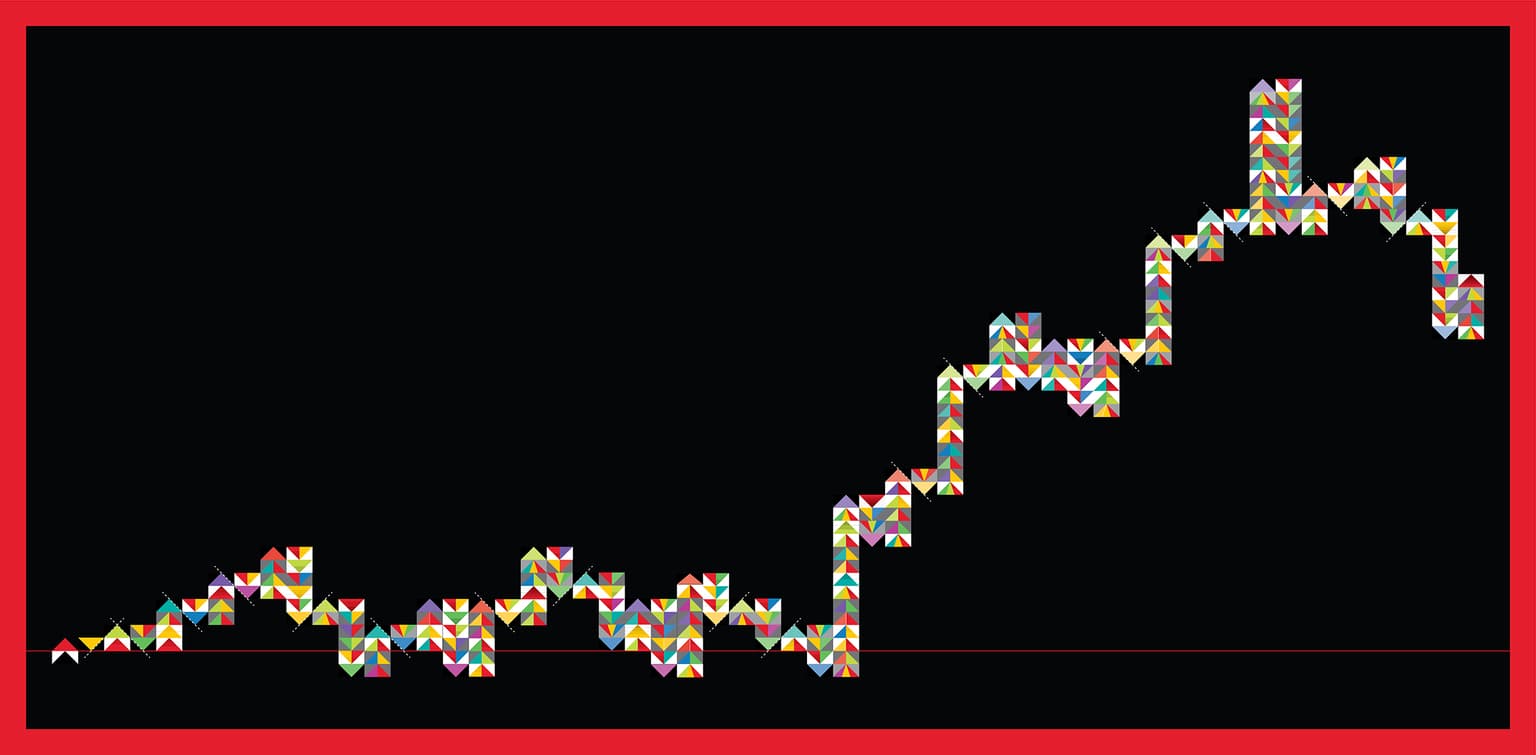
Release the Geese
40.0 x 50.0 cm
Archival Inkjet Print
2025
For this piece, I began with an artwork that I had shown at Bridges 2011. In the original design, right triangles are displayed in 8 columns echoing the format of a “Wild Goose Chase” quilt pattern. Each right triangle represents an integer from 1 to 256 and shows the decomposition of that integer into prime factors through color coding. I explored what would happen if I let the primes determine the layout. I divided the vertical strips of the first format into smaller vertical strips each ending with a prime (a solid right triangle) and displayed them horizontally in an alternating format of ups and downs. I expected this process would average out to produce something fan-like, but broadly symmetrical, but instead the geese took off!