I create computer graphics based on objects from differential geometry and singularity theory. I start from a curve: I pair points with parallel tangents and mark the point dividing each chord in a fixed ratio λ:(1−λ). Their locus is the affine λ-equidistant; at λ=0.5, it’s the Wigner caustic - the midpoints of such chords. I’m drawn to places where these structures kink, fold, or meet. I often add the Centre Symmetry Set - the envelope of those chords and the locus of singularities across all affine equidistants - a quiet spine. I keep images spare: clean lines, steady pacing, limited colour - clarity that turns into surprise of singular objects. In collaboration with Iza Danielewska, Dawid Poławski, and Dominika Sterczewska.
Artworks
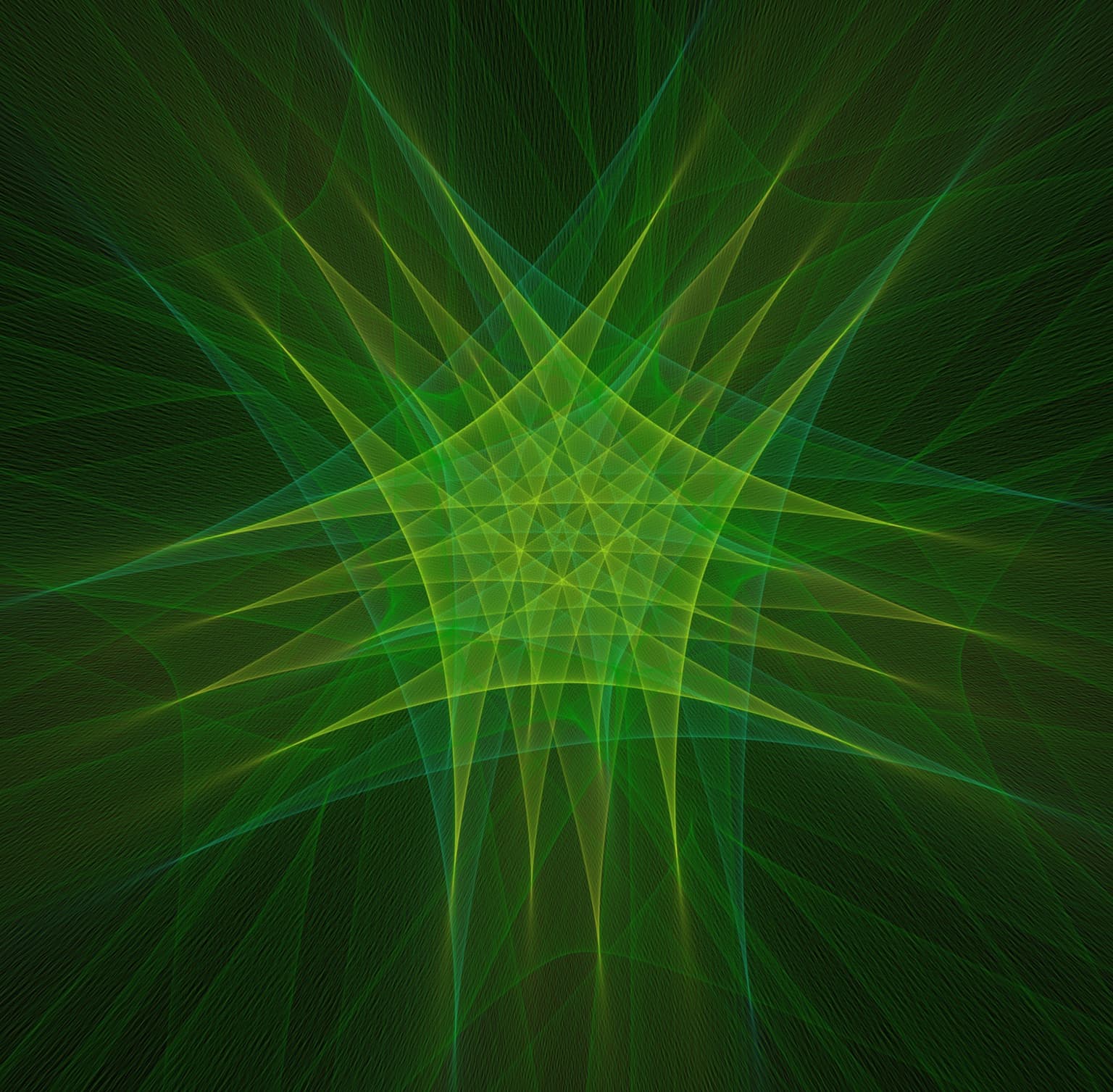
Pestilence
35.0 x 35.0 x 0.0 cm
Digital artwork
2024
“Pestilence” was sparked by the feeling of spread - how a local spark multiplies through a network. Mathematically, from a smooth curve, I pair points with parallel tangents and build the affine λ-equidistant by dividing each chord in the ratio λ:(1−λ); at λ=0.5 this becomes the Wigner caustic. I also trace the Centre Symmetry Set, the envelope of those chords and the locus of singularities across all affine equidistants. These rules yield the star-like core and radiating filaments. Its uniqueness lies in the meeting of exact geometry and atmosphere: layered moirés, tapered vectors, and tuned greens that read as contagion - order turning into unease.
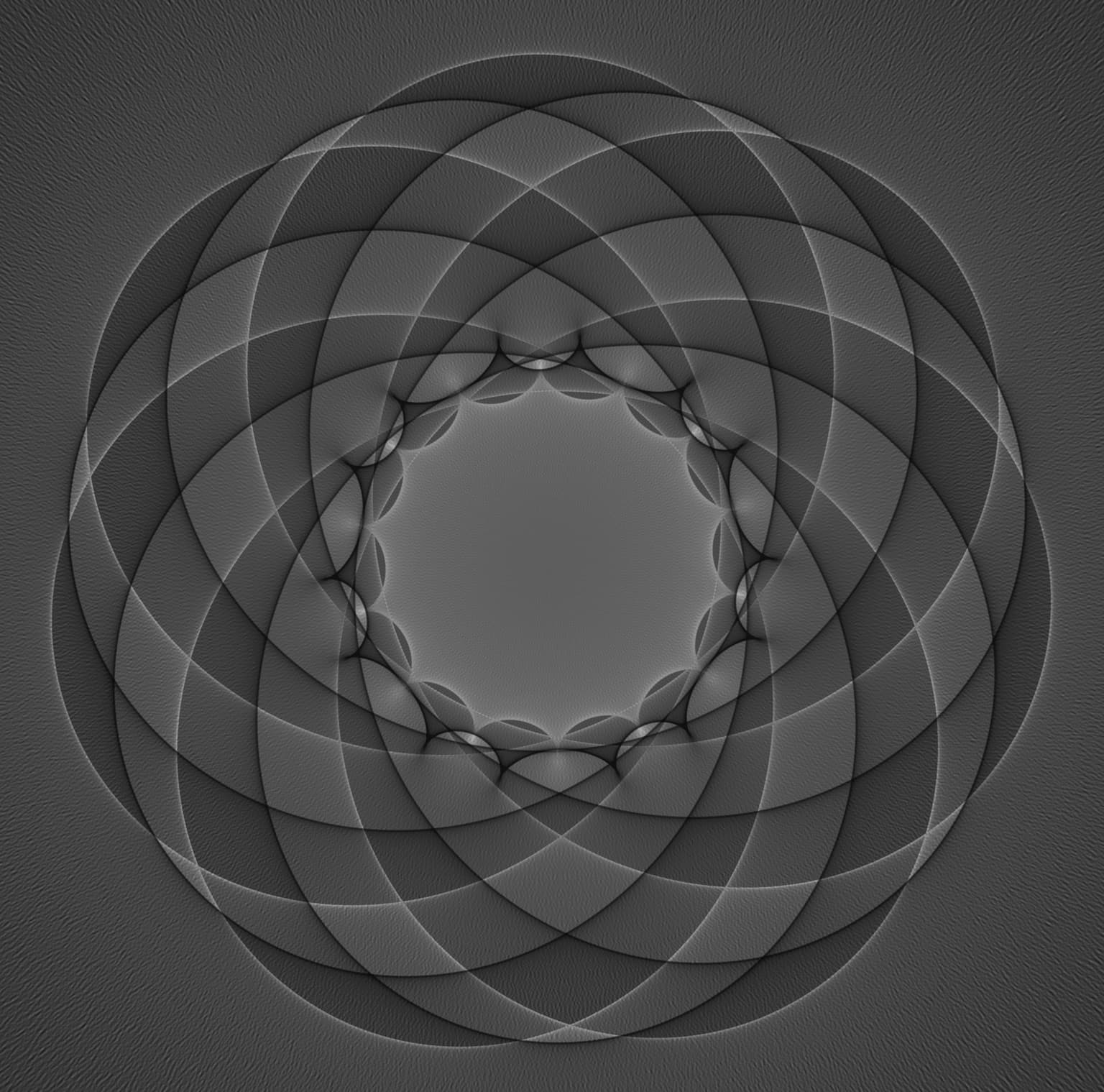
Black & White
35.0 x 35.0 x -2.0 cm
Digital artwork
2024
“Black & White” was inspired by quiet, circulatory rhythms - breath, orbit, the way light wraps a rim. Mathematically, it begins with a smooth closed curve. I pair points with parallel tangents and build the affine λ-equidistant (dividing each chord in ratio λ:(1−λ)); at λ=0.5, this yields the Wigner caustic. I also trace the Centre Symmetry Set, whose envelopes seed the rosette of cusps around the hollow core. Its uniqueness lies in rigorous geometry rendered as tactile grayscale: layered arcs, moiré mini-textures, and soft “relief” shadows that make the structure feel carved rather than drawn.