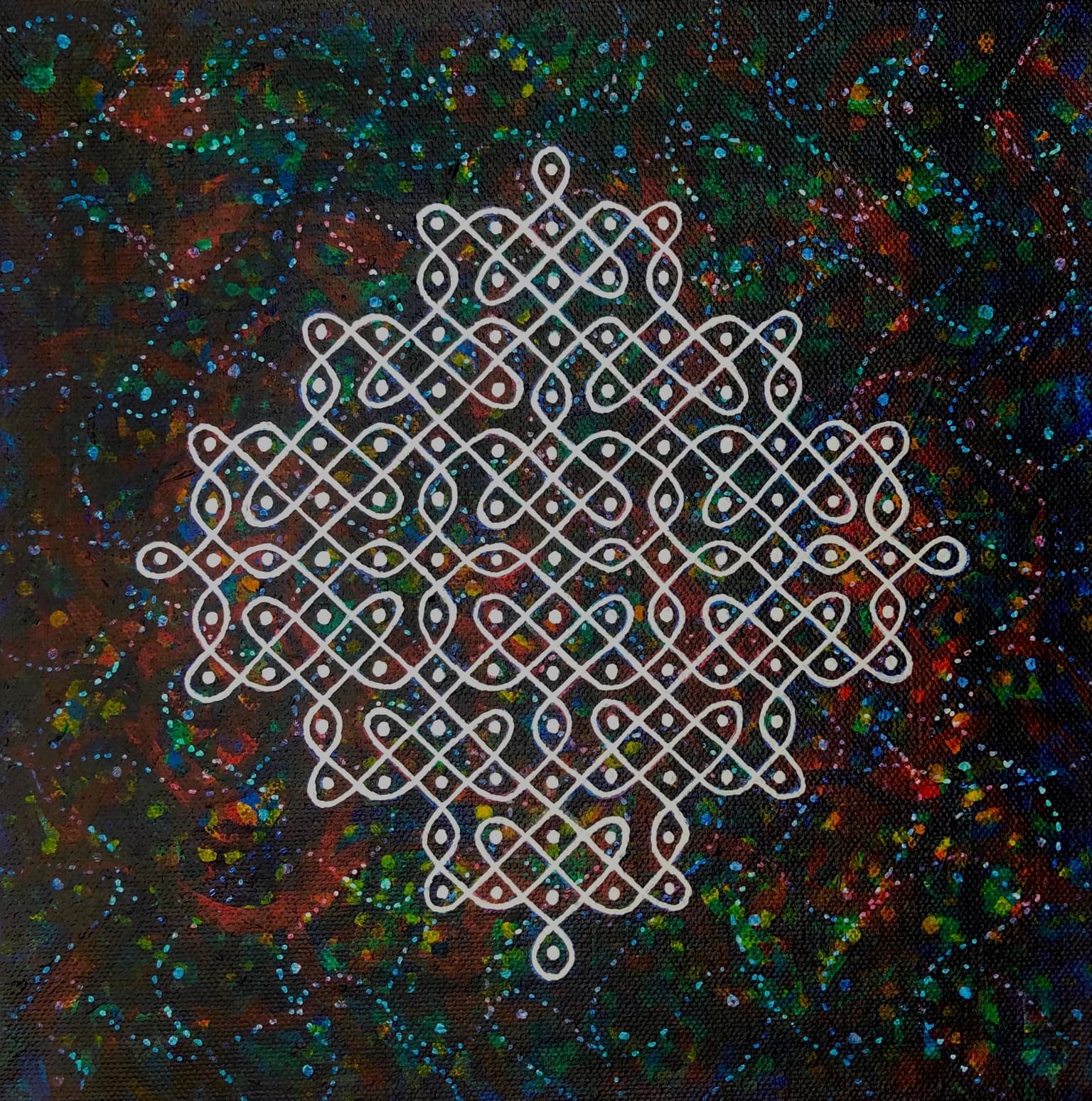
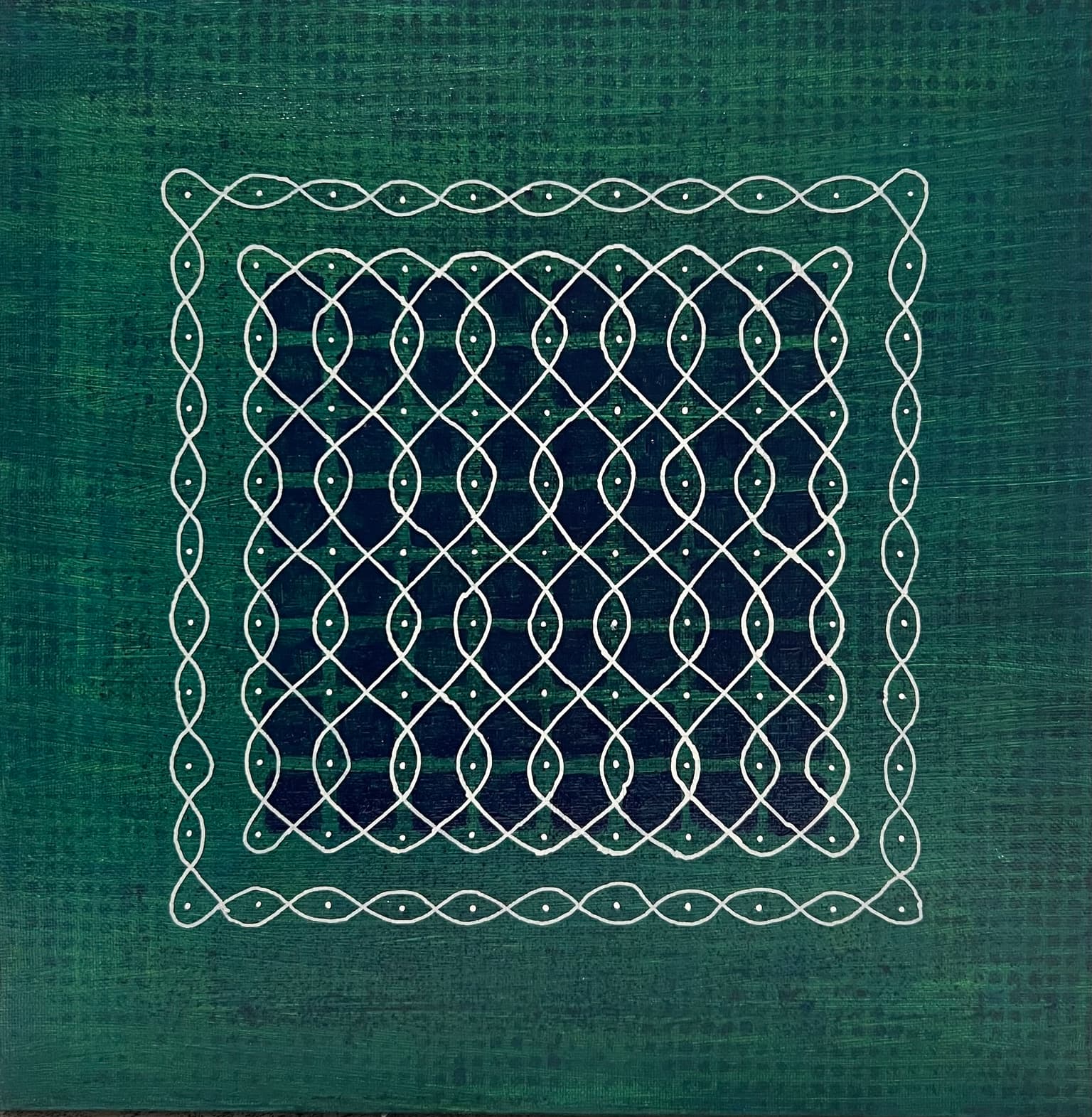
Kolam is a traditional Indian drawing made by Tamil women using rice or rock powder made on the floor in front of their houses. These aesthetically beautiful patterns of dots and lines are philosophical, and signify the cosmos, symbolizing the concepts of impermanence, non-attachment and the cycles of creation and dissolution at various scales. Kolams are mathematical involving geometry at its core. The patterns are composed of six key shapes formed by the combinations of four quarters of a circle and a square. Concepts such as symmetries, fractals and graph theory are also involved in this creative art form though the practitioners perform it every day simply following an age-old tradition, which I have tried to capture in my artwork.
Artworks
Kolam- Universe
25.0 x 25.0 x 3.75 cm
Acrylic on canvas
2021
Kolam captures the essence of the cosmos, a small portion of something much larger, with interconnectedness present at all scales. In this painting, I wanted to bring out the ephemeral nature of the highly ordered Kolam which disintegrates in a few hours, as a constant reminder of the cycle of creation and dissolution, and the play of entropy, from order to chaos. I used a unique traditional Kolam design with a 15-dot central line, made of a single line that follows a repeating pattern as it goes around all the dots to create a complex pattern and returns to the starting point. This Kolam begins with a 7-dot grid which can be extended further by increasing the central line by 4 dots to maintain the pattern, displaying its fractal aspects.
Kolam- Scale
25.0 x 25.0 x 2.5 cm
Acrylic on canvas
2019
Simple Kolams start with minimal dots and multiple closed loops to create symmetrical patterns. They can be scaled up by increasing the number of dots in the grids to maintain the patterns and also, made more complex by connecting the many closed loops to create a single closed loop that includes all the dots in the grid. This 9x9 dot grid Kolam began as a 5x5 dot grid pattern that was scaled up by adding four more rows and columns to maintain the single closed loop, while increasing it just by 1, 2 or 3 sets of rows and columns, changed the patterns or wound up with multiple loops. The square shaped Kolam border and the green background with the two grids of squares in different sizes refer to the fractal nature found in the universe.