2026 Joint Mathematics Meetings
Shiying Dong
Artists
Statement
I have been interested in abstract sculpture for a long time. With the help of my education and inspiration from the works of many great math artists, I developed a crochet technique rooted in the concept of a mapping cylinder in algebraic topology. I make yarn sculptures using this technique by seamlessly crocheting along ribbon graphs made from foundation chains. This technique deepens my understanding of many areas of math and provides the ultimate joy of creating a form with my own fingers.
Artworks
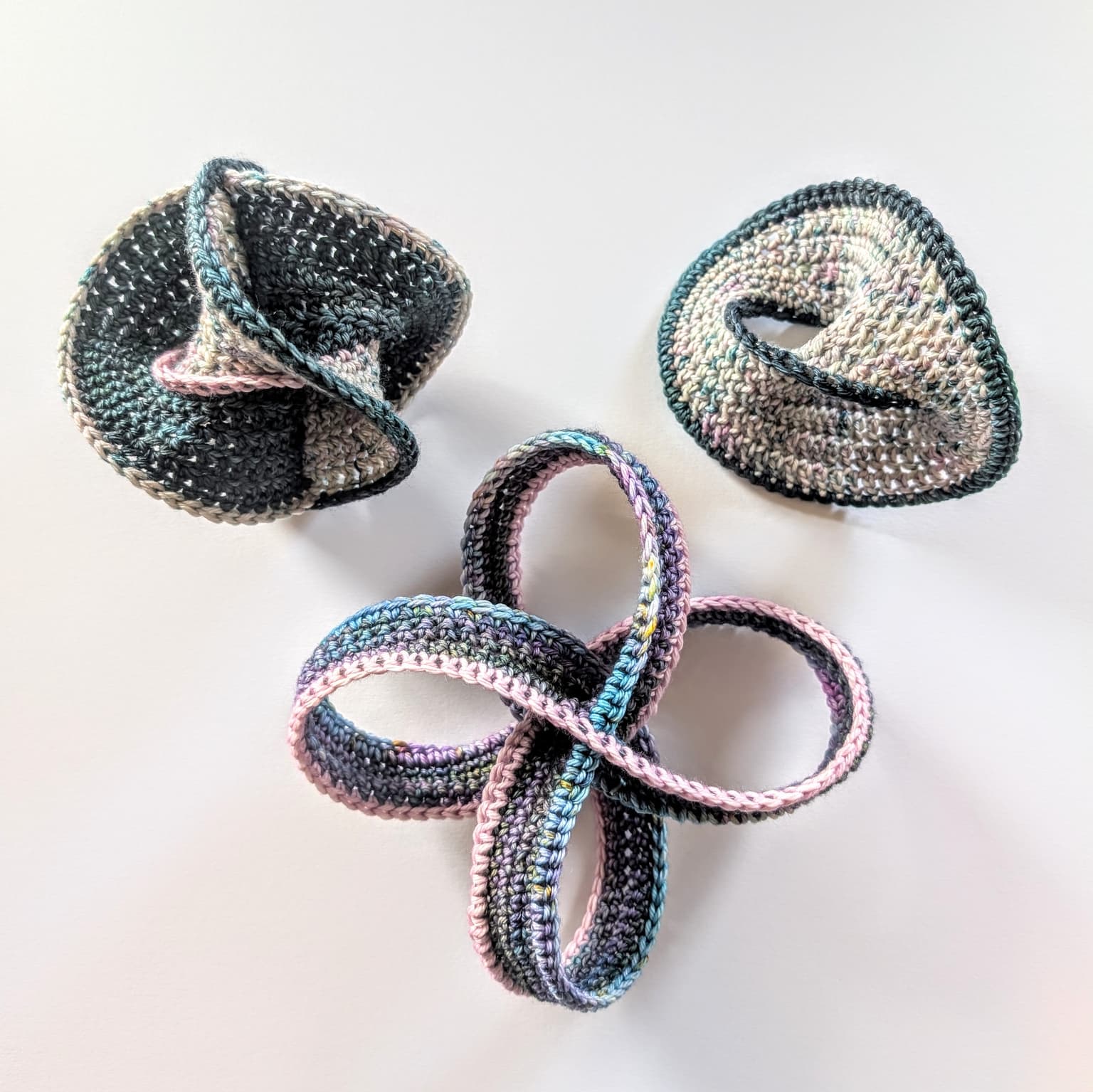
One of my pieces in JMM 2025 is a set of Klein bottles that were made using the topological crochet technique I developed. Among them is a twice-punctured Lawson’s Klein bottle with two intersecting saddle points. In this set, I start with the punctured Sudanese Möbius band (upper right). Then I performed a connected sum operation on them to form the same twice-punctured Lawson’s Klein bottle (upper left). My original design naturally flows into the next step in this process: combining the two ribbon graphs into a single graph and refining it. As a fun project, I further twisted some elements in the design to create a different, twice-punctured Klein bottle that feels like interlocking two infinities floating in space.
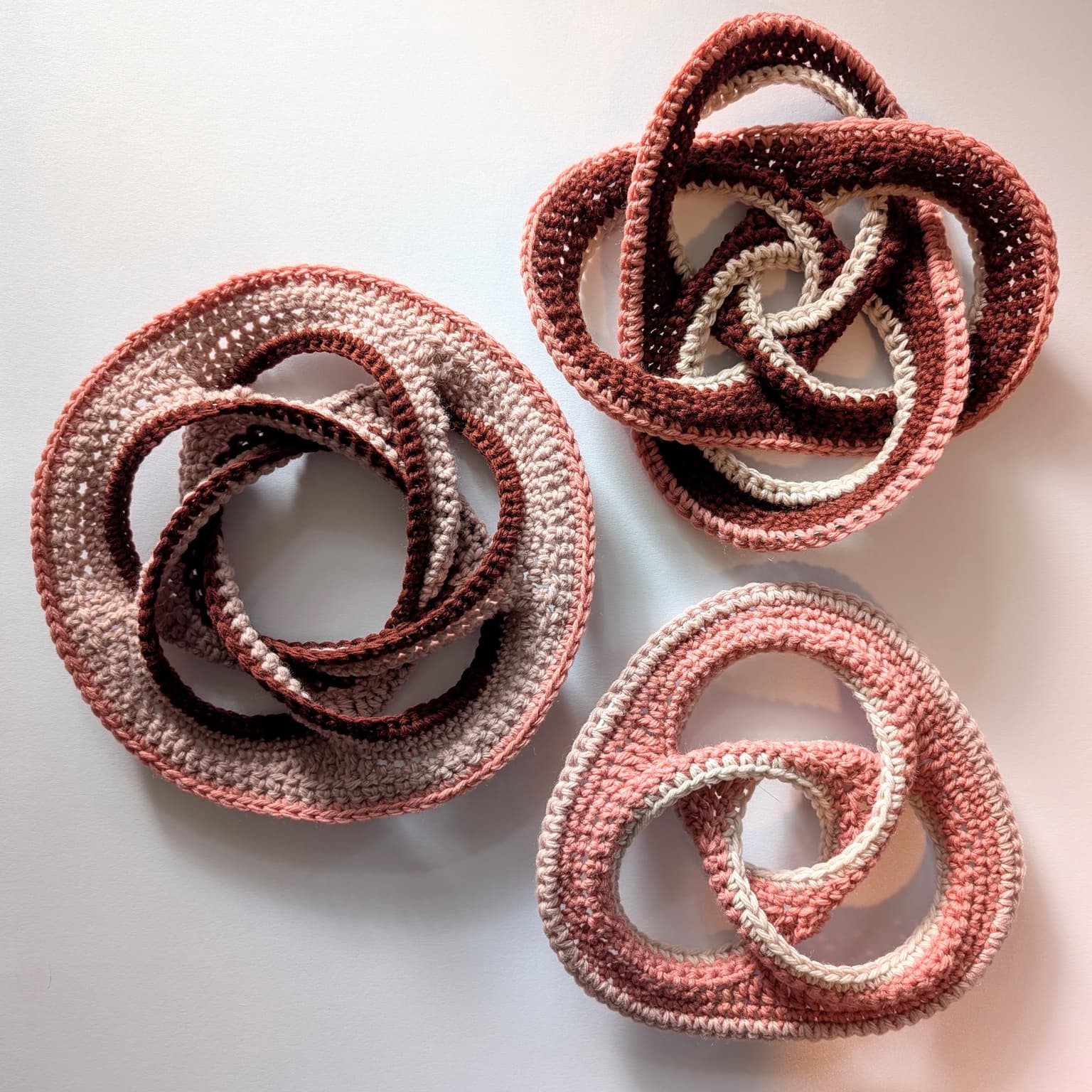
Sphere Eversion Trio
5.0 x 45.0 x 45.0 cm
Yarn, nylon.
2025
This set of 3 pieces studies the half-way models of sphere eversion, using the saddle method that I developed. Punctures are made in the surfaces to highlight the ribbon structures and avoid self-intersections. All boundary components are plain circles that can be capped to restore the full surfaces. Starting from the lower-right and going counterclockwise are: the Boy’s surface, the Morin’s surface, and the 5-cap version of the Boy’s surface, with 3, 4, or 5 interlinked circular boundary components around the center, respectively. Changing saddle points to edges makes the last one a model for the maximally complete mapping of the real projective plane. Details are available in the upcoming CRC book “Unravelling Topological Crochet”.