Artists
Statement
I have been designing origami works for several decades and am continually drawn to projects that blend mathematical elegance with puzzling intrigue. My recent book, Einstein Origami Paper Puzzles & Games (ISBN: 9780804859097), which embodies my passion for this fusion of origami and puzzles, contains the two works featured here. The first, “$ Origami Einstein Spectre Tiling,” reimagines a new geometry puzzle in a purely folded-paper form. The second, “Origami Square Jigsaw Puzzle,” explores a series of simplified, jigsaw-like pieces—crafted entirely through folding. Creating these works brings me deep satisfaction. Each design begins as a mystery, and assembling the finished pieces together opens up a series of new challenges.
Artworks
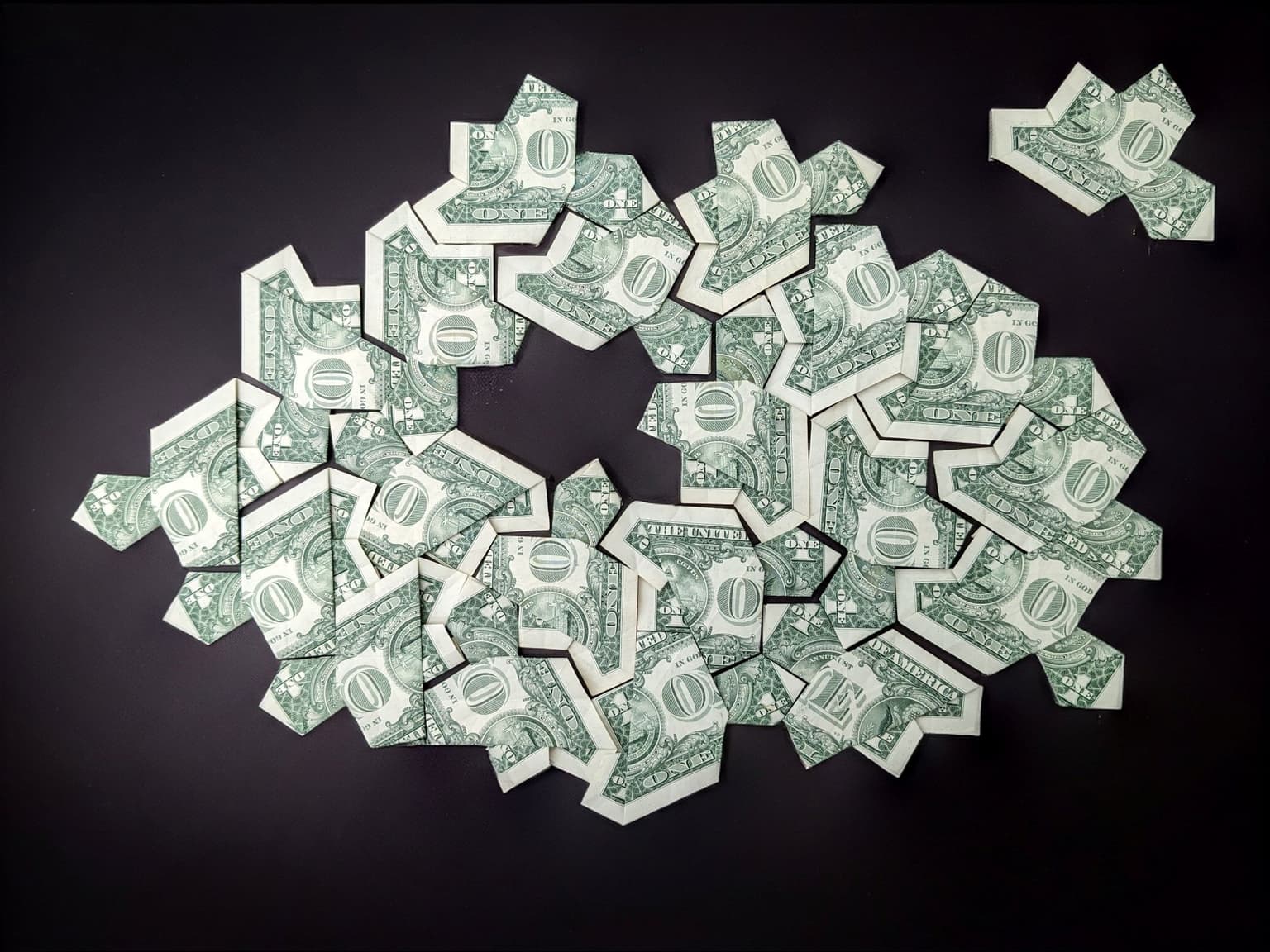
An "einstein"—from the German ein Stein, meaning "one stone"—is a single, unique tile that can cover a flat surface non-periodically. Two months after Smith, Myers, Kaplan, and Goodman-Strauss announced the discovery of the first einstein—a “hat”-shaped tile—in March 2023, they discovered another, which they named the “spectre.” Unlike the 'hat,' the spectre can tile a plane using only rotations and translations. After creating a few “hat”-shaped designs, my interest shifted to the newly discovered “spectre.” In this 21-piece art work, each identical tile is a folded U.S. dollar bill created without cutting or adhesives. These pieces can be assembled into a seamless tiling pattern without flipping.
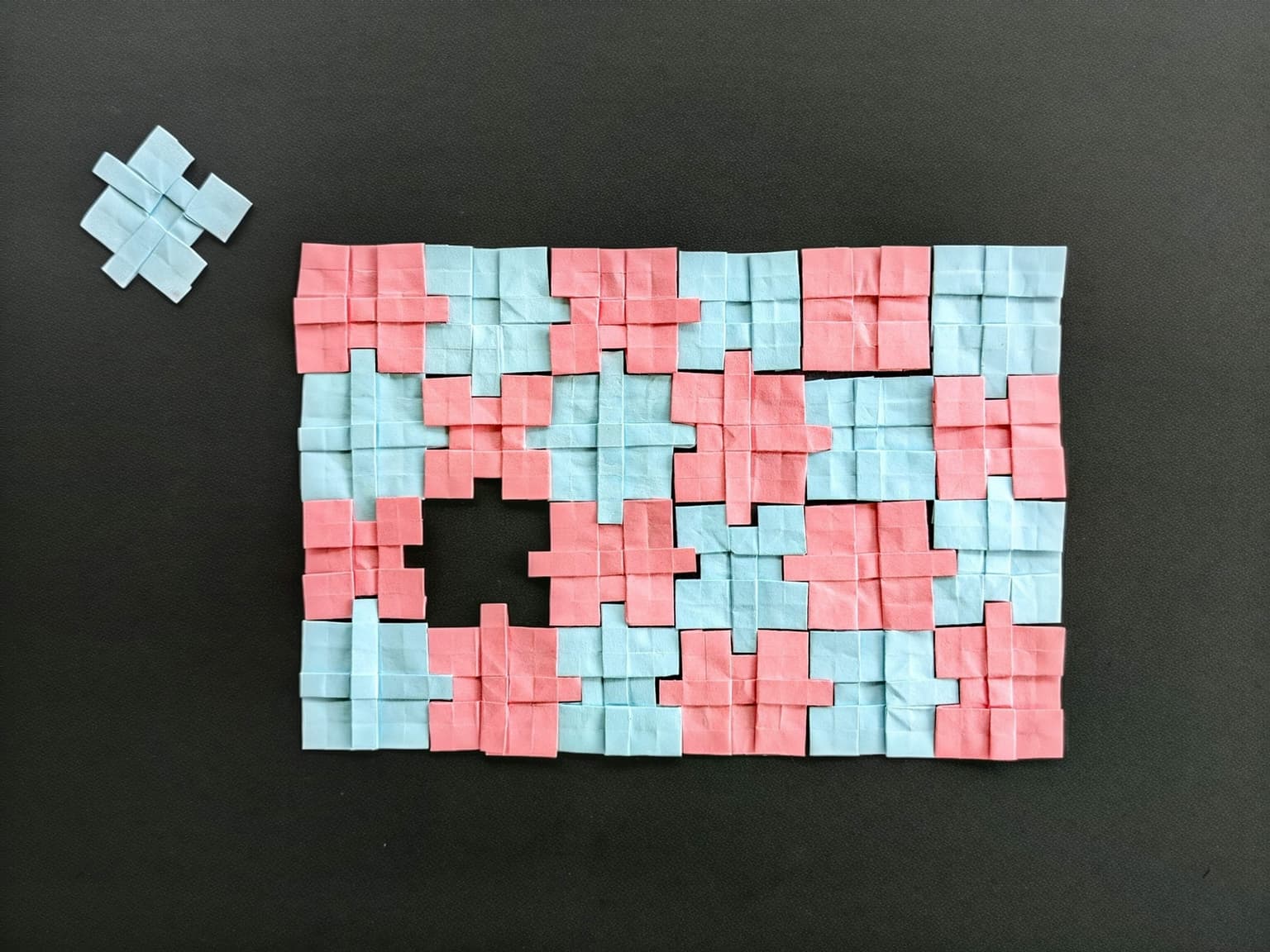
Creating origami jigsaw puzzles presents the unique challenge of achieving intricate shapes without any cutting, through folding alone. Using flat-folding techniques, it's possible to generate exactly 24 unique puzzle piece shapes by folding on each edge a square tab or blank (also known as “cutout” or “indentation”) or by leaving the edge unchanged. I came up with the folding patterns to make all 24 different pieces from identically sized squares. Assembling these jigsaw pieces into a seamless 4 × 6 rectangle is a surprisingly challenging and rewarding puzzle.