During my career as a math teacher, students convinced me that my nice-looking calculus graphs could qualify on their own as art. I now spend my time trying to bring the joy and visual beauty of mathematics to an unsuspecting public. In each piece I create, there is always an underlying math principle that I try to infuse with color, depth, and purpose.
In popular culture, math is commonly perceived as being separate from art, and we often hear "I'm not a math type, I'm creative!" But as makers and viewers of math art, we enjoy using both halves of our brains! My art displays mathematical relationships and visual patterns in a way that I hope makes people stop and say, "That's cool! That's math?”
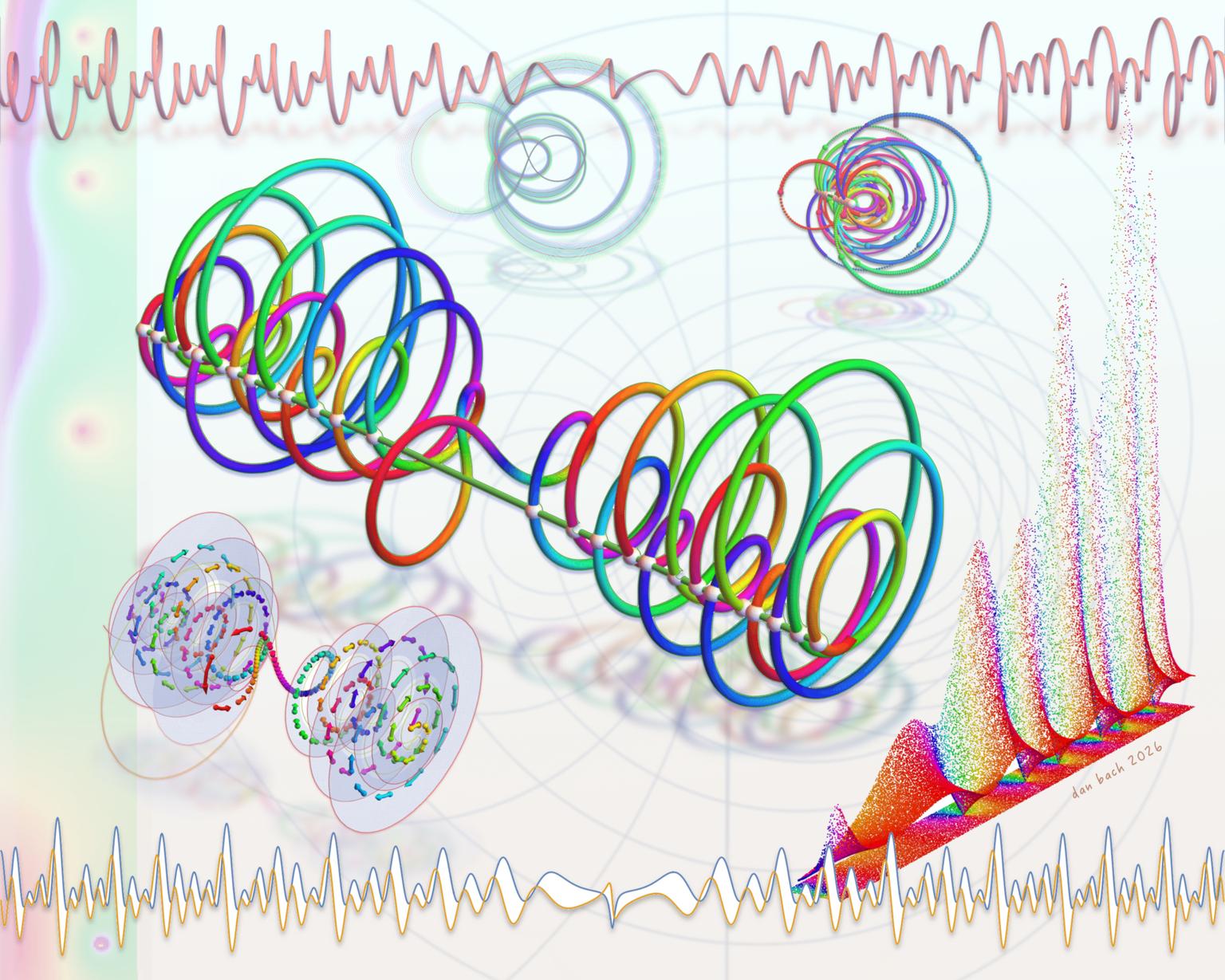
The series for the Riemann Zeta function Z(s) = Sum_n (1/n^s) only converges for Re(s) > 1, but it can be analytically continued to the whole complex plane, except for a pole at s = 1. The non-real zeroes of the new function, infinite in number, are in the critical strip 0 < Re(s) < 1.
The Riemann Hypothesis is that they all lie on the vertical line Re(s) = ½. This artwork shows the image Z(½ + i t) of that line in various forms, the main spiral having several roots (white beads) for -100 < t < 100. The dot plot on the right shows the modulus of Z(a + i t) as height, and its arg as hue, with roots as ‘tornado touchdown points’ on the domain. The value of t along the curves can also be tracked by color.
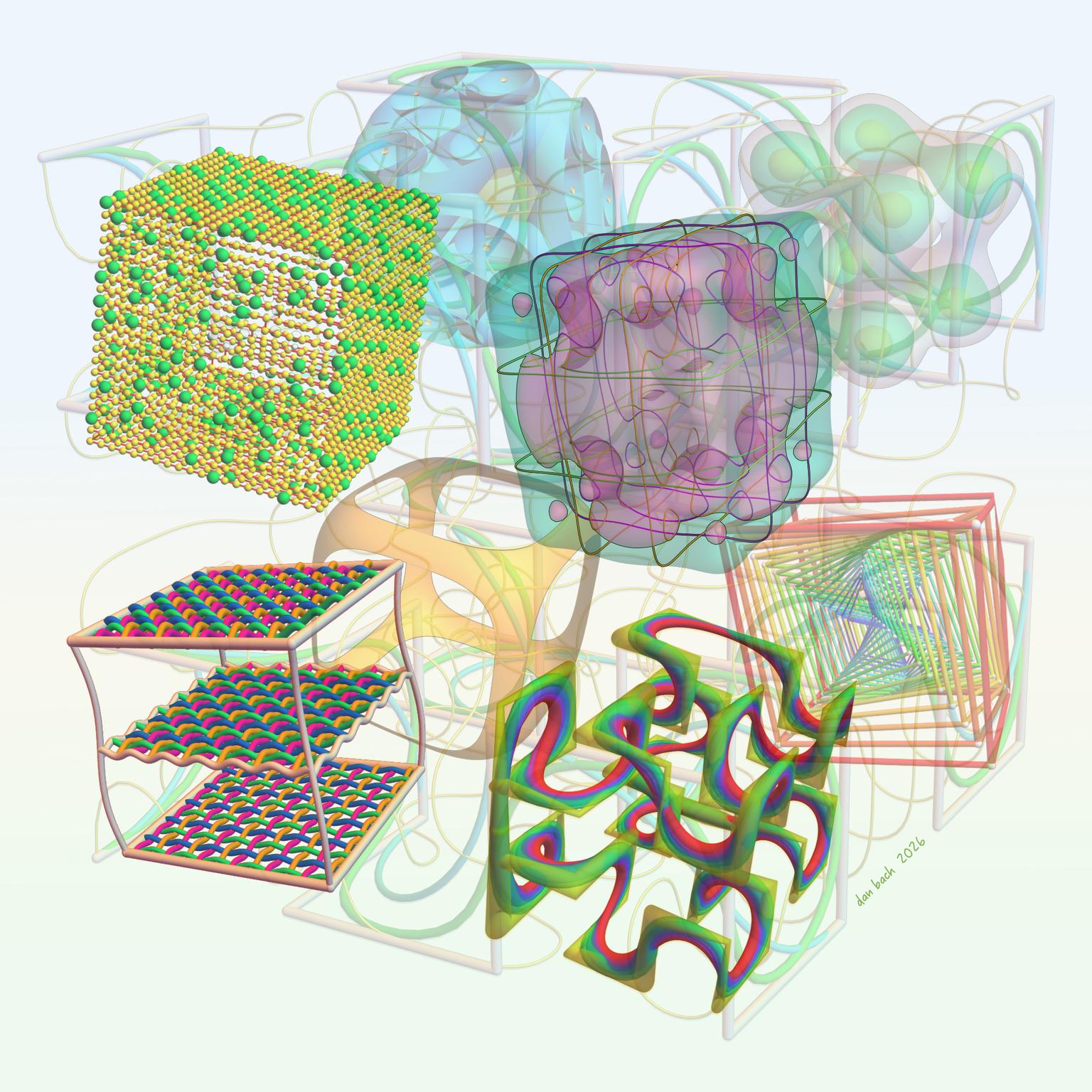
A cube has eight corners, so here are eight cube-based artworks laid out in a cubical formation, 2 x 2 x 2. The background is itself a Hilbert cube space curve, so that’s really nine cubes. The tilts of the cubes alternate around the main cube, hinting at the two tetrahedra inherent in all cubes.
The small cubes show: Prime Beads along a cubical lattice path, 3D Contour Bubbles, Twisty Shells, and Woven Cosines; the Hilbert Cubes follow level 2 polygons with 3D B-spline curves, and the contour cubes involve quartic equations (x^2 + y^2 + z^2) - c*(x^4 + y^4 + z^4). (Drawn with Mathematica and composited in Pixelmator Pro)