2027 Joint Mathematics Meetings
Doug Dunham, Lisa M. Shier
Artists
Doug Dunham
Professor Emeritus of Computer Science
Dept. of Computer Science, University of Minnesota Duluth
Duluth, Minnesota, USA
Lisa M. Shier
Adjunct Professor
University of Maryland Global Campus
New Market, Alabama, USA
Statement
In the past we have used a computer-controlled embroidery machine to create repeating patterns in the Poincare disc model of the hyperbolic plane. We continue this project by creating a new hyperbolic pattern inspired by M.C. Escher's Euclidean Regular Division Drawing number 20. We use (p,q) to denote a fish pattern with p-fold rotation centers at the meeting points of the tails and q-fold rotation centers at the meeting points of dorsal fins. The pattern will be hyperbolic if (p-2)(q-2) > 4. Thus there will be a doubly infinite family of such patterns. We chose to implement the (5,4) pattern.
Artworks
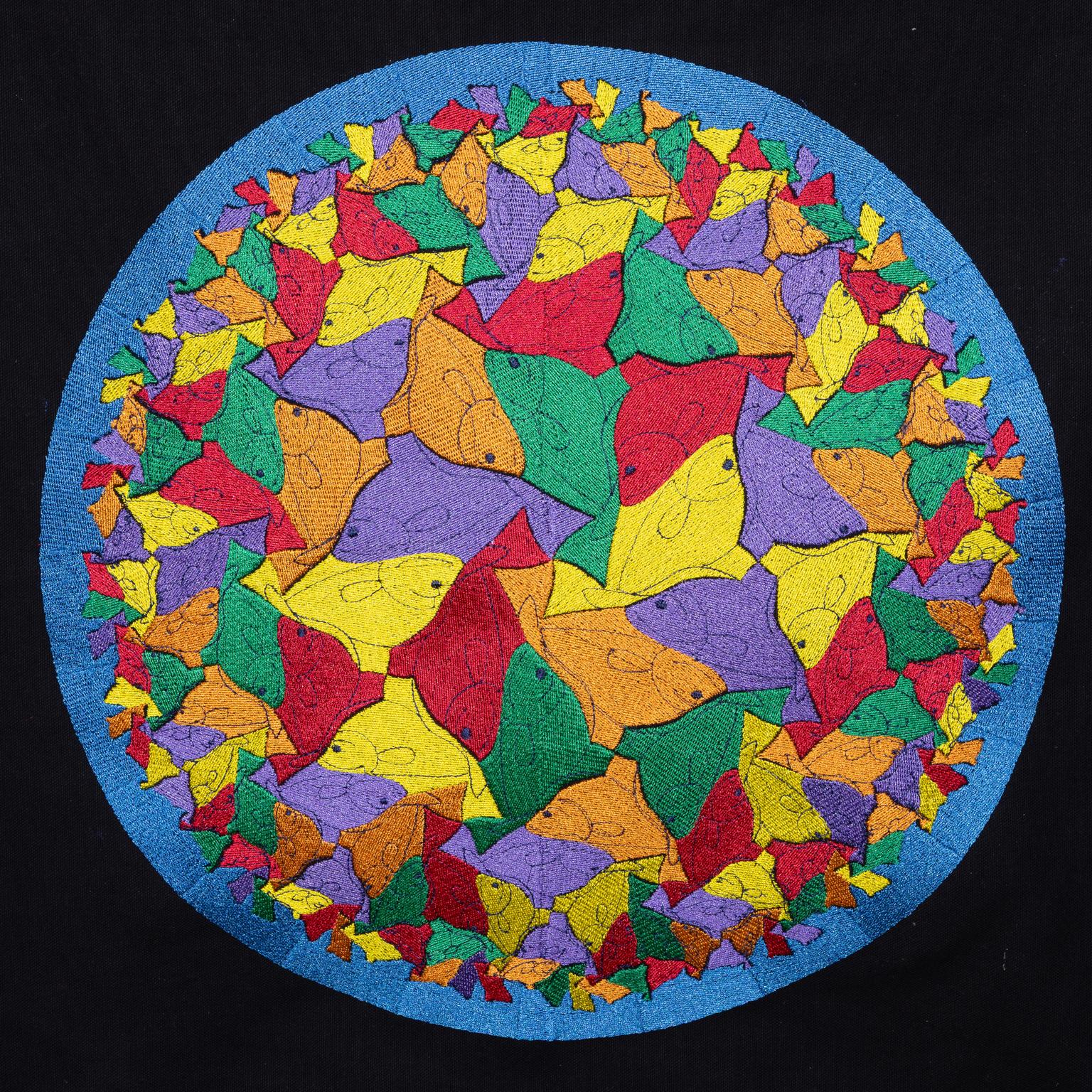
Hyperbolic (5,4) Fish Pattern
35.0 x 35.0 cm
Embroidery on canvas
2026