As a kid, I grew up exploring coastal British Columbia, sometimes bringing home treasure that I found. I would sometimes feel an intense need to find out what the view is like from a mountain visible in the distance. Similarly, as an adult I find myself intensely curious about, for example, "What do 3D cross-sections of 4D Menger sponges look like?". In both cases, an answer exists - I just have to go out and find it (either by climbing the mountain, or by doing the math).
In this spirit, I see mathematical art less as a creative process and more one of exploration and discovery. Just like when I was a kid, I rarely find anything interesting. However, I occasionally stumble up a treasure which I want to take home (with a 3D printer).
Artworks
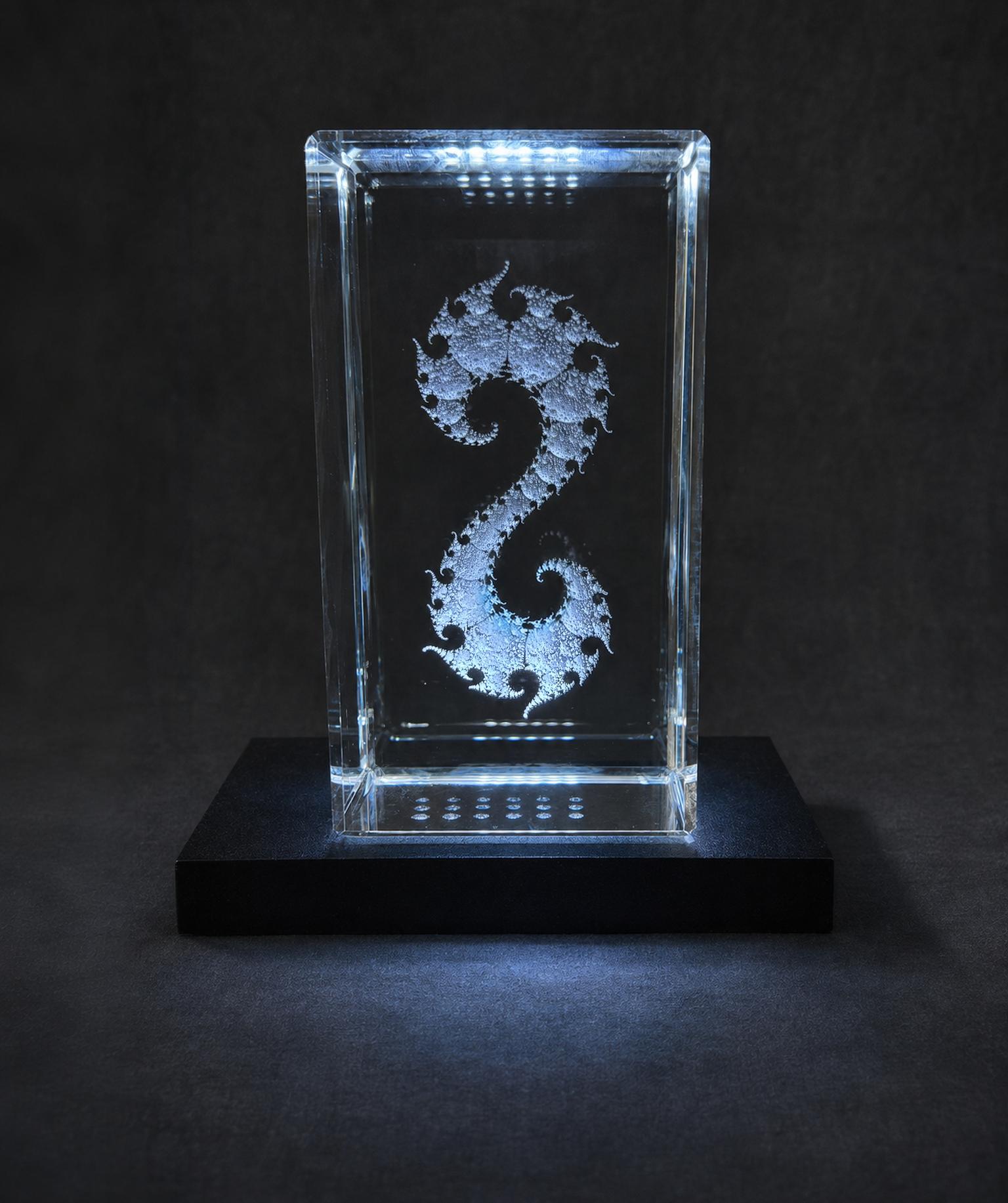
Fractal Seahorse
20.0 x 10.0 x 8.5 cm
Glass Etching
2026
The book "Indra’s Pearls" introduced me to Kleinian limit-set fractals, created by repeatedly applying Möbius transforms to complex numbers in 2D. These intricate fractals sometimes consist of infinitely many circles touching one another at at most one point.
Higher-dimensional Möbius transforms can similarly produce 3D fractals containing infinitely many spheres, also "just touching one another". This relatively unexplored idea is considered in "On Limit Sets of 4-dimensional Kleinian Groups with 3 Generators" by Keita Sakugawa. This glass etching is based on Figure 4, which resembles a seahorse. I created it to better understand the 3D structure that the figure could not fully convey.
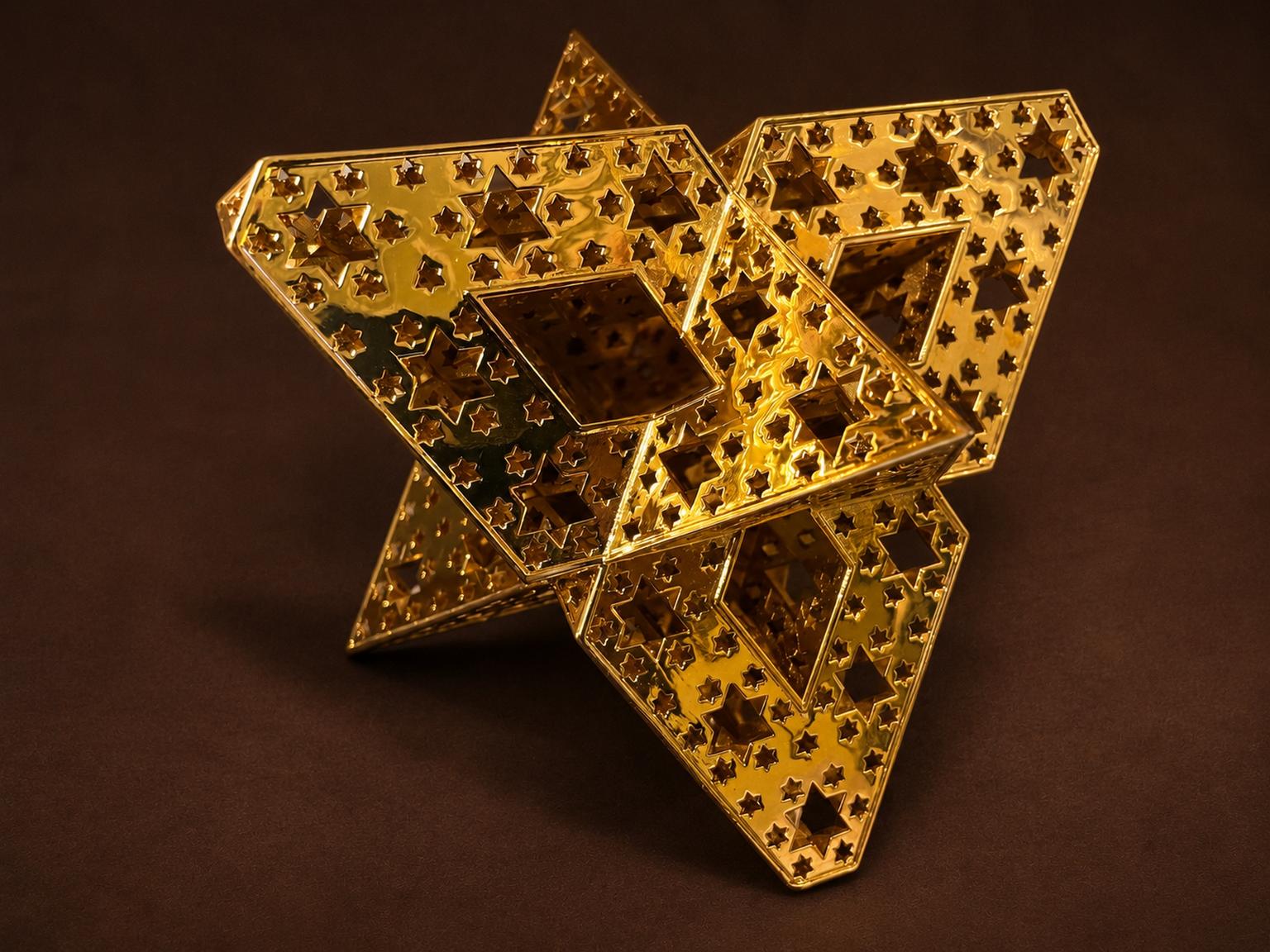
Broken Symmetry
13.0 x 13.0 x 13.0 cm
Gold Plated Brass 3D Print
2025
In 2023, I became fascinated by 3D cross-sections of 4D Menger sponges. I spent a year exploring these structures, 3D-printing interesting slices and presenting my work at Bridges 2023.
Returning to this idea in 2025, I realized that cross-sections of a "stellated 4D Menger sponge" (obtained by stacking the sponges back to back along all four coordinate axes) would yield "stellated" versions of the original 3D cross-sections. As the central cross-section is a fractal octahedron, slicing through the center would yield a fractal stellated octahedron. However, in a nod to quantum field theory, I chose to instead print a slightly perturbed slice. This small but deliberate "symmetry breaking" makes the final result more appealing to me.