I create art with custom software I built to explore phase portraits of complex functions. Each point is colored by the argument of the function’s value: zeros and poles appear where all colors meet, and under iteration, fractal boundaries emerge between orbits with different fates. The process is interactive: the mouse position is a second complex variable, so each picture is a slice through four dimensions that moves with the mouse.
The artistic design lies in the choices: the function, its parameters, the features I add, where to look, how deep to zoom, and how the argument becomes color. The mathematics supplies every detail in the frame. Much of this territory is unmapped, and a rare feature can take hours to find.
Artworks
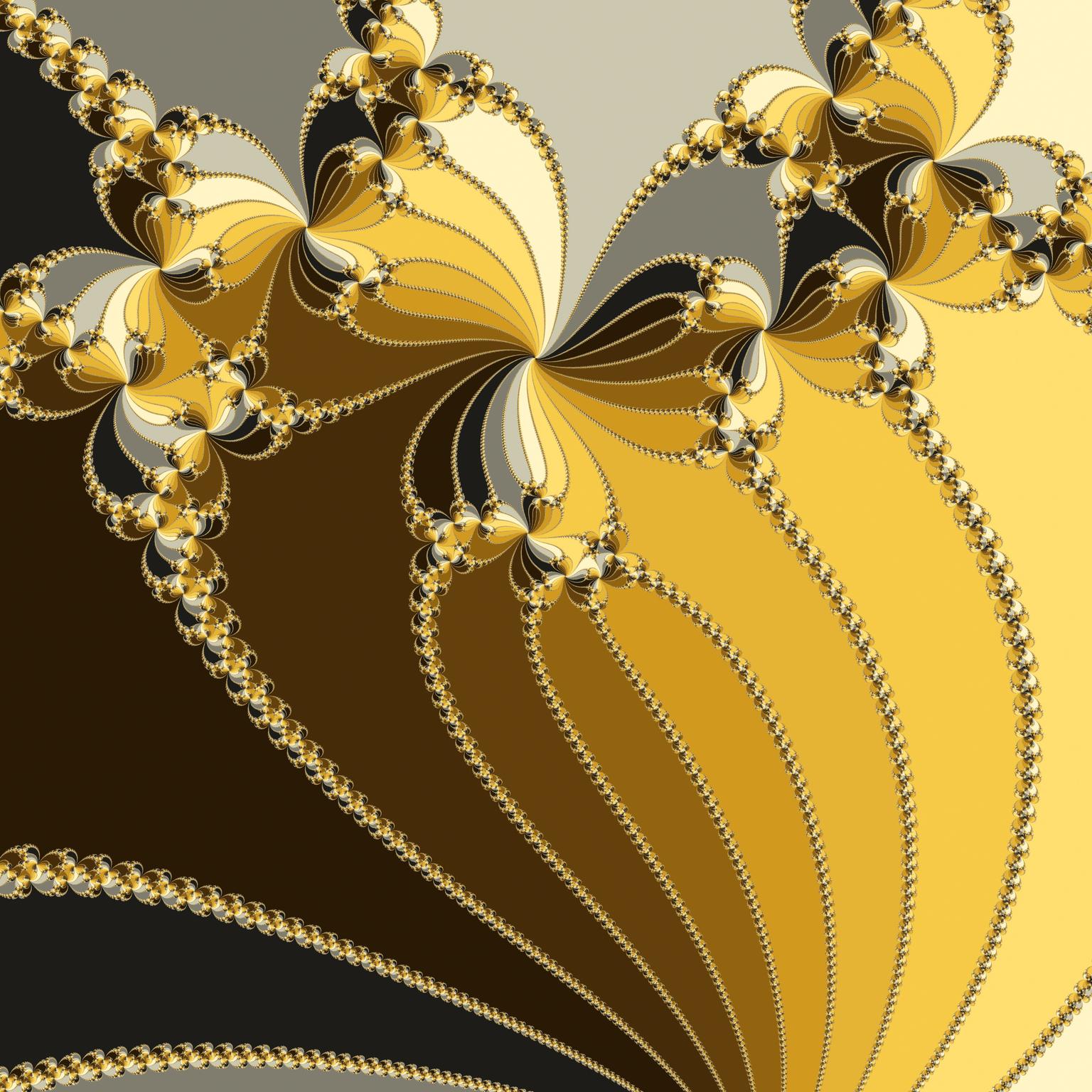
Samael, Before the Fall
61.0 x 61.0 cm
Printed on a metallic sheet
2026
Newton’s method finds roots by stepping toward them. I wanted to see what happens when the step is pushed too far, and what I found recalled Samael, the angel who before his fall had twelve wings, twice the seraphim’s six.
This piece iterates z ↦ z − α·p(z)/p′(z) for p(z) = z³ − 1 + w, with complex step size α = (w + w²)/2 and w = 0.975 + 1.008i. All three roots repel, so the method finds none of them. Instead, almost every point falls into a ring of twelve points and circles it forever. After 500 steps, each point is colored by where on the ring it sits, so the picture has exactly twelve tones: Samael’s twelve wings.
Newton fractals usually show which root each point finds; this one shows a method that finds none.
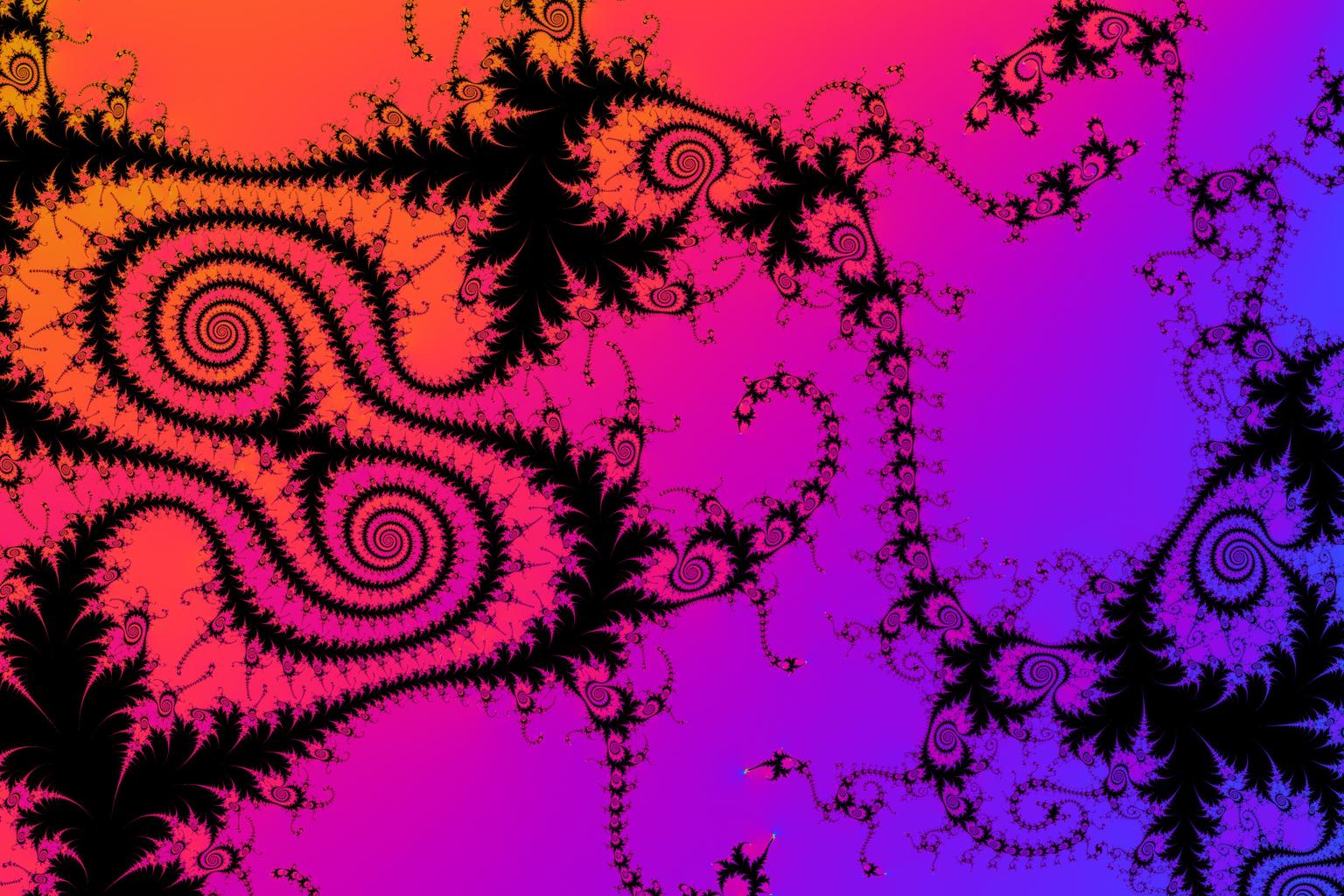
Sinus Occasus
41.0 x 61.0 cm
Printed on a metallic sheet
2026
My first double spiral appeared by accident, deep in a zoom I never saved, and was lost. This is the second, found after hours of searching. Each point w is a different function, sin z + w, iterated 1950 times from z = 0 and colored by the argument of the result; black marks orbits that escaped to infinity. The lace is the sine family’s counterpart of the Mandelbrot set’s boundary, and a double pole just off the frame sets the sunset colors.
The image captures a process in motion: each further step lets more orbits escape, and flecks of every color at the tendril tips mark the cutting edge. Single spirals are common here; matched pairs are rare. Sinus Occasus is Latin for “Bay of Sunset”; sinus is also the root of “sine.”