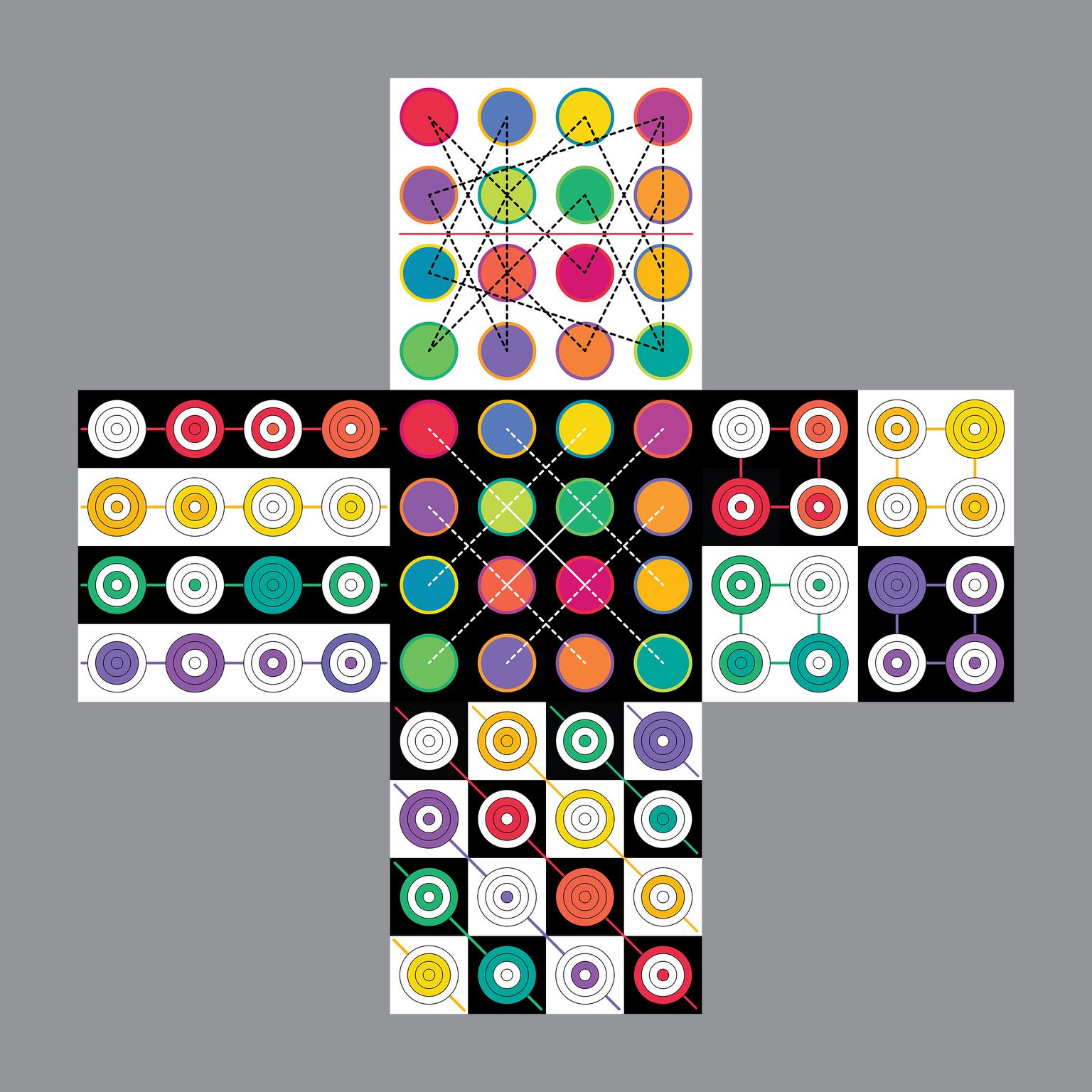
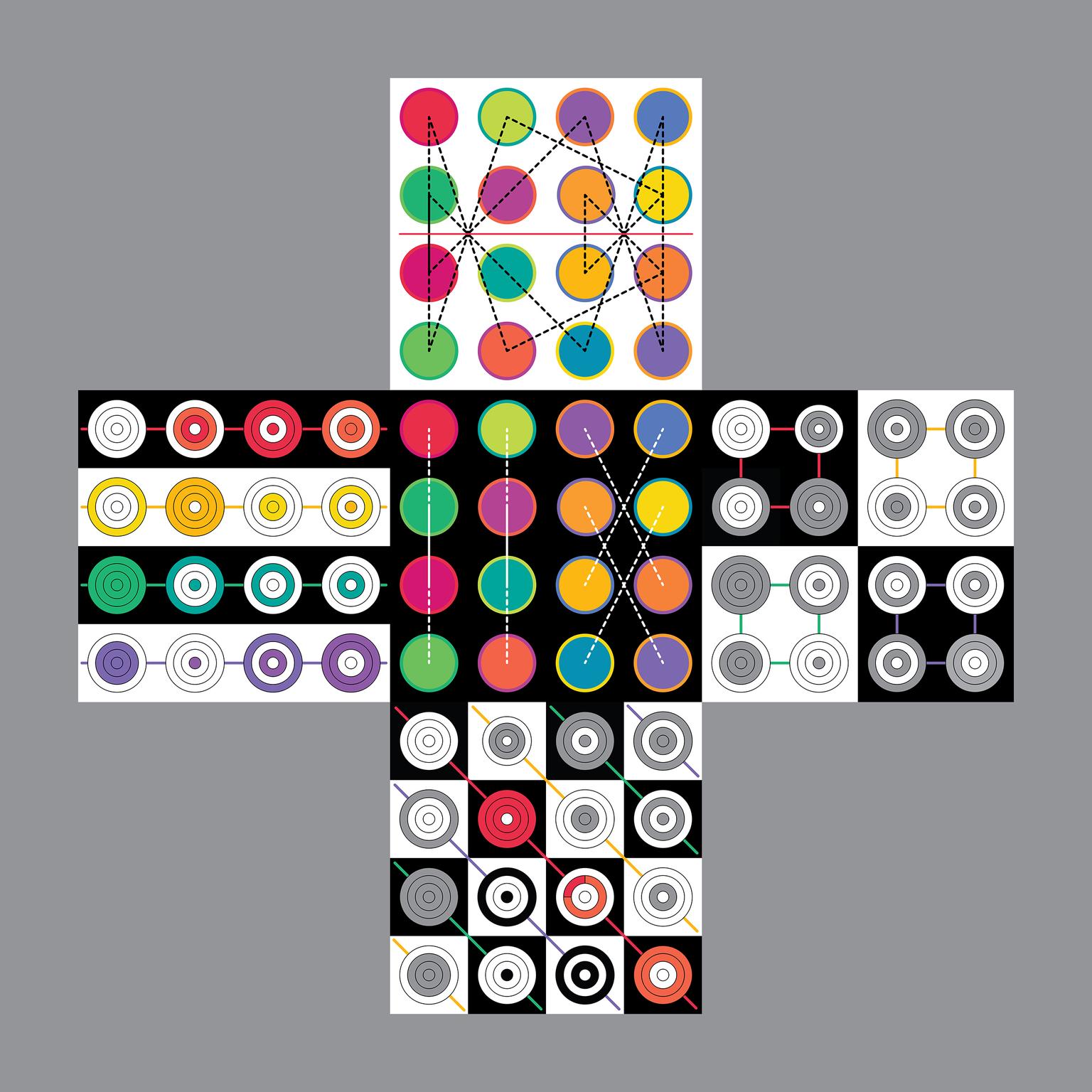
I enjoy expressing mathematical concepts through visual attributes such as color, geometric forms, and patterns. Recently, I have been exploring ways to categorize and visualize magic squares. The 880 magic squares of Order 4 can be grouped into just a dozen basic categories based on diagrams of their complementary number pairs. The “magic path” diagram for each specific magic square provides interesting insights into its underlying structure. Expressing the numbers in a Base 2 format allows for the visual verification of various sums within the square. The amount of magic in a magic square can vary from the basic definition to “most-perfect” squares with magic at every turn!
Artworks
Trust But Verify: 4x4 Magic Square 171
50.0 x 50.0 cm
Archival Inkjet Print
2026
This magic square belongs to the Category I group of the Order 4 magic squares. This group is identified by complementary number pairs as shown in the central black square. The numbers in the square (0 to 15) are represented by circles in 16 colors. Complementary pairs sum to 15 and are joined by white dotted lines. In the upper white square, the same elements are shown joined by the magic path, a line linking consecutive numbers. The remaining three squares express the numbers in Base 2 (white = 0 and solid = 1) to allow for "visual addition" of elements. This can be used to verify that the square is magic in its rows, all diagonals (including broken ones), and 2x2 sub-squares. It is a most-perfect magic square!
Trust But Verify: 4x4 Magic Square 88
50.0 x 50.0 cm
Archival Inkjet Print
2026
This magic square belongs to the Category XII group of Order 4 magic squares. This group has complementary number pairs related as shown in the central black square. The numbers in the square (0 to 15) are represented by circles in 16 colors. Complementary pairs sum to 15 and are joined by white dotted lines. In the upper white square, the same elements are shown joined by the magic path, a line linking consecutive numbers. The remaining three squares express the numbers in Base 2 (white = 0 and solid = 1) to allow for "visual addition" of the elements. This reveals that the rows and the main diagonal are magic (elements shown in color), while the broken diagonals and the 2x2 sub-squares are not magic.