In my art, I explore the aesthetic qualities of mathematics through sequences, series, and mappings. I express my ideas in drawings, sculptures, artist's books, and videos. Recurring themes in my work are the Fibonacci Sequence, Chaos Theory, symmetry, the Cartesian Coordinate System, the Cantor Set, Self Similarity, and Fractals. Crucial to me is that all my work is hand-drawn: I design the algorithm and then I execute it by hand. I am the computer.
My most recent work is inspired by the symmetries and mathematical patterns in fiber arts. I have been making hand-drawn algorithmically generated designs based on lace making and Bargello needle work.
Artworks
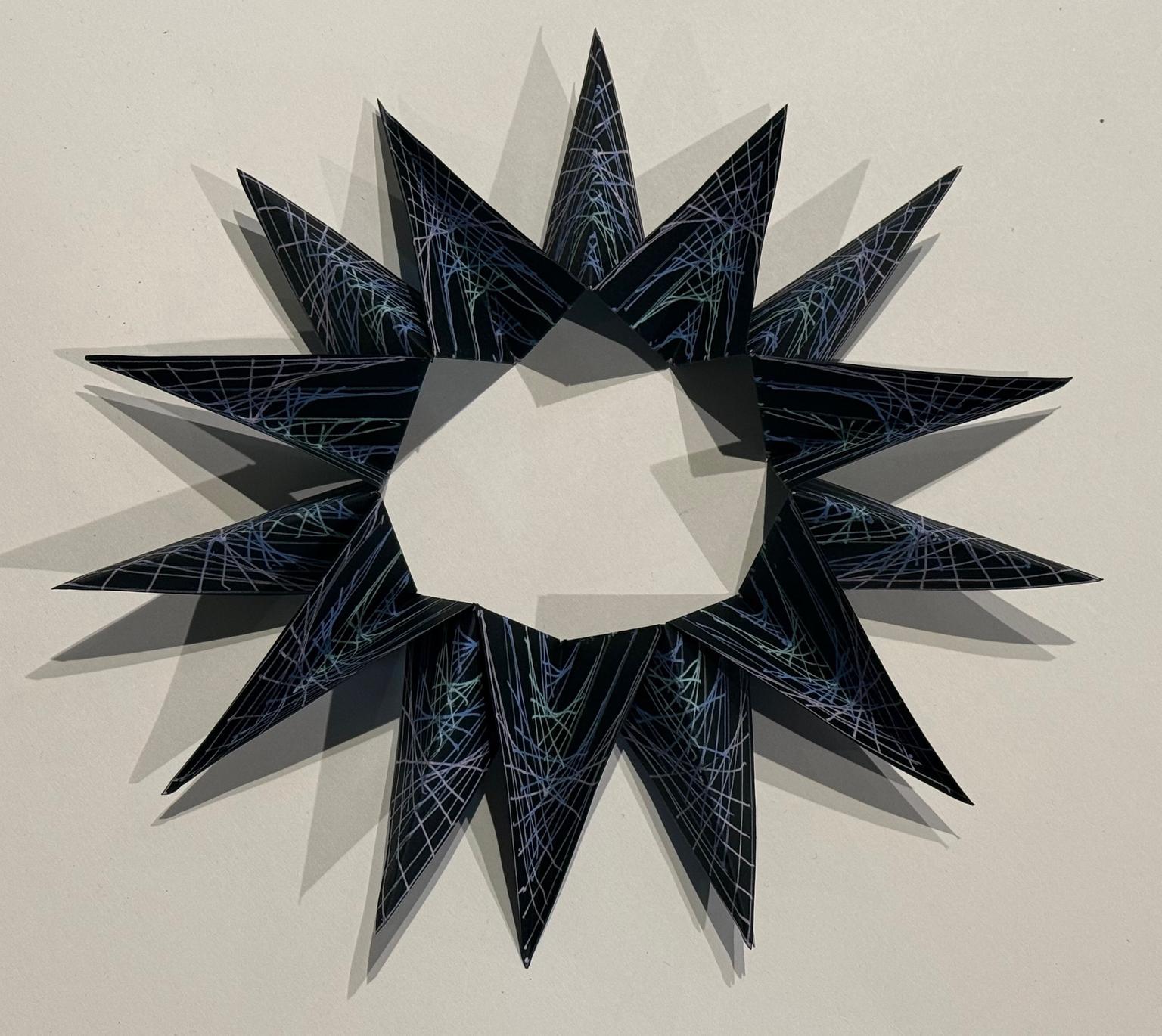
Crown of Pythagoras
5.0 x 22.0 x 22.0 cm
Ink on Paper Sculpture
2026
My “Crown of Pythagoras“ sculptures are the 3-dimensional result of my exploration of the symmetries found in zig-zag patterns. I cut a strip of paper creating a series of isosceles triangles featuring Glide Reflection symmetry. This type of symmetry is found in the zig-zag patterns in traditional textiles like rick-rack and Bargello needle work. To create a 3-D sculpture from a 2-D paper strip, perpendicular folds were implemented. The folds separate and then bifurcate each of the isosceles triangles from the vertex to the center of the base. The folds on 90 degree angles of the right triangles form the hills and valleys of the sculpture. Attaching the two ends of the folded strip of paper forms a type of spiked torus.
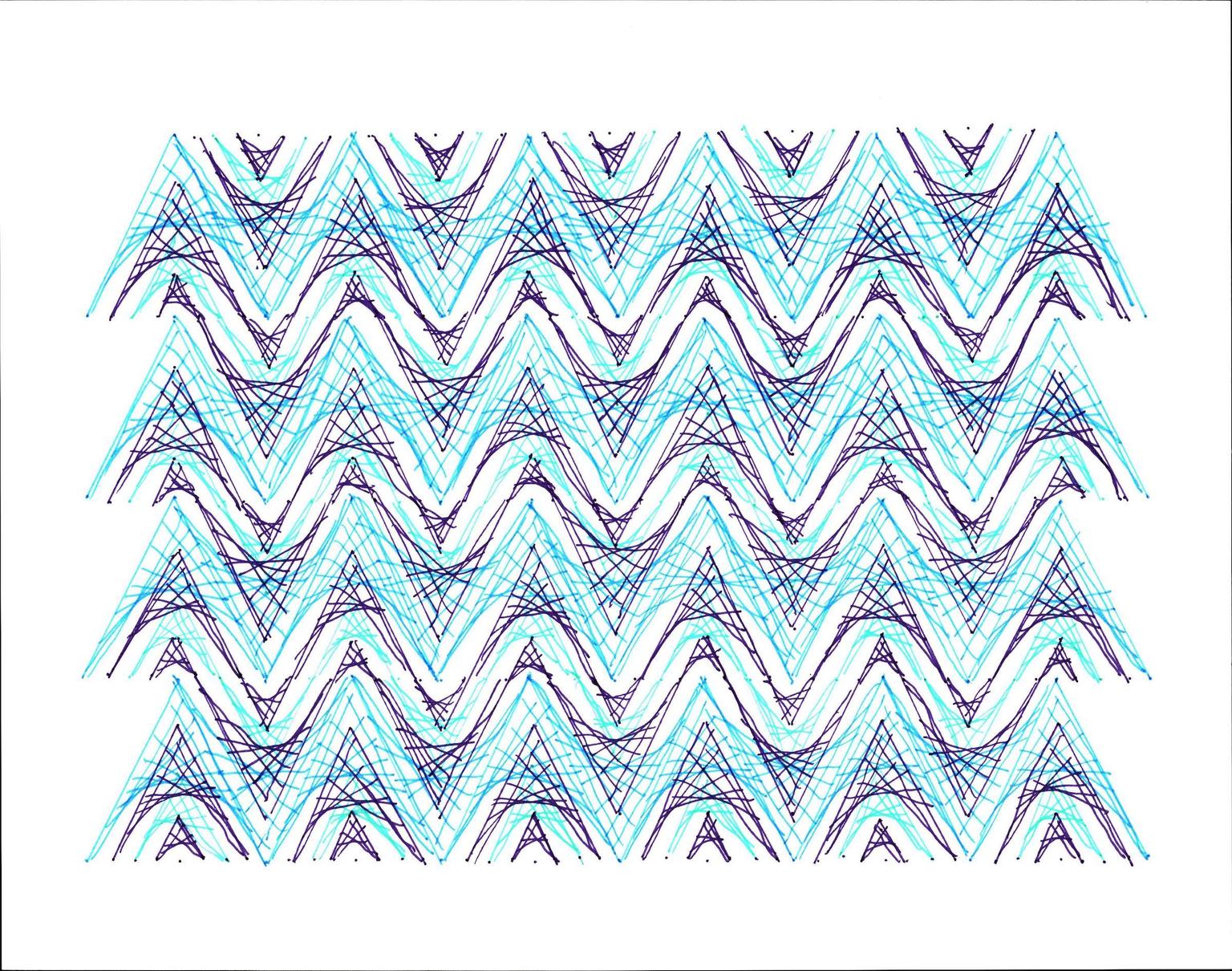
Three-Color Zig-Zag
0.0 x 35.5 x 28.0 cm
Ink on paper
2026
The drawing “ Three-Color Zig-Zag is based on the glide symmetry found in Bargello needle work particularly flame patterns. I start out with a row of identical isosceles triangles. Then I add the mirror image of the first row with glide or shifting the pattern one half the length of the base of the triangles. In order to have a continuous zig-zag patten each triangle needs to have the same patterning and points along the bases need to line up in accord with the glide shift. Once one row of zig-zags is complete I can add more layers and then fill in top and bottom rows to complete a rectangular drawing.