2027 Joint Mathematics Meetings
Vladimir Bulatov
Artists
Vladimir Bulatov
Mathematics and Arts Explorer
Corvallis, Oregon
Statement
My artistic passion is purely mathematical images and sculptures, which express a particular vision of form and shape: my interpretation of distance, transformation and space. To me, mathematics is a way of thinking, a way of life. My images and sculptures are like photographs of interesting mathematical ideas, which I discover and bring into the real world. I have always been intrigued by the possibility of showing the intrinsic richness of the mathematical world, whose charm and harmony can be appreciated by everyone.
Artworks
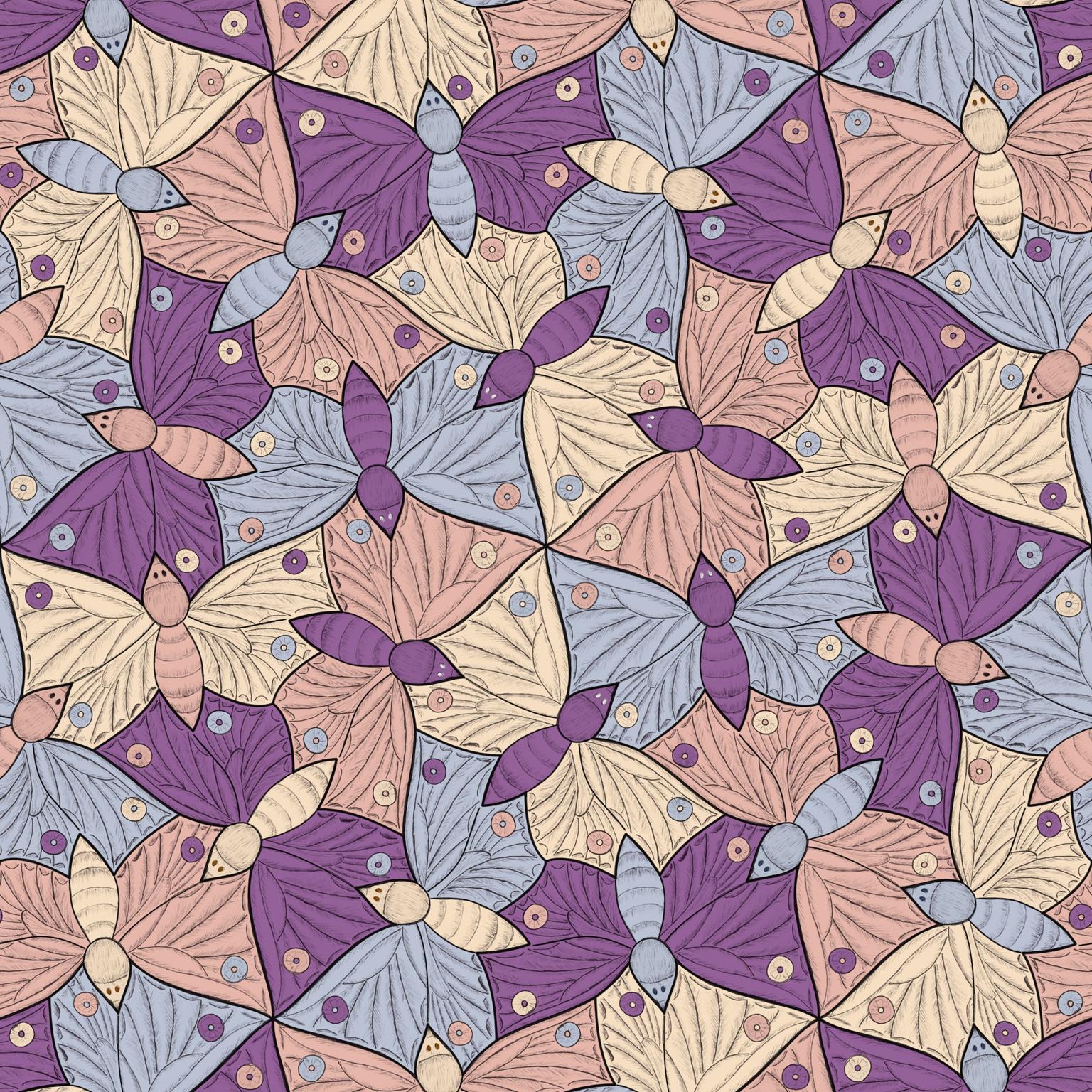
M.C. Escher's artistic combination of symmetry and color was one of the major sources that sparked interest in color symmetry in the mathematical and crystallographic communities in the 1950s. Here we explore his symmetric drawing of butterflies (No. 70) with a variety of color symmetries. Escher's pattern has symmetry p6 (632 in orbifold notation). He needed at least three colors to make sure that neighboring butterflies have different colors. He used the same three colors for the spots on the wings, with the same symmetry but a different arrangement of colors. In this piece we use four colors: the subgroup is highlighted with a dark color and its three cosets with light, washed-out colors.
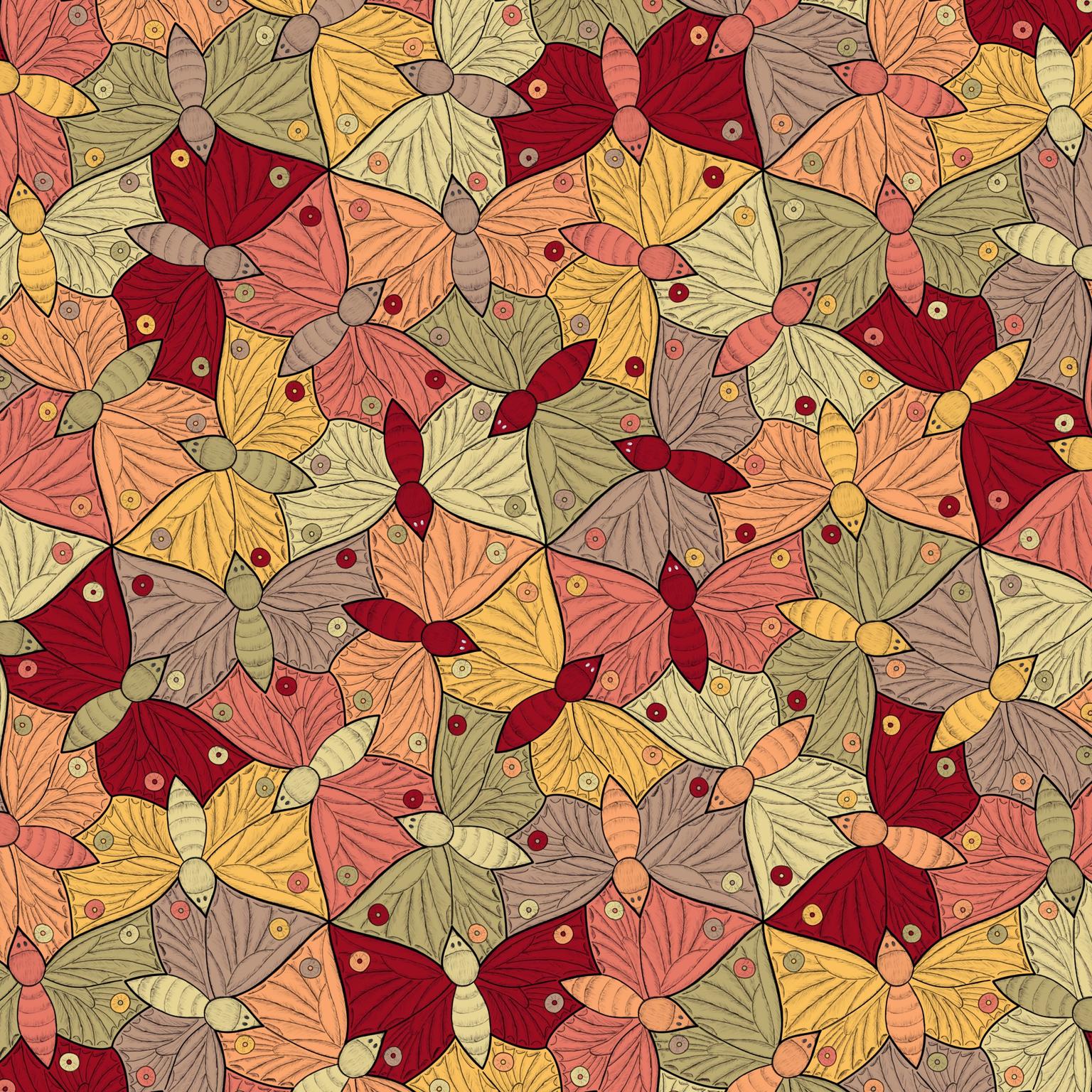
Color symmetry is usually described as a geometric transformation combined with a permutation of colors. It can also be seen as a coloring by a subgroup and its cosets, which shows an important detail: different placements of the subgroup inside the group yield significantly different patterns. Escher's spots and wings follow the same color permutations, but their patterns differ. Here the subgroup is dark and its six cosets are light. Wings, bodies, and front and back spots use different placements of the subgroup and so form different global patterns. It is illuminating to see how the cosets repeat the shape of the subgroup and fit together to fill the whole group. The symmetric rendering was done by the SymPix application.