In my artistic practice, I explore the creation of art objects using three main approaches:
1. Problem solving;
2. Changing an angle of perspective;
3. Combining existing ideas.
Using a combination of these methods in the creative process led me to create mathematical art. Mathematical art is an interdisciplinary field (3). In my work I use an asymmetric way of connecting floral motifs (2). I reduce the space between the petals (1).
By creating mathematical art, my intention is to show that not only can art be a way to convey emotions, feelings, and perceptions, but it can also be the result of research and analysis.
Artworks
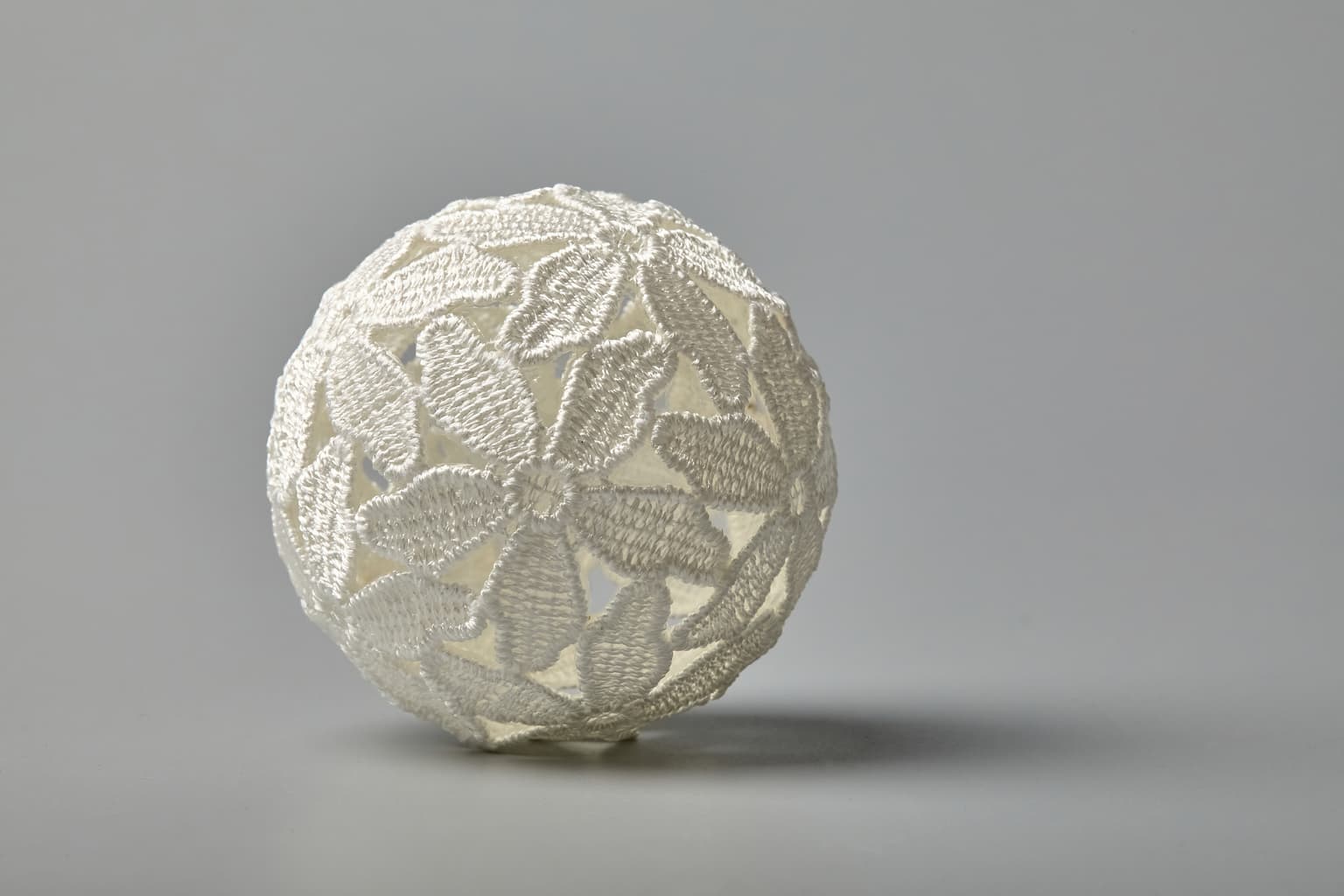
Floral ball
6.0 x 6.0 x 6.0 cm
Polyester lace flowers, gelatin.
2026
An experiment with fifth-order circular symmetry was conducted. Thanks to the asymmetric method of joining motifs, the properties necessary for creating a three-dimensional shape were revealed.
Imagine a dodecahedron containing a textile flower with five petals inside each pentagon. Each flower rotates 30 degrees relative to the neighboring flower, and the edges of the petals connect. The petals should protrude at the attachment point. Six flowers connected in this way form a bowl. Then, connect the two hemispheres.
The uneven edges of the petals create a rhythmic pattern in the geometric object's structure. Fowers of the desired shape are cut out of lace. Object's shape is formed using gelatin.
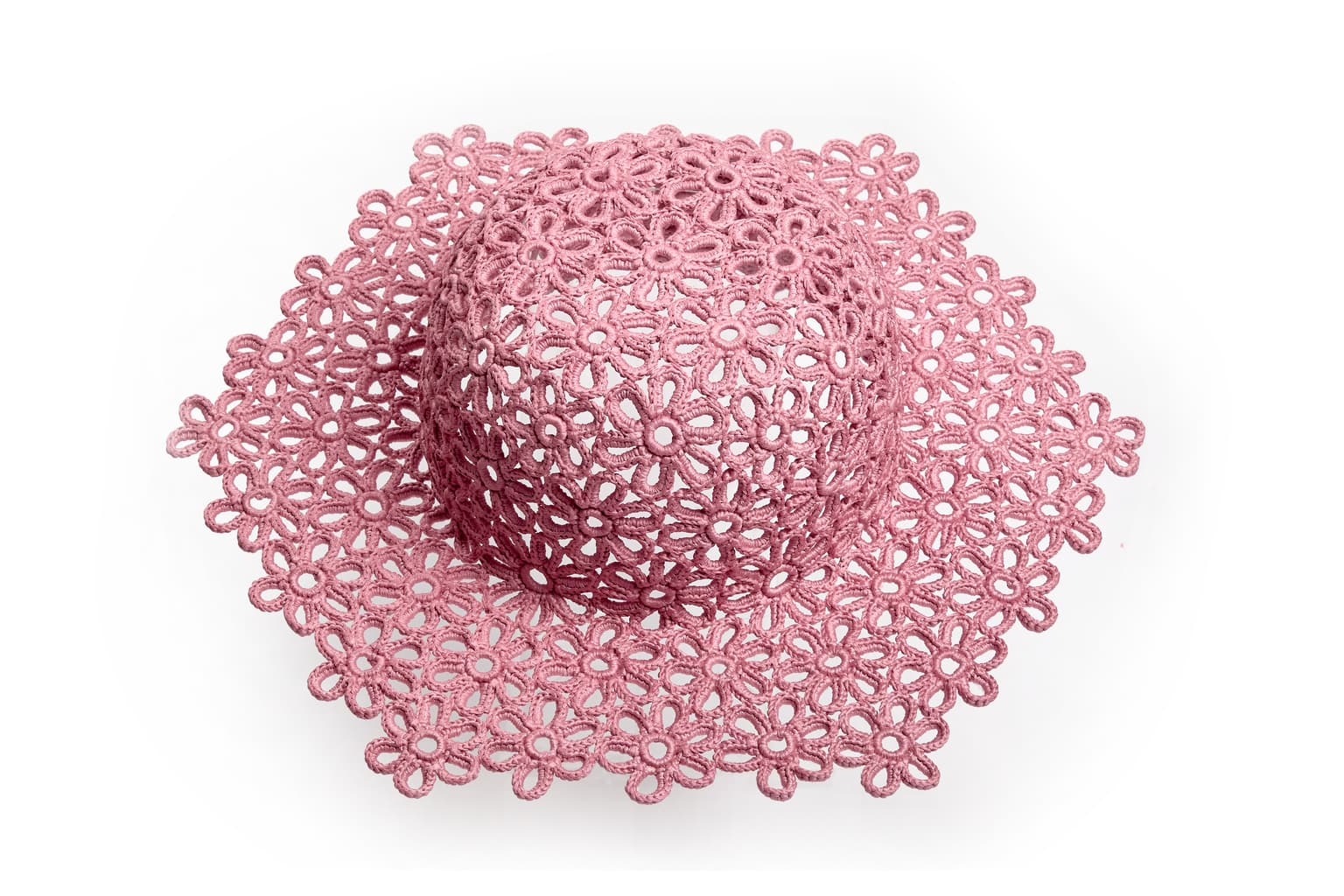
Garden Zephyr
12.0 x 38.0 x 38.0 cm
Mercerized cotton yarn, gelatin.
2025
An experiment with sixth-order circular symmetry was conducted. Due to the asymmetric method of joining motifs, the properties necessary for acquiring three-dimensional shapes were identified. Connecting six-petal floral motifs in an asymmetric way creates a denser pattern on the plane. My goal was to create a cylinder. To achieve this, I alternated between five- and six-petaled flowers along the second circle from the center to wrap edges by 90 degrees. The fourth row consists of six-petaled flowers that form the walls of the cylinder. Then, I tried bending the edges outward by alternating six- and seven-petaled flowers on the fifth circle. The subsequent circles consist of six-petaled flowers that form the brim of the hat.