Artists
Amy Wendt
Professor Emerit of Electrical and Computer Engineering
University of Wisconsin-Madison
Madison, Wisconsin, USA
Statement
My artwork reflects a lifelong affinity for crafts along with technical skills developed over a long career as an academic engineer. I am inspired to seek the convergence of textile arts with a love of geometric patterns and shapes through the use of computer controlled tools and mathematical trickery.
Artworks
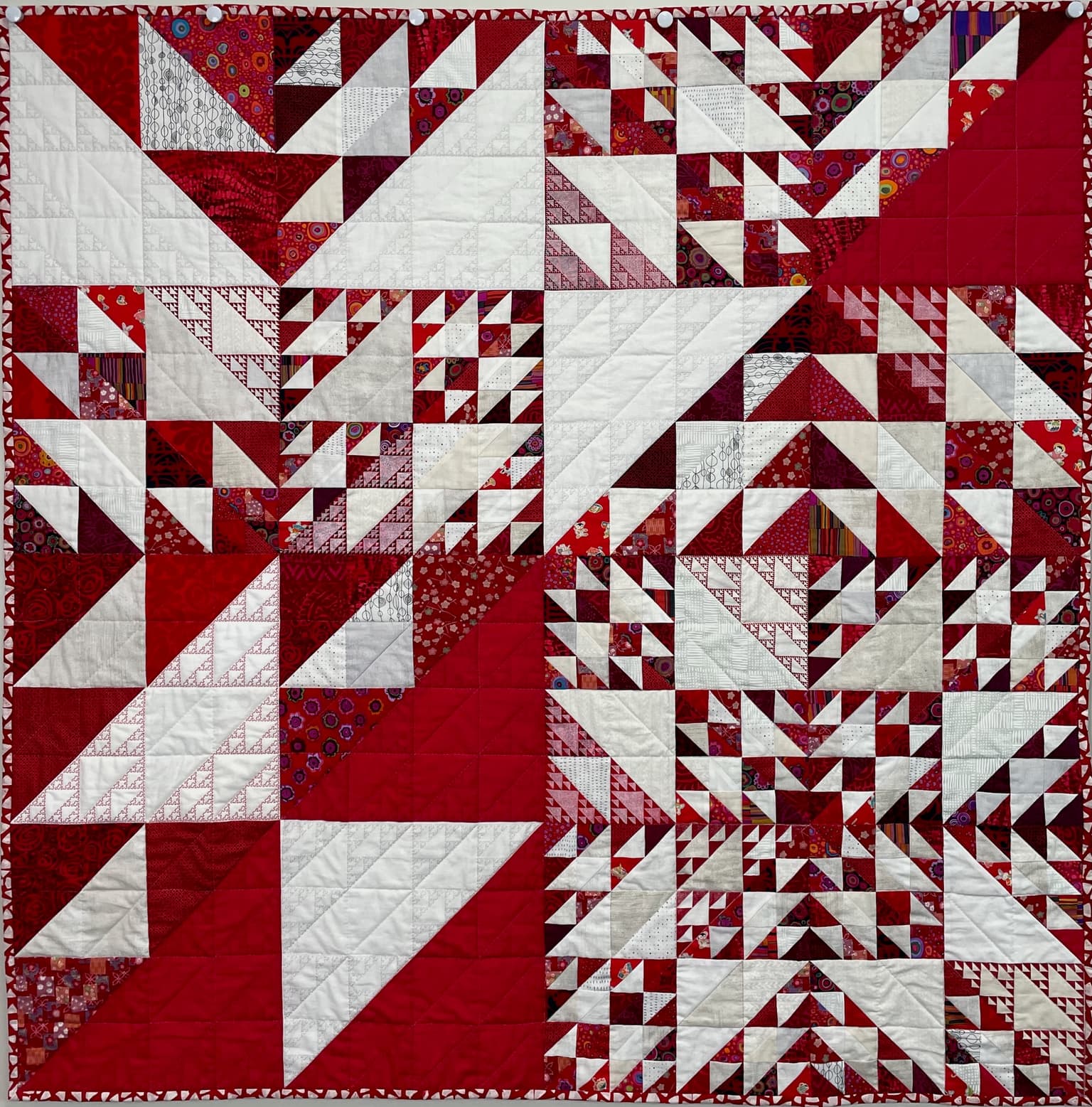
Stitching with Sierpiński: An Exploration of Triangles, Fractals and Patchwork
122.0 x 122.0 cm
Cotton fabric and batting; polyester, rayon and cotton thread; oil-based ink
2025
Sierpiński gaskets in right triangle form are an ideal building block for a patchwork quilt. This quilt is constructed entirely of Sierpiński gaskets, arranged such that at least two traditional patchwork blocks ("Sawtooth Star" and "Square in a Square") can be found within, while highlighting self-similarity in the gaskets as well as in traditional patchwork. Woodblock printing extends the sequence of Sierpiński gaskets to higher order, so that the quilt evokes fractals through triangle size spanning more than two orders of magnitude. In addition, the rules of the Sierpiński Arrowhead Curve were developed for the right triangle case, and a Level 8 iteration was stitched with thread to decorate some of the fabric triangles.
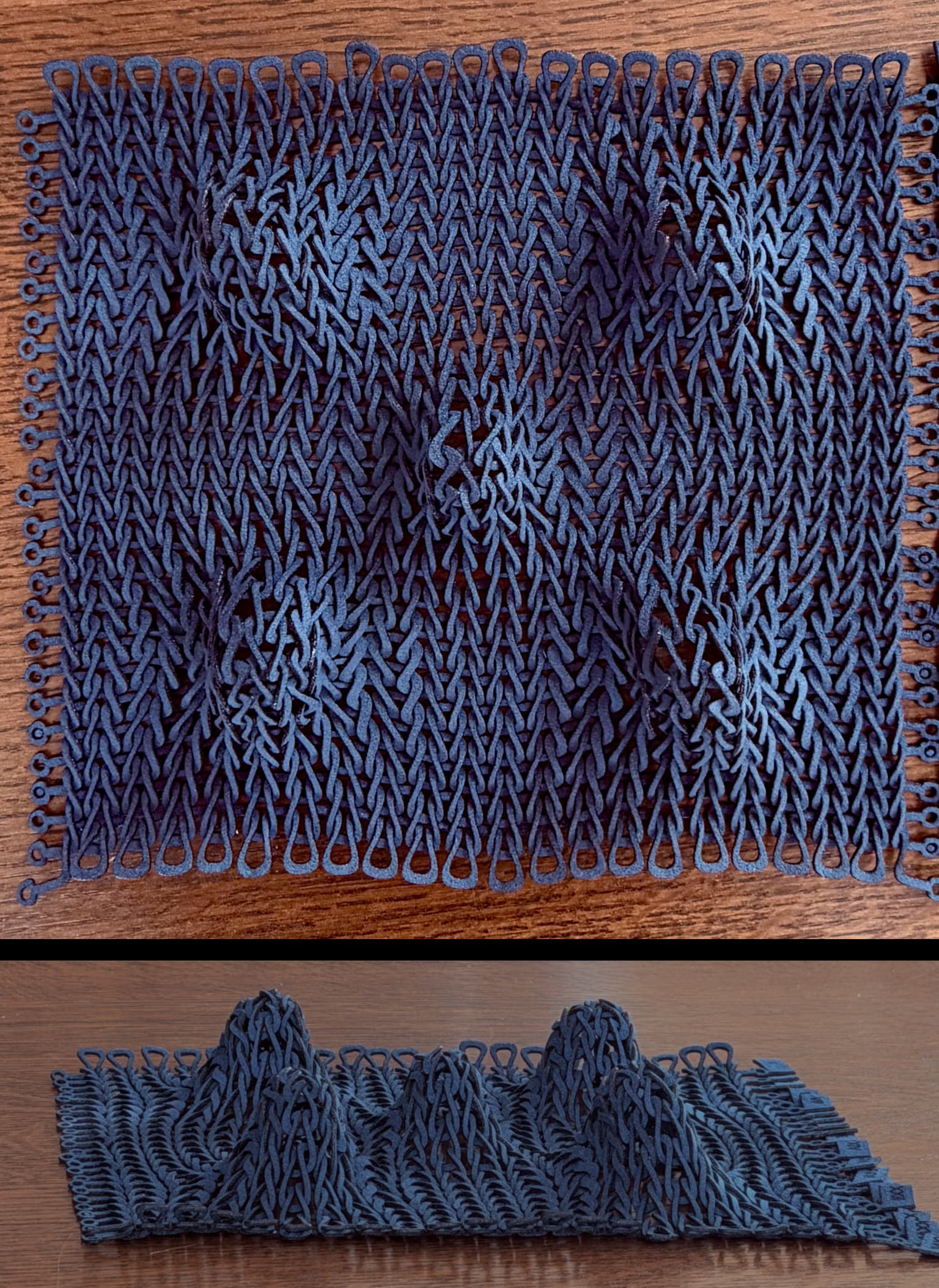
Five Gaussians: A Knitted Surface Plot
18.0 x 18.0 x 4.0 cm
Ultrasuede (TM) nonwoven microfiber fabric
2026
This piece explores a method for knitting in 3D when freed from the constraints of yarn as a medium, i.e., by laser-cutting strands from nonwoven cloth. Individual stitches connect together to form strands with a serpentine geometry, as in knitting with yarn. However, the use of Bézier curves to mathematically represent stitch shape is introduced as a framework for systematically tailoring the dimensions of individual stitches. This framework has been implemented to produce knitted "surface plots," in which a user-specified function f(x,y) (in this illustration, five Gaussians) serves as input to computing the distinct shape of each strand to be cut so that the knitted result is a 3D representation of that function.