We work with paper weaving, a Danish craft tradition most people know from small Christmas hearts. We are fascinated by how a simple handmade technique can unfold into complex geometric forms.
By determining how the strips are prepared before weaving, we create patterns that follow curved surfaces and form three-dimensional structures. The work develops from a simple premise: what happens when a familiar craft is pushed beyond its traditional limits?
We explore how repetition, colour, and structure create rhythm and movement in the woven surface. Through this process, two sheets of paper in different colours can become something architectural, mathematical, and alive.
Artworks
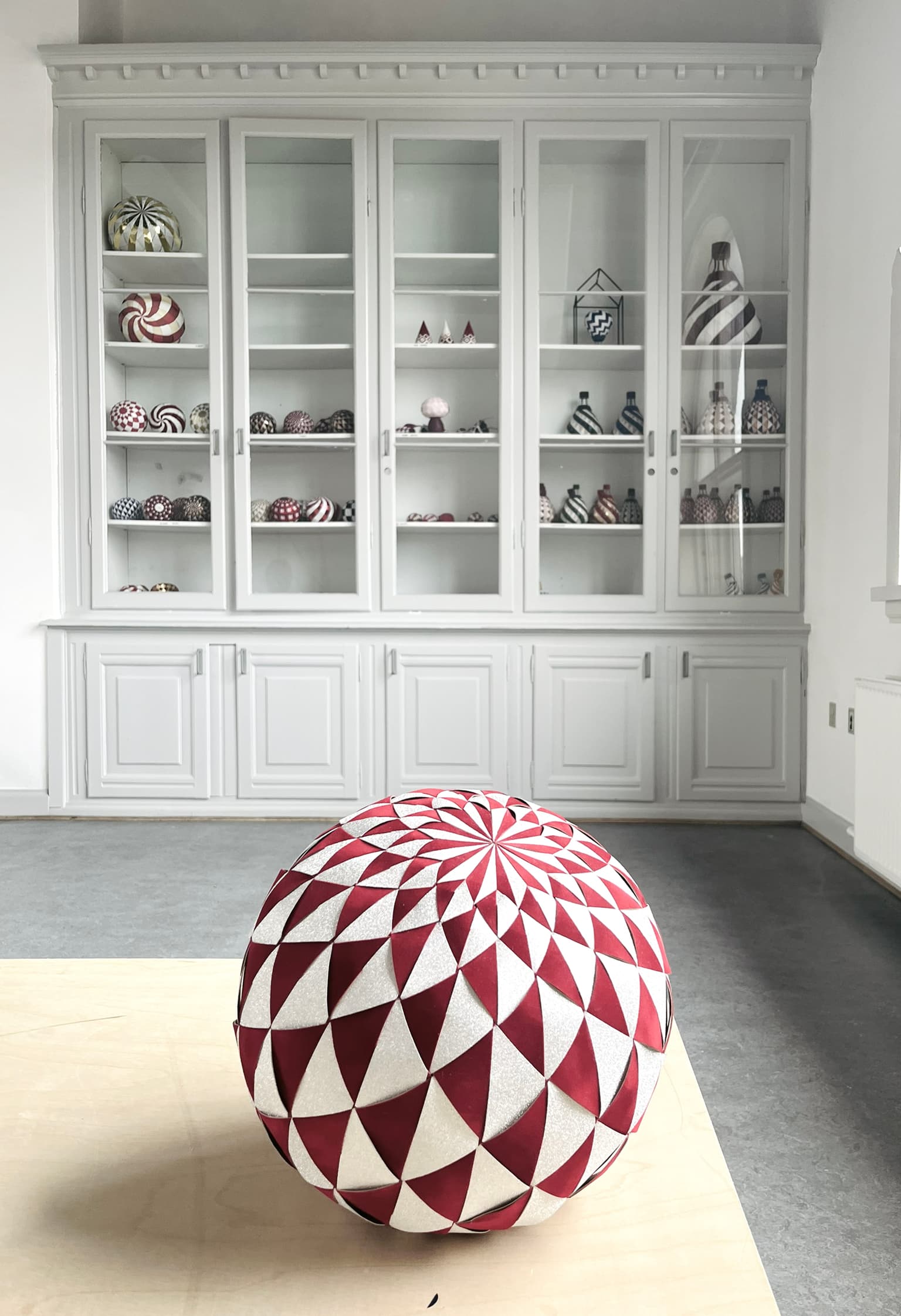
Twirled and woven sphere
35.0 x 35.0 x 35.0 cm
Paper/cardboard
2024
This artwork grows out of the research practice PaperMatrix, where we investigate new geometric possibilities within the Danish tradition of paper weaving. Historically, the craft has been limited to orthogonal grids on planar surfaces. Through our method twirl before weaving, two coloured paper strips are combined into a single patterned strip before weaving. This simple operation introduces diagonals and greatly expands the number of possible tessellated patterns. By systematically programming the strips, complex surfaces can be constructed and applied to three-dimensional forms such as spheres. The work transforms a historic craft into a mathematical system of pattern, symmetry, and structure.
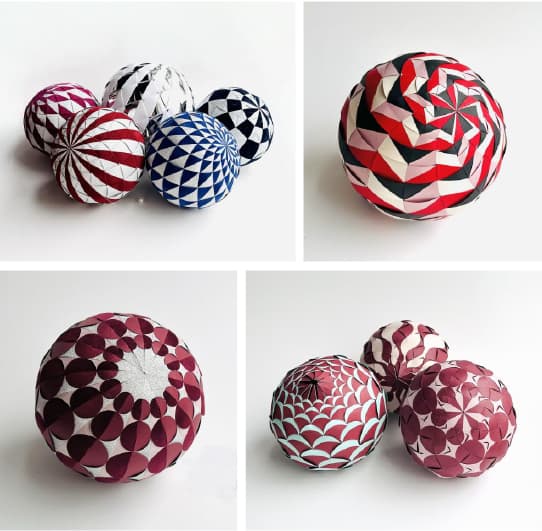
Twirled and woven spheres
45.0 x 45.0 x 12.0 cm
Paper
2025
Like the large sphere, these smaller woven spheres are based on the same geometric system derived from the Danish tradition of paper weaving. Historically the craft has been limited to orthogonal grids on flat surfaces. Through the method twirl before weaving, two coloured paper strips are combined into a single patterned strip before weaving. This introduces diagonals and greatly expands the number of possible tessellated patterns. By systematically programming the strips, many different and surprising patterns can be created and applied to spherical forms. The work shows how a historic craft can become a mathematical system of pattern, symmetry, and structure.