Our work brings together a mathematics educator interested in providing new avenues for appreciating mathematics and a quilter with many years of experience pursuing quiltmaking as a hobby and a longtime enjoyment of mathematics. Together we explore combinatorics and invariance through quilts, using elements such as fabric color, thread, and quilting techniques to encode mathematical relationships and invite viewers to discover patterns through counting and comparison. Quilting provides a medium in which mathematical structure can be made visible and tactile while drawing on the traditions and craft of quiltmaking.
Artworks
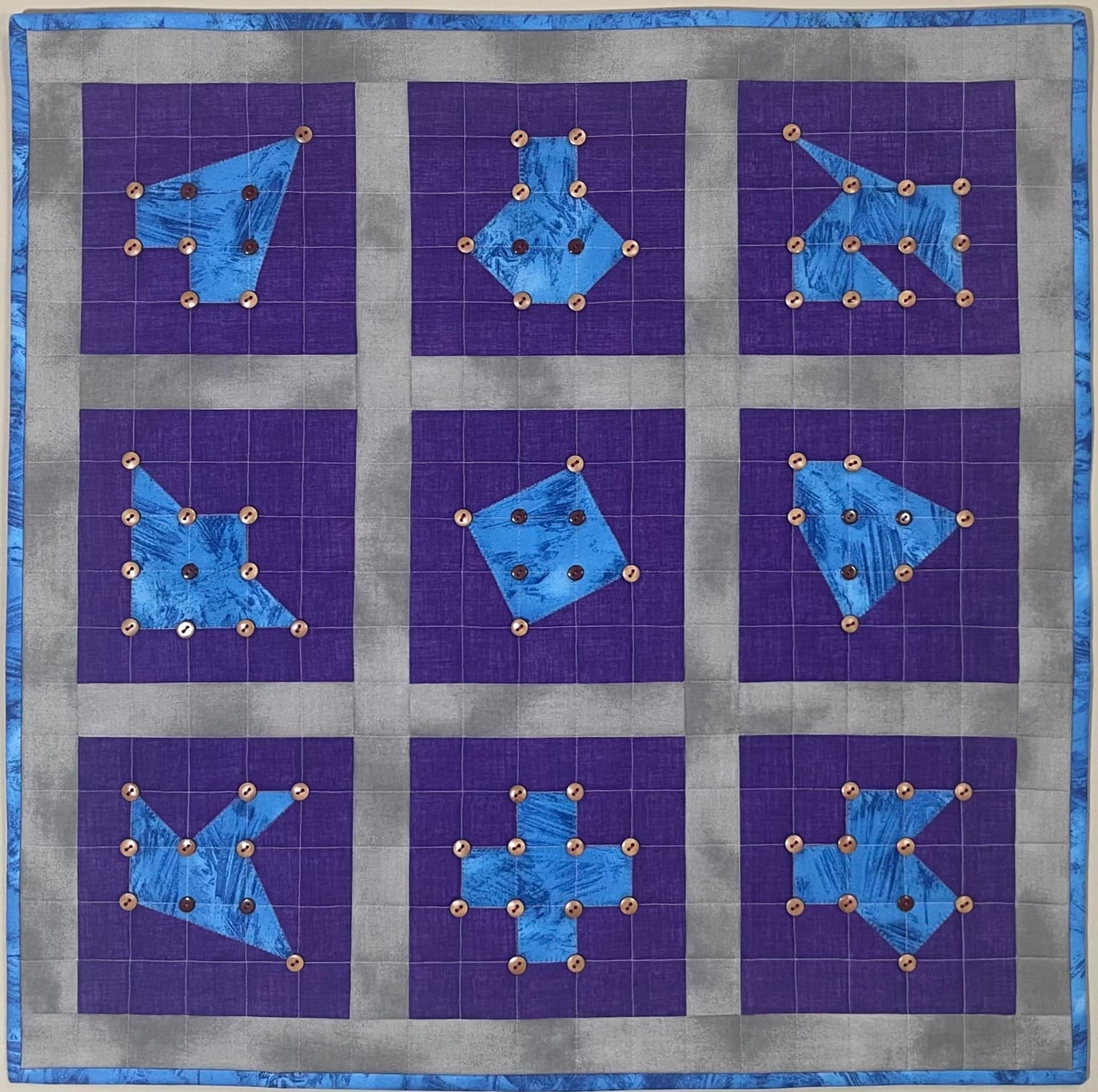
Counting Buttons
60.0 x 60.0 cm
Cotton fabric, batting, thread, wood buttons, and plastic buttons
2026
This quilt explores Pick’s Theorem, a result in geometry relating the area of a polygon with integer-coordinate vertices to the number of lattice points on its boundary and in its interior: A = I + B/2 - 1. Each panel is a different polygon appliquéd on a quilted integer lattice. The nine polygons were constructed to all have the same area despite their varied shapes. Viewers are invited to count the buttons corresponding to interior and boundary lattice points to see how different combinations satisfy Pick’s theorem. By comparing panels, one can observe how distinct lattice configurations balance interior and boundary counts to produce the same area.
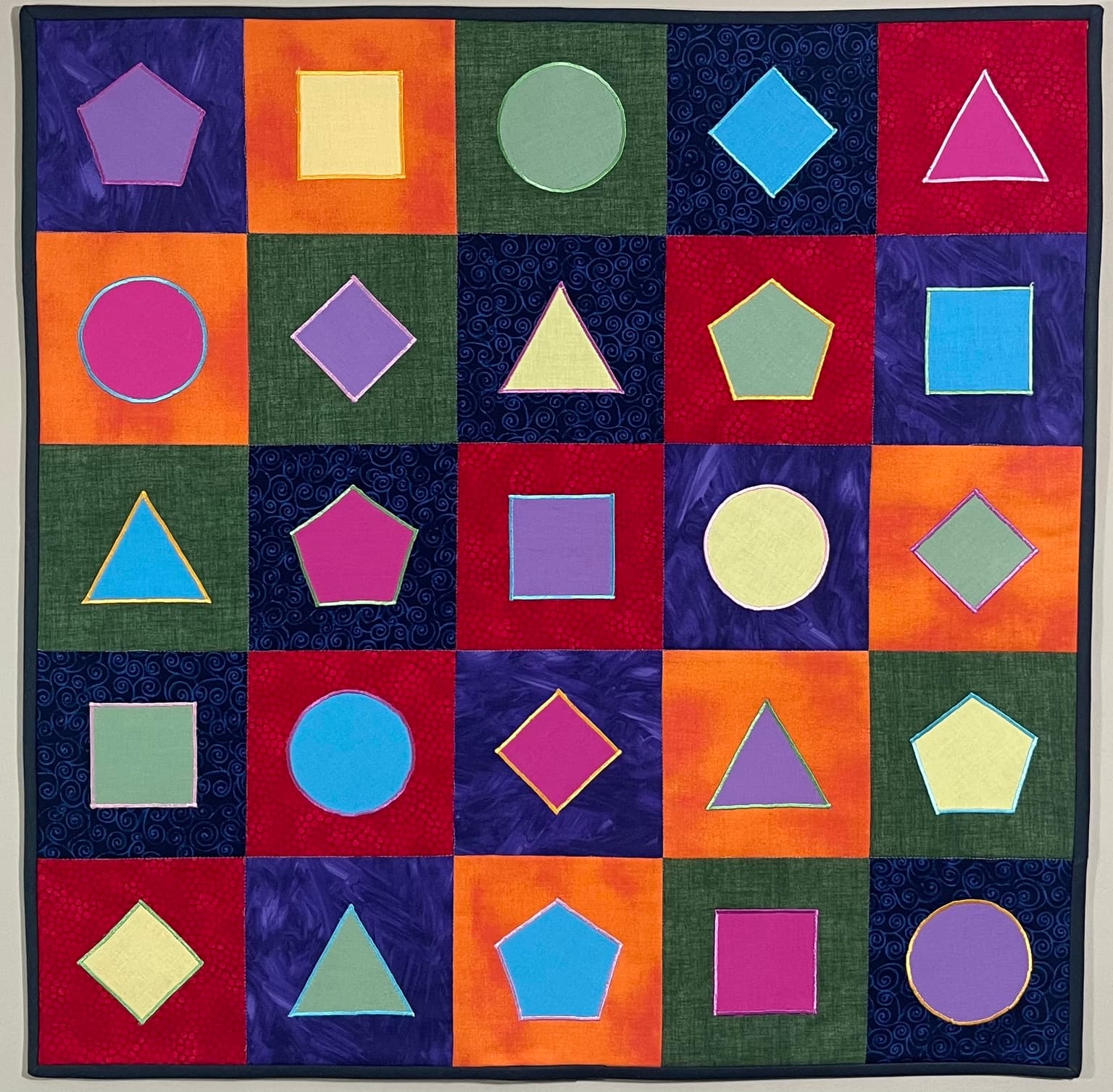
Sudoku without Numbers
64.0 x 64.0 cm
Cotton fabric, batting, thread
2025
This quilt is inspired by a combinatorial structure called a complete set of mutually orthogonal Latin squares of order five. Each visual attribute—background fabric, shape, shape fabric, and stitching color—forms a Latin square on the 5×5 grid, meaning each value appears exactly once in every row and column. Overlaying these four Latin squares ensures that every pair of attributes appears exactly once across the quilt. Latin squares are also the mathematical structure underlying familiar puzzles such as Sudoku. Viewers are invited to explore the grid and discover how these layered patterns interact.