Artists

Edmund Harriss

Assistant Professor of Mathematics and Art

University of Arkansas

Arkansas, USA

eharriss@uark.edu

maxwelldemon.com

View exhibition history

Lucía Rossi

Postdoc researcher in Mathematics

Vienna University of Technology

Vienna, Austria

lucia.rossi.moure@gmail.com

sites.google.com

View exhibition history

Statement

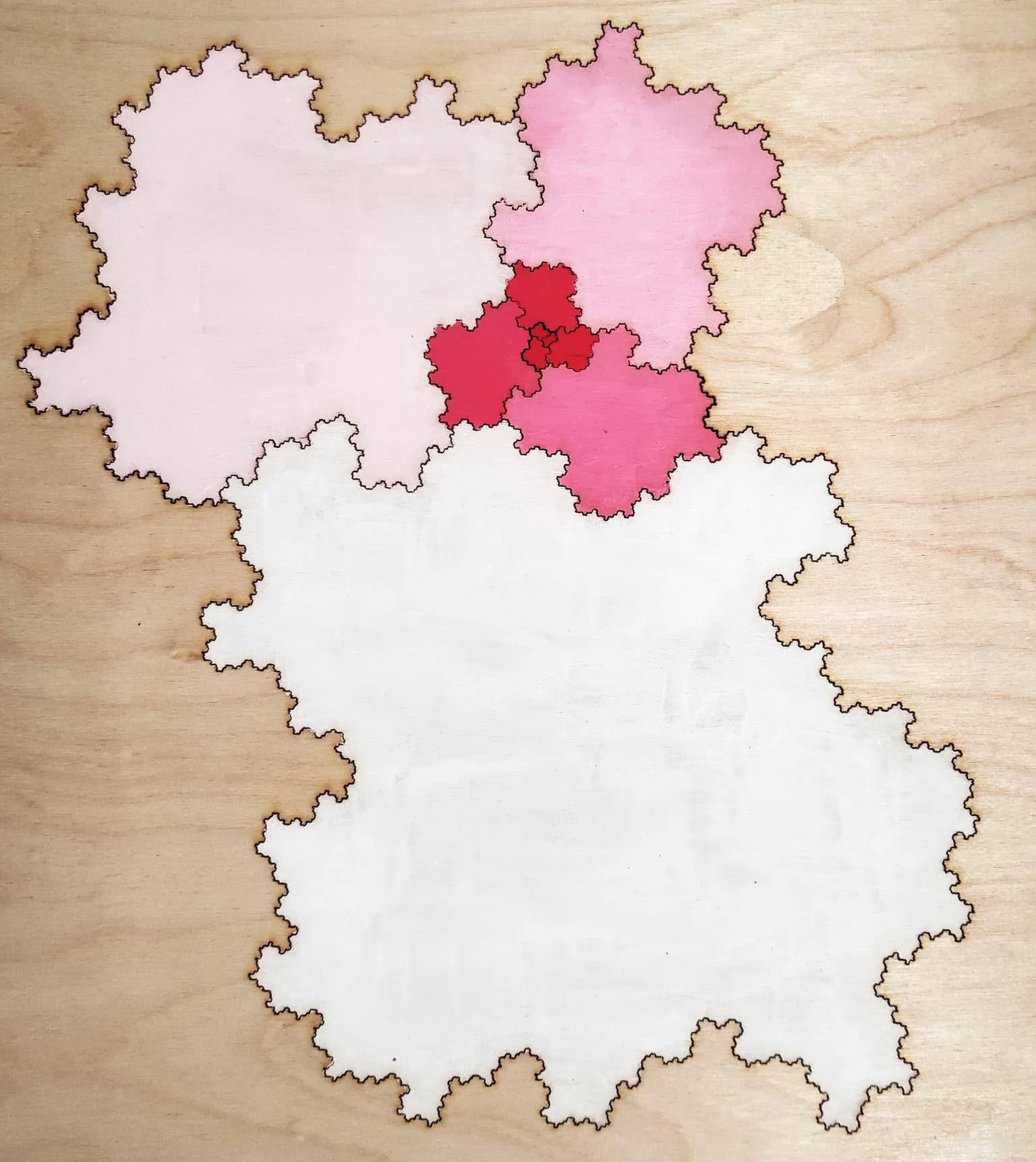
A two-piece work, consisting of a mobile sculpture (a 3D printed skeleton holding laser cut wooden pieces) and a painting (acrylics in laser carved wood), illustrates a mathematical object that exists beyond familiar geometry. It is a self-affine set, meaning it can be subdivided into smaller copies of itself that repeat at different scales, resulting in a fractal structure. It lives in a p-adic dimension where distance behaves in unfamiliar ways, represented in the sculpture’s vertical axis along which planar slices of the set are placed. These nine tiles fit together as a puzzle to form the shape shown in the painting, where the self-affine structure is highlighted. Viewers are invited to play with the tiles and solve the puzzle.

Artworks
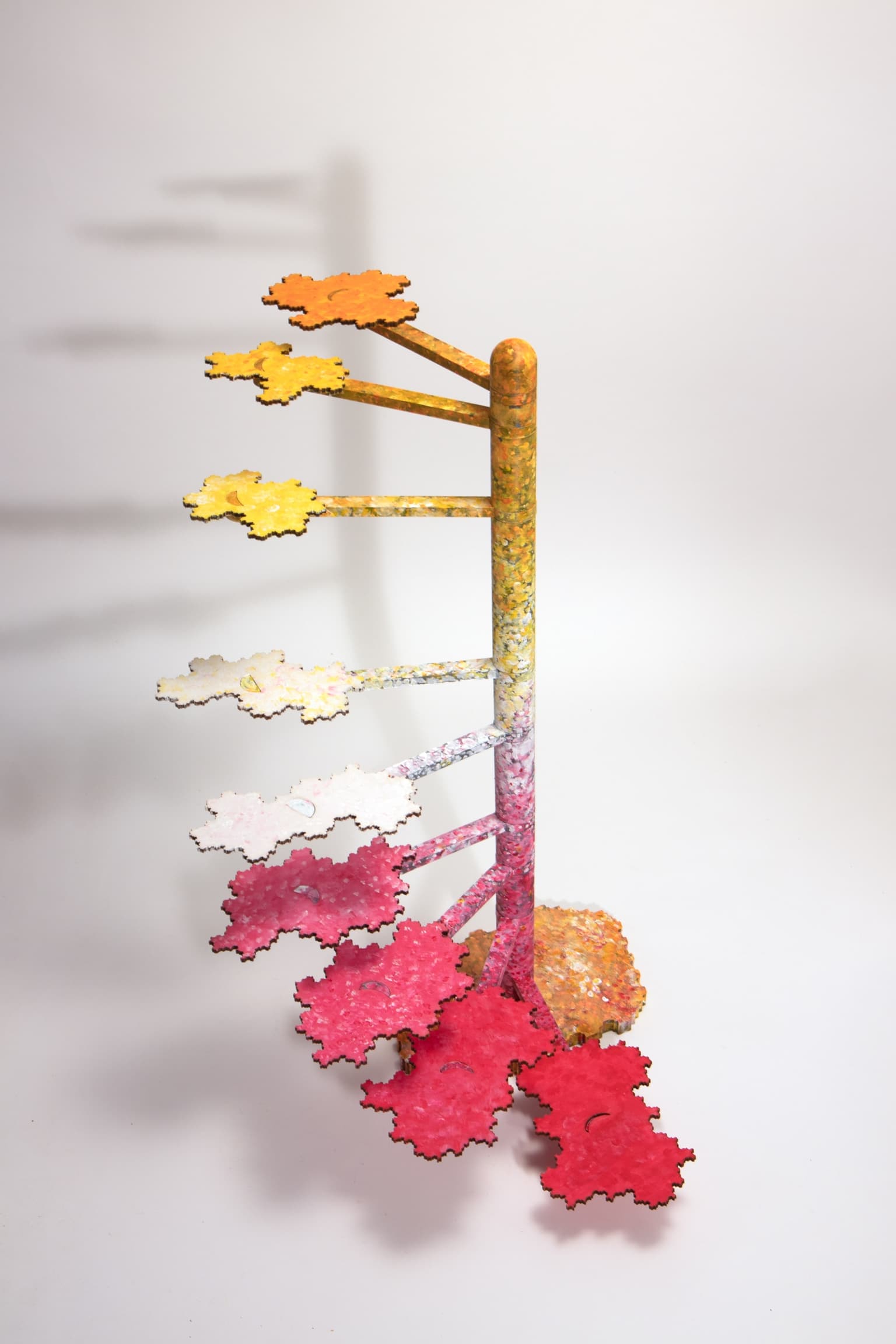
Image for entry 'Fragments of a p-adic fractal (sculpture)'

Fragments of a p-adic fractal (sculpture)

50.0 x 35.0 x 20.0 cm

Acrylics in laser cut wood and 3D print

2023
Additional info

This sculpture was created while researching rational self-affine tiles, a family of mathematical objects first introduced by Steiner and Thuswaldner in the context of numeration systems in algebraic bases. This particular object lives in a space with a $p$-adic dimension related to the complex (Gaussian) prime $p=1+i$. In $p$-adic spaces, powers of a prime $p$ of the form $p^n$ become small as the exponent $n$ grows, so distances behave in unusual ways, making illustration challenging. We represent the object using planar slices whose vertical position corresponds to their $p$-adic height. Look at the shape of the bottom tile: can you assemble the nine pieces to form a larger version of it?
Image for entry 'Fragments of a p-adic fractal (painting)'

Fragments of a p-adic fractal (painting)

38.0 x 33.5 cm

Acrylic in laser carved wood

2023

Additional info

This painting represents a self-affine set. The outer shape repeats inside itself at infinitely small scales, as highlighted by different shades of pink, giving the boundary a fractal structure. For many people, it looks like a map, because natural formations such as coastlines are often best modelled by fractals. This set, however, arises in the abstract setting of numeration systems: just as real numbers can be written in base ten, complex numbers can be written in complex bases. This particular self-affine tile corresponds to a numeration system with basis $\frac{-1+3i}{2}$. The arithmetic properties of this system are reflected in the repeating structure of the set.