My Fibonacci Art is based on the Fibonacci number sequence. Fibonacci Art follows the spirit of Concrete Art or the Dutch De Stijl movement: they all pose constraints on the artwork. In Fibonacci artworks, the simple geometric objects must follow the dimensions of the Fibonacci numbers. The Fibonacci constraint, for me, is much like the metre is a constraint in poetry. It allows me to create poems for the eyes.
My ambition is to use light, colors, forms, arrangements, space and substrate to a point where one does not need to appreciate or understand the mathematics behind an artwork to find the beauty and harmony in it. My Fibonacci artworks display an inherent harmony, clarity, lightness and timelessness.
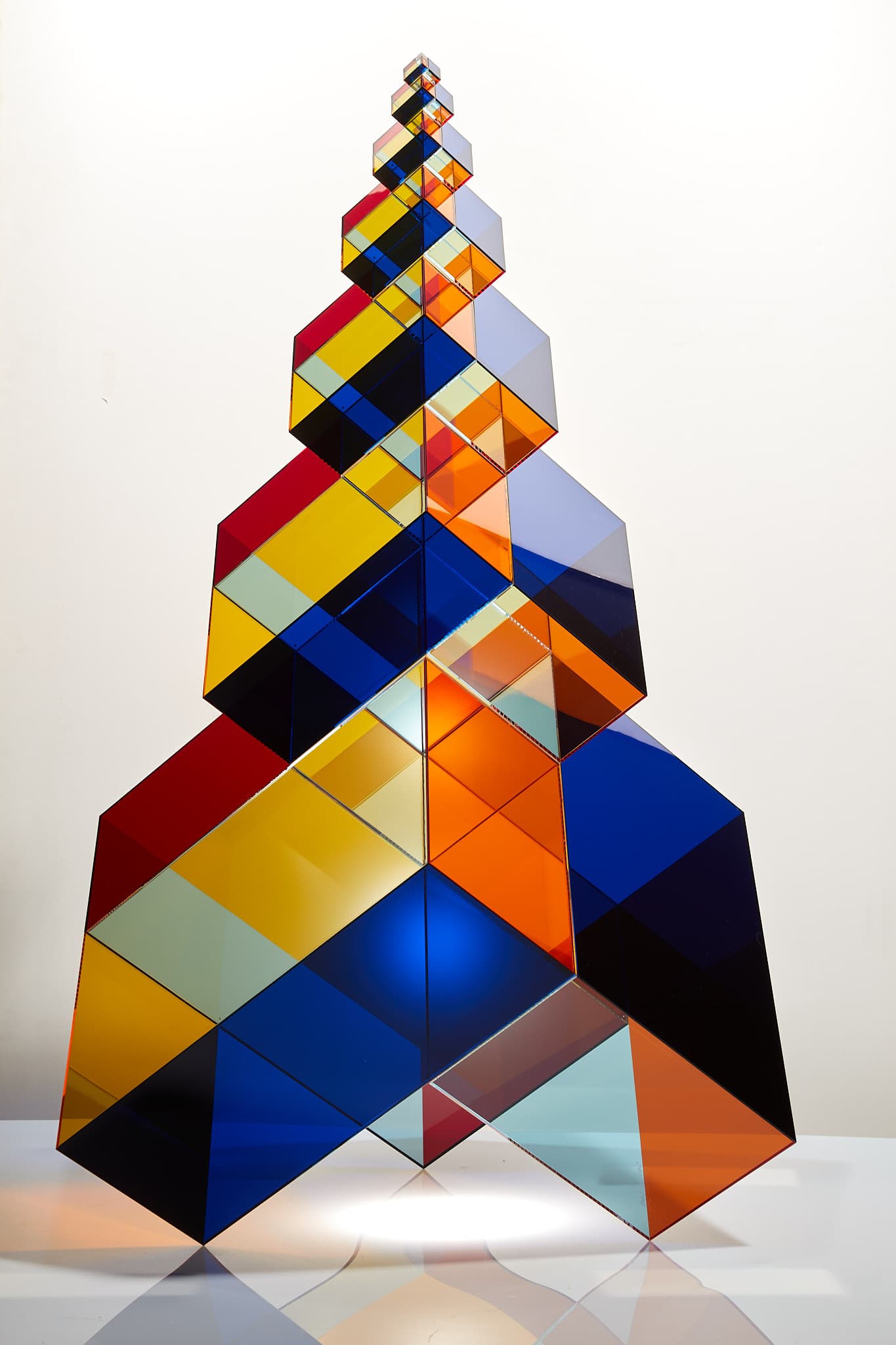
The sculpture is built from 28 Fibonacci cubes and Fibonacci cuboids, which together form a pyramid. The Plexiglas surfaces create a fascinating kaleidoscopic image. The sculpture changes its appearance like a chameleon depending on the viewpoint.
Fibonacci cubes have the amazing property that they can be built from two smaller Fibonacci cubes and three identical Fibonacci cuboids. This follows from the cubic formula $(x+y)^3=x^3+3x^2y+3xy^2+y^3$ by setting $x=F_{n-1}$ and $y=F_{n-2}$ and the Fibonacci sum $x+y=F_n$. Thus: $F_n^3=F_{n-1}^3+F_{n-2}^3+3 F_n F_{n-1} F_{n-2}$. This decomposition is applied recursively.
The pyramid sculpture is built by stacking the cuboids and cubes on top of each other.
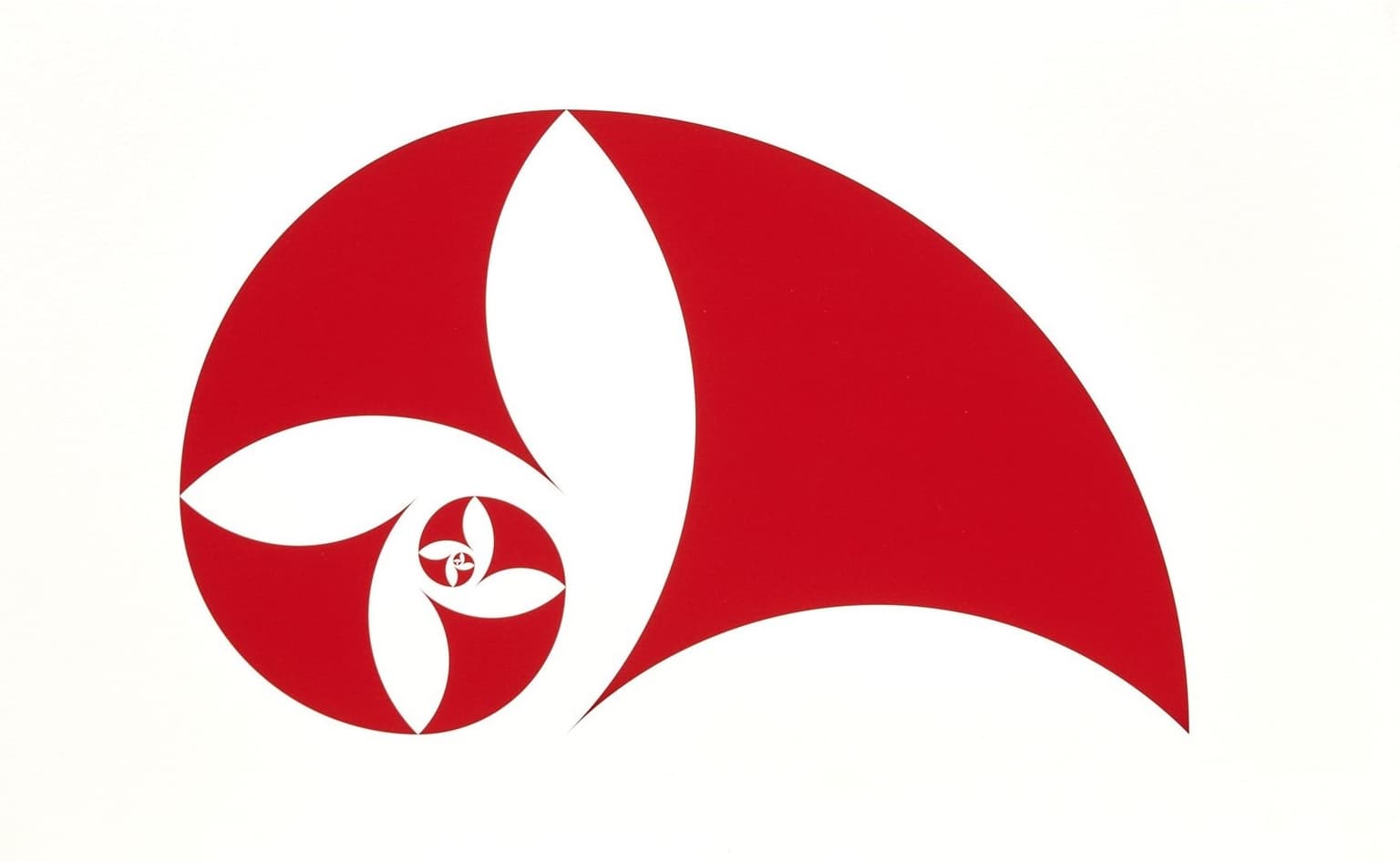
A curved kite is a geometric figure resembling a kite. The edge of a curved kite consists of three quarter-circles. The two small ones are the same size and form the pointed tail of the kite. The large one connects them. A curved kite has the property that its area is exactly $r^2$ where $r$ is the radius of the small circles.
The artwork is created by aligning a series of individual kites whose wingspans are Fibonacci numbers. The large quarter-circles are aligned by rotating the kites clockwise by $\pi/2$. This creates the well-known Fibonacci spiral. The white space within the spiral, formed by the tails, resembles the curling leafs of a fern creating a second image that competes with the spiral for the viewer’s attention.