In my career as a physical chemist I have been fascinated by symmetry and geometric order at multiple scales. While teaching chemistry in Spain, this interest led to my study of the intricacies of Moorish art and tilings, ultimately devising my own patterns inspired by this ancient tradition. Recently I have been researching the strapwork strands that emerge in Girih decoration of aperiodic Penrose tilings. This work naturally leads to images highlighting their complexity, symmetry, topology, and endless variety. I find beauty and serenity in contemplation of these emergent Girih strands, and in their revelation of order and structure within the seeming chaos of the Penrose tiling.
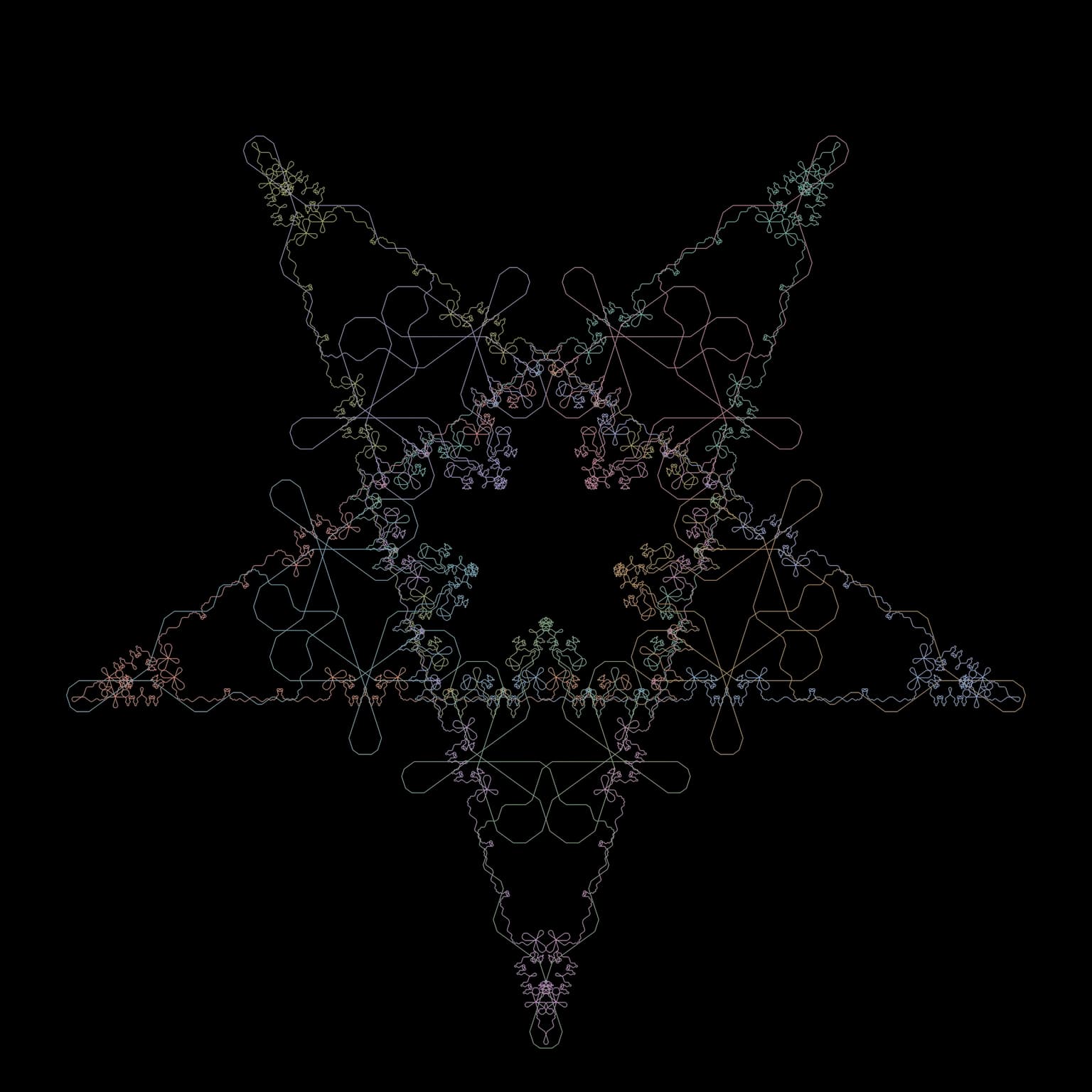
From the Girih decoration of aperiodic tilings emerge strapwork strands of remarkable complexity. This strand is just one example, emerging in the interwoven Girih pattern that arises from a simple decoration of the Penrose kite and dart tiling. As described in my contribution to Bridges 2026, the strand forms a mathematical knot with 6,430 self-crossings in this projection. In the course of completing a full circuit, the trajectory encounters 607,480 crossings within the Girih pattern, and orbits the center of the tiling 4 times. A cyclic color map is used to track the four orbits. The accompanying animation helps visualize the strand trajectory as it emerges from a local cartwheel symmetry center in a decorated star axiom tiling.
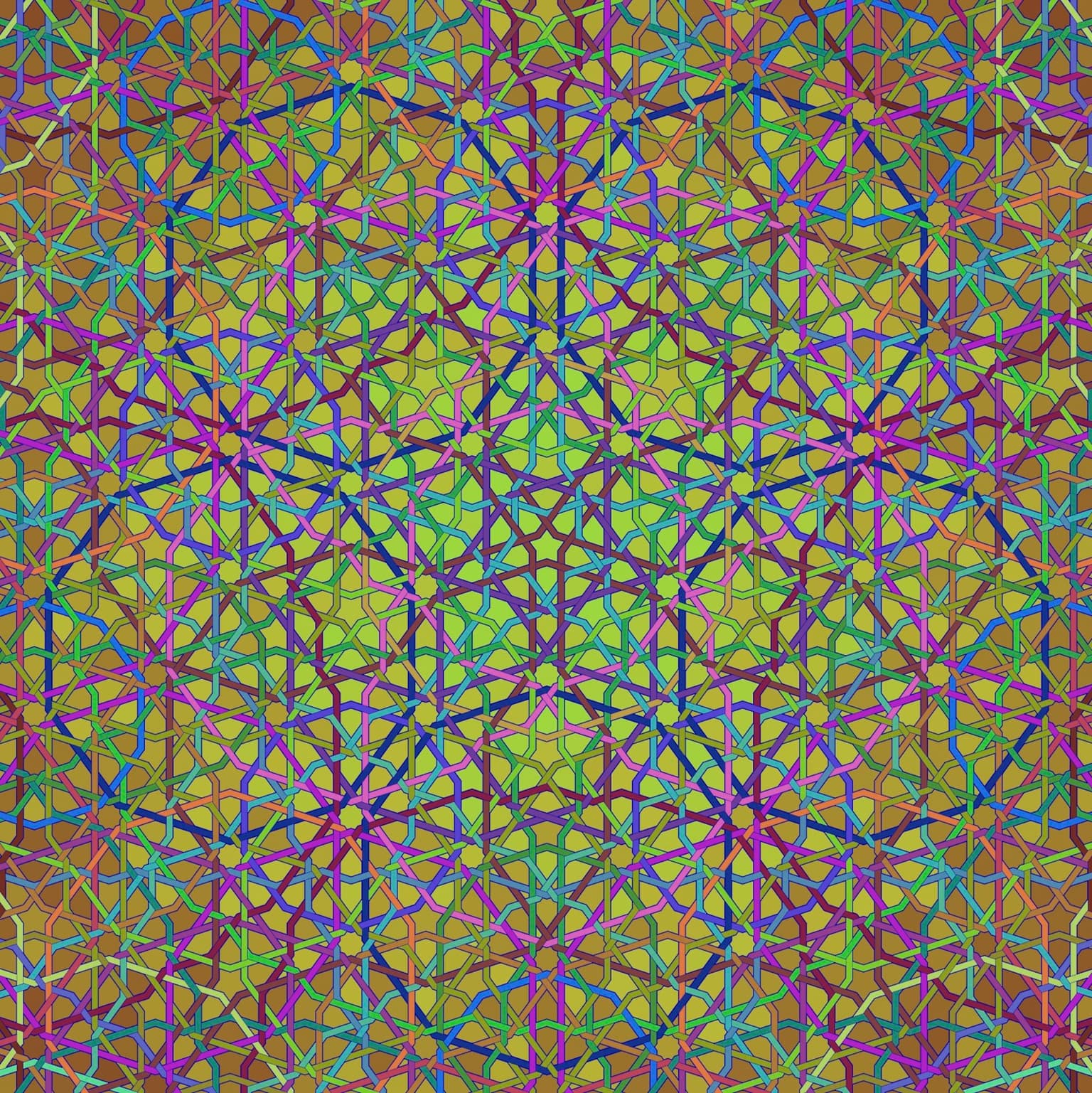
From the simple Girih decoration of an aperiodic tiling can emerge an apparently unlimited variety of strapwork strands. The star axiom Penrose kite and dart tiling has five-fold symmetry about its center, and this image shows the interwoven strands emerging from a simple decoration of its central prototiles. Each unique or symmetrically equivalent strand has its own color, and each forms a loop or a mathematical knot. A few strands complete their trajectory within this image, others embark upon a complex journey extending well beyond this tiny window into the tiling. The enclosed polygons are colored using a quasi-random, radially variable color map to acknowledge aperiodic chaos and accentuate the pattern's d5 center of symmetry.