I am a second-career artist with a background in software development and long-standing interests in the physical sciences and mathematics. A recent MSc in mathematics included a dissertation on aperiodic Wang tiles for which I developed software to generate tilings and explore alternative visual renderings. For the Bridges exhibition I extend this work using the Kari–Culik tile sets, seeking visual ways to reveal the mathematical logic that enforces non-periodicity. The images balance mathematical structure with visual rhythm, gradually transitioning toward the traditional Wang representation with coloured triangular edges.
Artworks
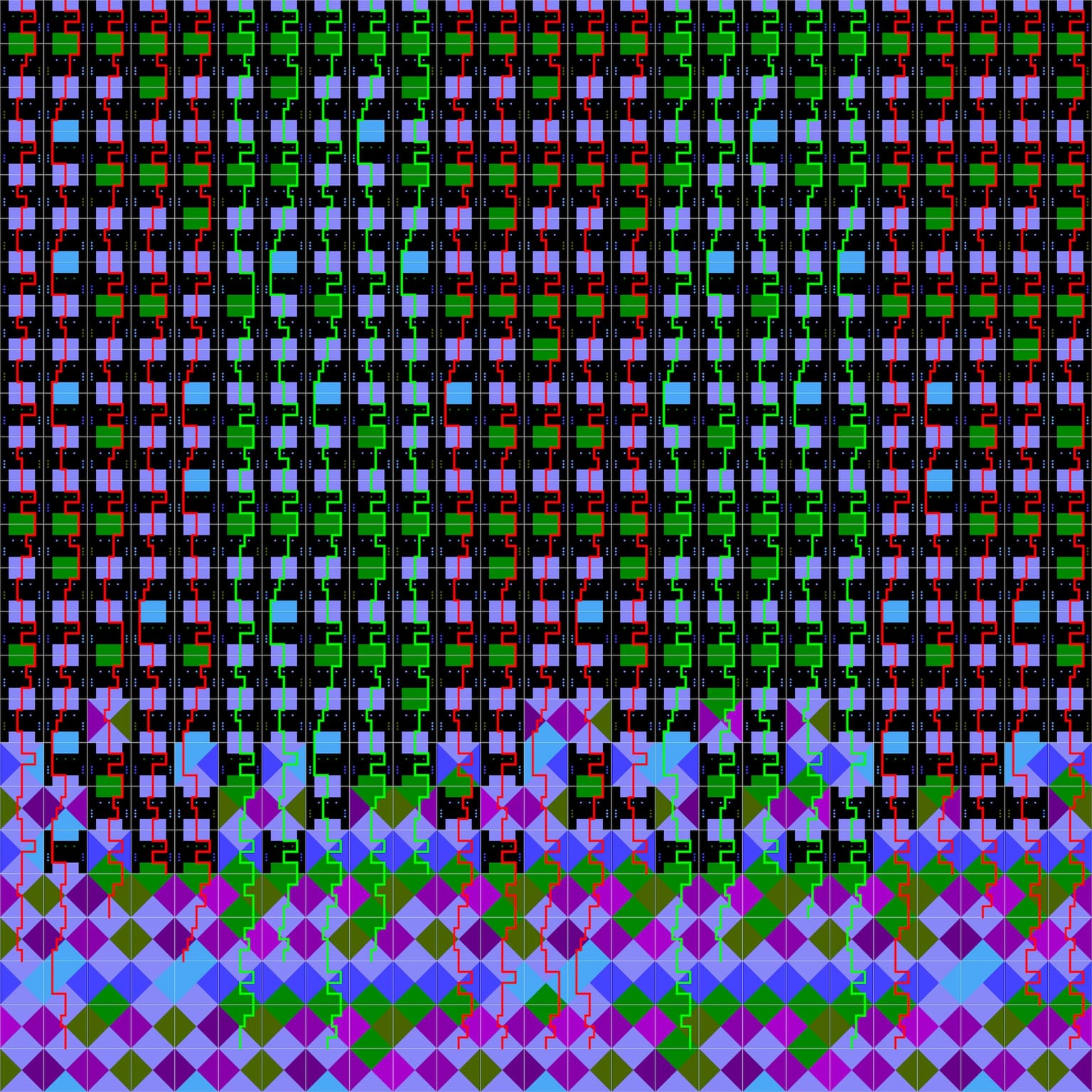
Kari tiles, Beatty Sequences. The encoding of aperiodicity.
55.0 x 55.0 cm
Generative algorithmic artwork, archival pigment print on paper.
In Kari’s 14 aperiodic Wang tiles, real numbers are encoded by Beatty sequences of the two integers bracketing the value. The average value of a subsequence of a Beatty sequence converges to the required value as its length approaches infinity. Colours represent integers, with two non-matching colours for zero. Coloured rectangles encode row input and output (starting at 1). Rows of three dots indicate multipliers, 2 or 2/3, shown as finite Beatty sequences. All tiles in a row have the same multiplier. Each row is a multiple of the previous, so no row repeats in an infinite tiling. Side-edge dots encode carries, while staggered vertical lines show how column values evolve. At the base the tiles return to the traditional Wang representation.
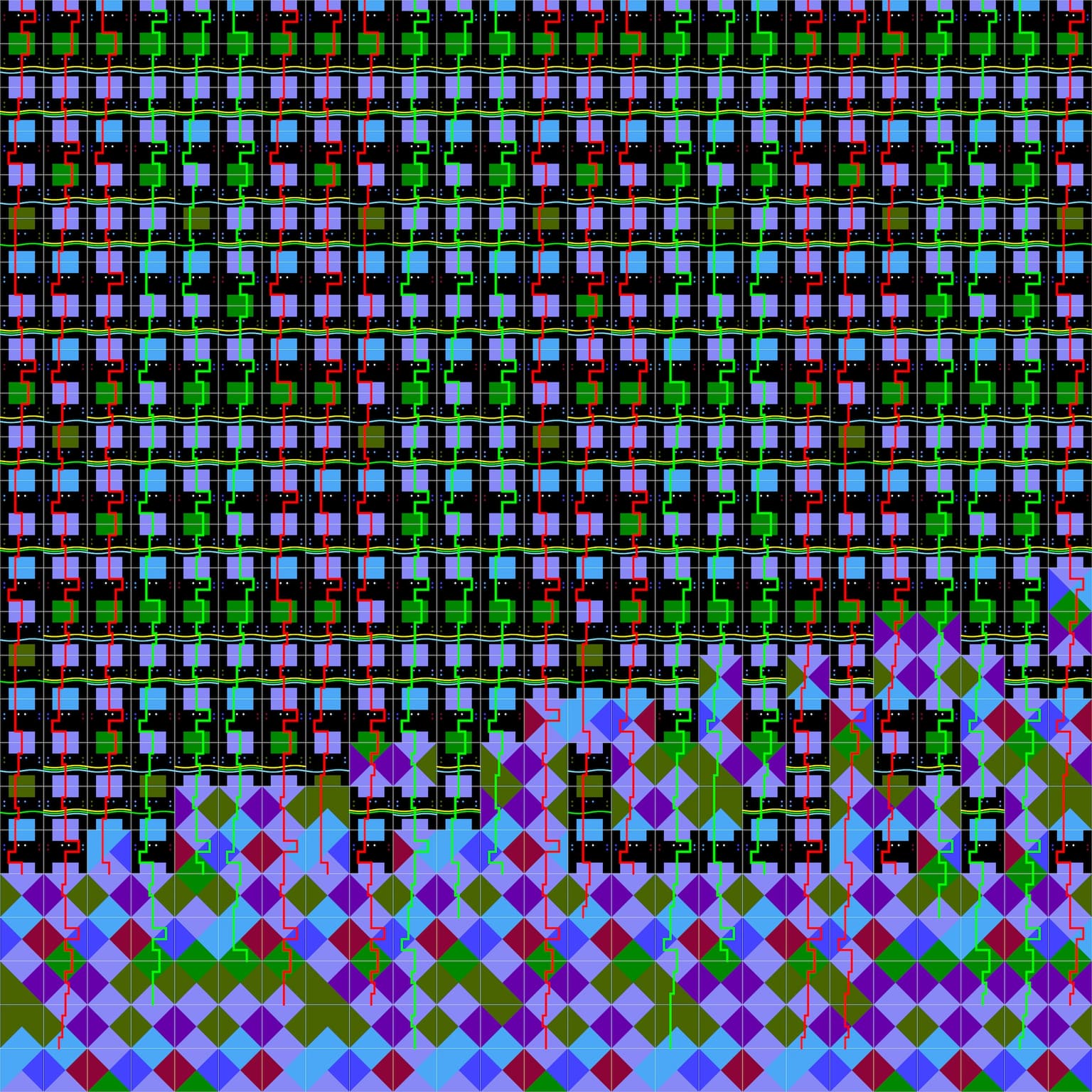
Culik's response
55.0 x 55.0 cm
Generative algorithmic artwork, archival pigment print on paper.
In this rendering of Culik’s set of 13 aperiodic Wang tiles the first row input represents 1/3 as a Beatty sequence. A row of 2 dots represents a multiplier, either 3 or 1/2, associated with each tile. All tiles in a row have the same multiplier. The input of one row being a multiple of the previous, no row can be repeated in a tiling of infinite length. The side-edge values are carries. The staggered vertical lines, whose colours are insignificant, show how the value represented in a column changes. The multiplier 1/2 tiles have 3 overlapping subsets, shown by the shallow sine curves, and one of these subsets must include all the tiles in a given multiplier 1/2 row.