I have been fascinated with tessellations and tilings as long as I can remember. Since 2014, I have been posting interactive computer graphics on shadertoy.com, and since 2021, I have focused on producing tangible mathematical artworks that combine traditional and digital fabrication techniques.
I aim to create works which appeal to viewers on multiple levels beyond the aesthetic. I hope that people who spend time with my work are sparked with curiosity, or are rewarded by thinking in new ways about symmetry and patterns. A recurring theme in my work is the tension between geometric structure and organic variation. Although the forms may be generated by code, the finished artwork should nonetheless reflect human creativity.
Artworks
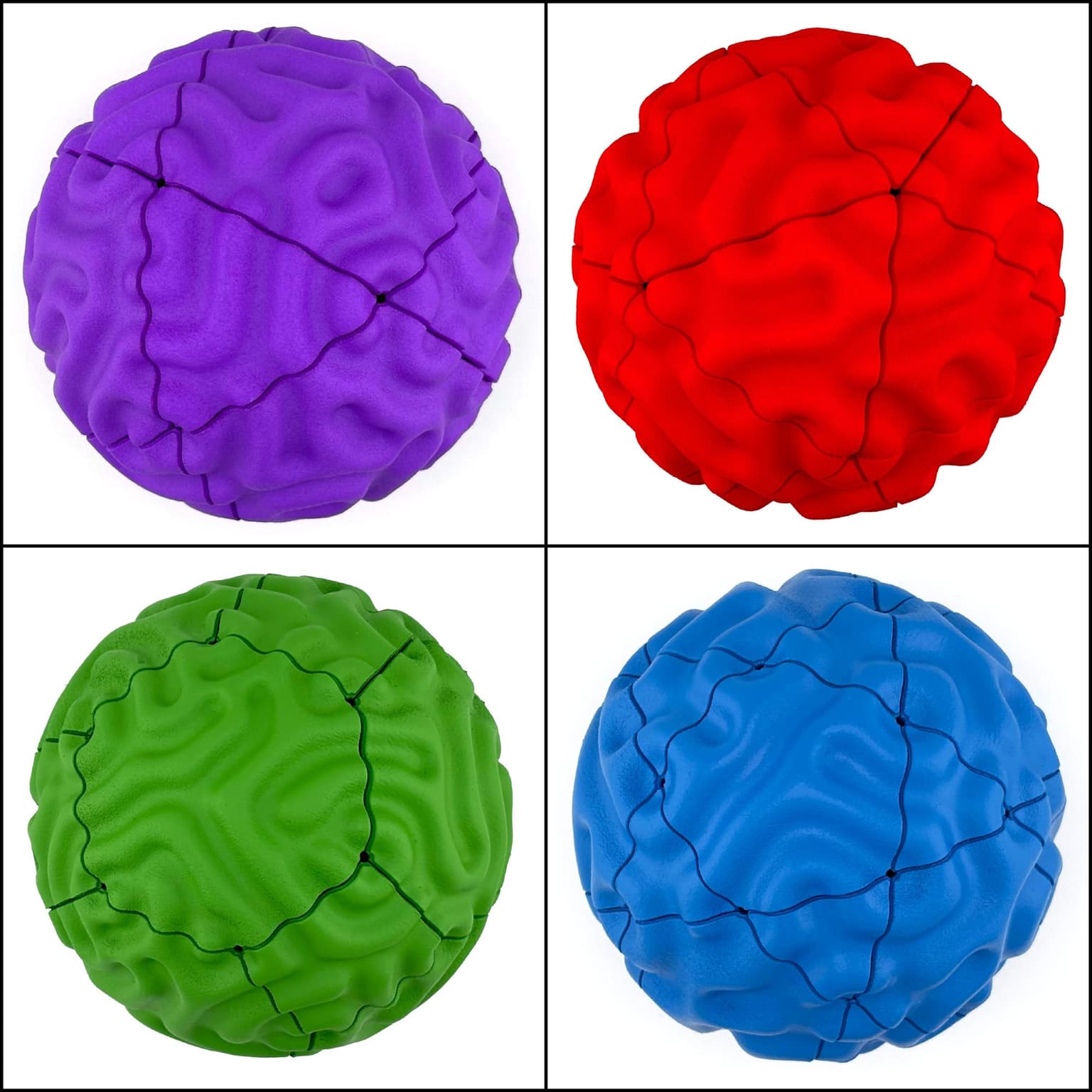
Reaction-diffusion Truchet tilings of the sphere
10.0 x 10.0 x 10.0 cm
3D-printed nylon, neodymium magnets
2026
These four spherical tilings correspond to the truncated octahedron (green), icosahedron (red), cuboctahedron (purple) and icosidodecahedron (blue). The organic, coral-like patterns on the tiles are generated using a modified version of the Gray-Scott reaction diffusion model, a partial differential equation (PDE) inspired by chemical reactions observed in nature.
Although the patterns look random, structure emerges upon close inspection. Not only are many tiles duplicates of each other, but all of their edges are congruent. Hence, any tile can be rotated in place or swapped with another tile of the same shape without introducing discontinuities. To ensure this property, the Gray-Scott PDE must be solved in an unusual topological space.
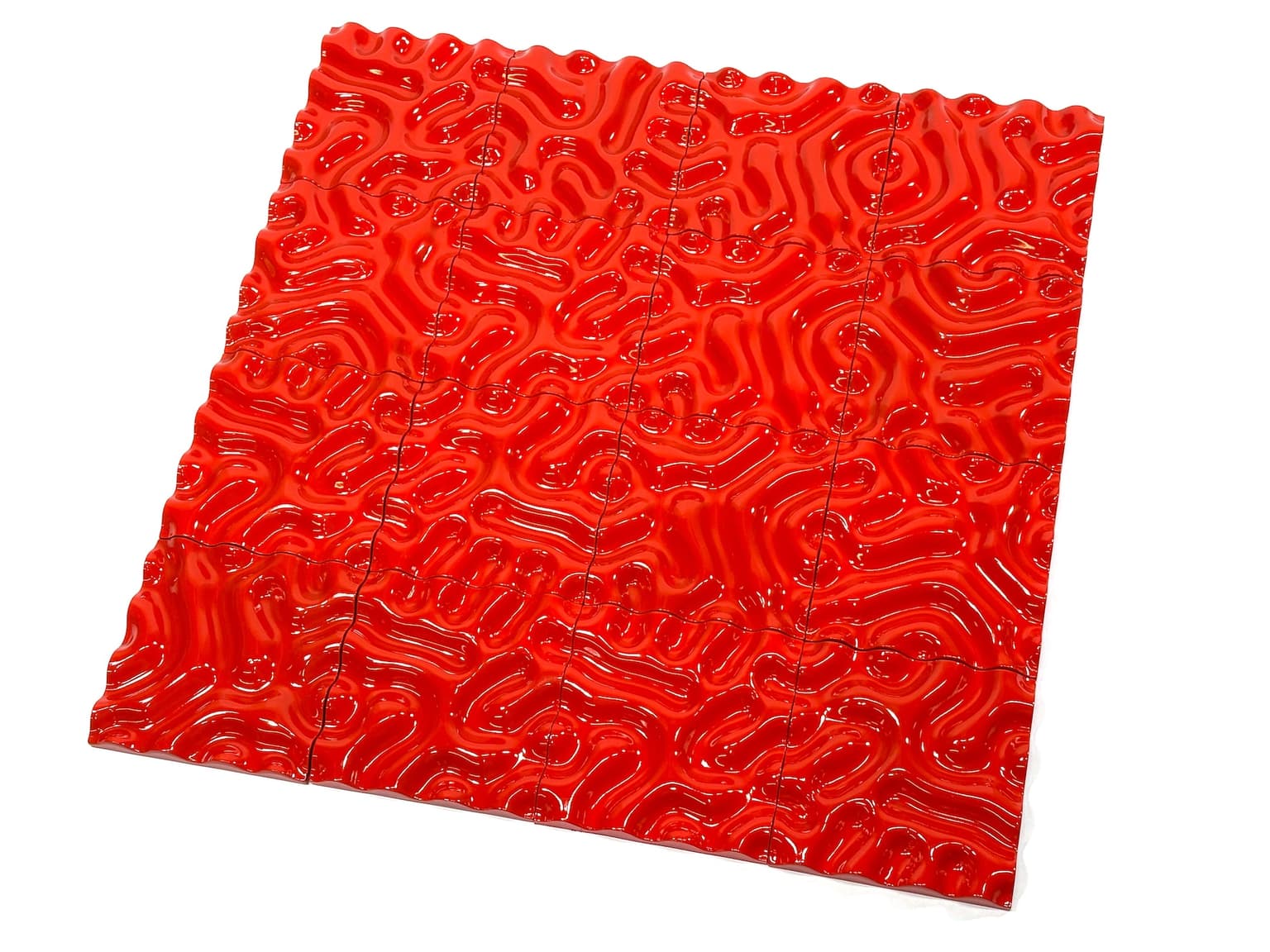
Square planar reaction-diffusion Truchet tiles
40.0 x 40.0 x 1.5 cm
3D-printed nylon
2026
Like their spherical counterparts, these square tiles appear to create an unordered organic and coral-like pattern. However, close inspection reveals that there are exactly two unique tile designs, and all four edges of each tile are identical.
The glossy finish of the tiles evokes a stark industrial atmosphere that contrasts with the organic patterns on the tiles. By rearranging the tiles, novel compositions can be created with 90° or 180° symmetry.