I make art inspired by science, technology, engineering and mathematics (STEM). My artworks include drawing machines, walk-in camera obscura rooms, pandemic portraits via Zoom, record player animations, pinhole photography, and spherical sculptures. I often use repurposed and everyday materials in my work, to make abstract STEM subjects relatable, real and fun. My work explores the beauty of mathematics and the creative possibilities of recycling.
I have brought my art activities to schools and science events around the UK, and worldwide to France (Maker Faire Lille), Uzbekistan (Aral Sea environmental art), South Korea (Sculpture Festa), New York (Museum of Math), Egypt (Biross art symposium), India (The Story of Space), and many more.
Artworks
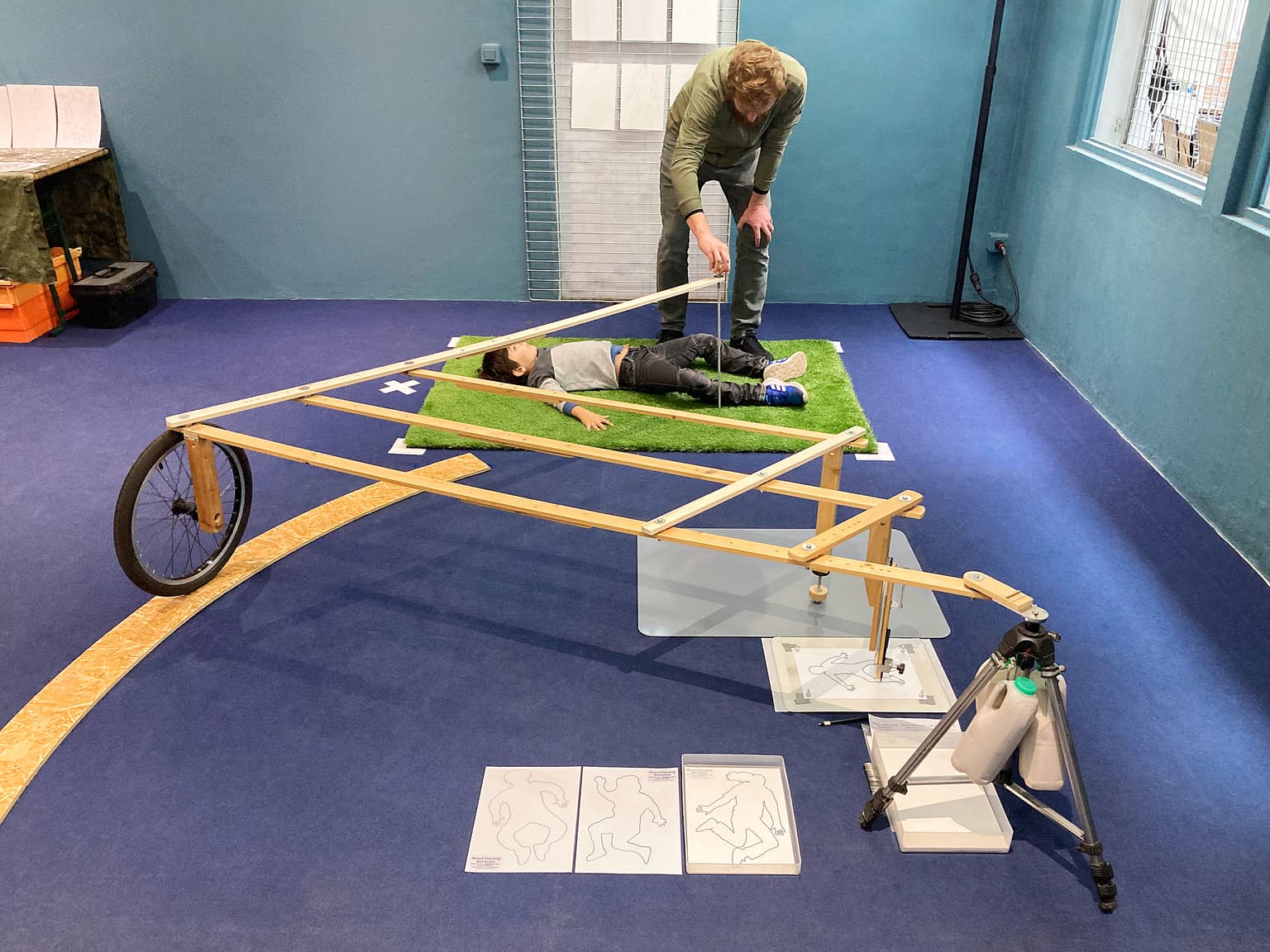
Giant Pantograph 2.0
300.0 x 500.0 x 50.0 cm
Wood, bearings, nuts and bolts, camera tripod, bicycle wheel, other scrap materials
aka “The Body Miniaturising Machine”
This drawing apparatus allows participants to draw 1:6 scale body outlines of each other directly onto A4 art paper. It is inspired by the Sketch-a-Graph toy I had as a child. This is a toy version of the pantograph tool that has been used for centuries by various draughtspeople.
I've brought it to schools, science events and festivals around the UK, and worldwide to Summer Nostos cultural festival (Greece) and Abu Dhabi Science Festival (UAE).
Following the pandemic, I retrieved the machine from Lockdown storage and reconfigured it to work on rough terrain – not just smooth indoor floors. Now I can bring it to outdoor events on grass lawns, as well as indoor science events in school halls!
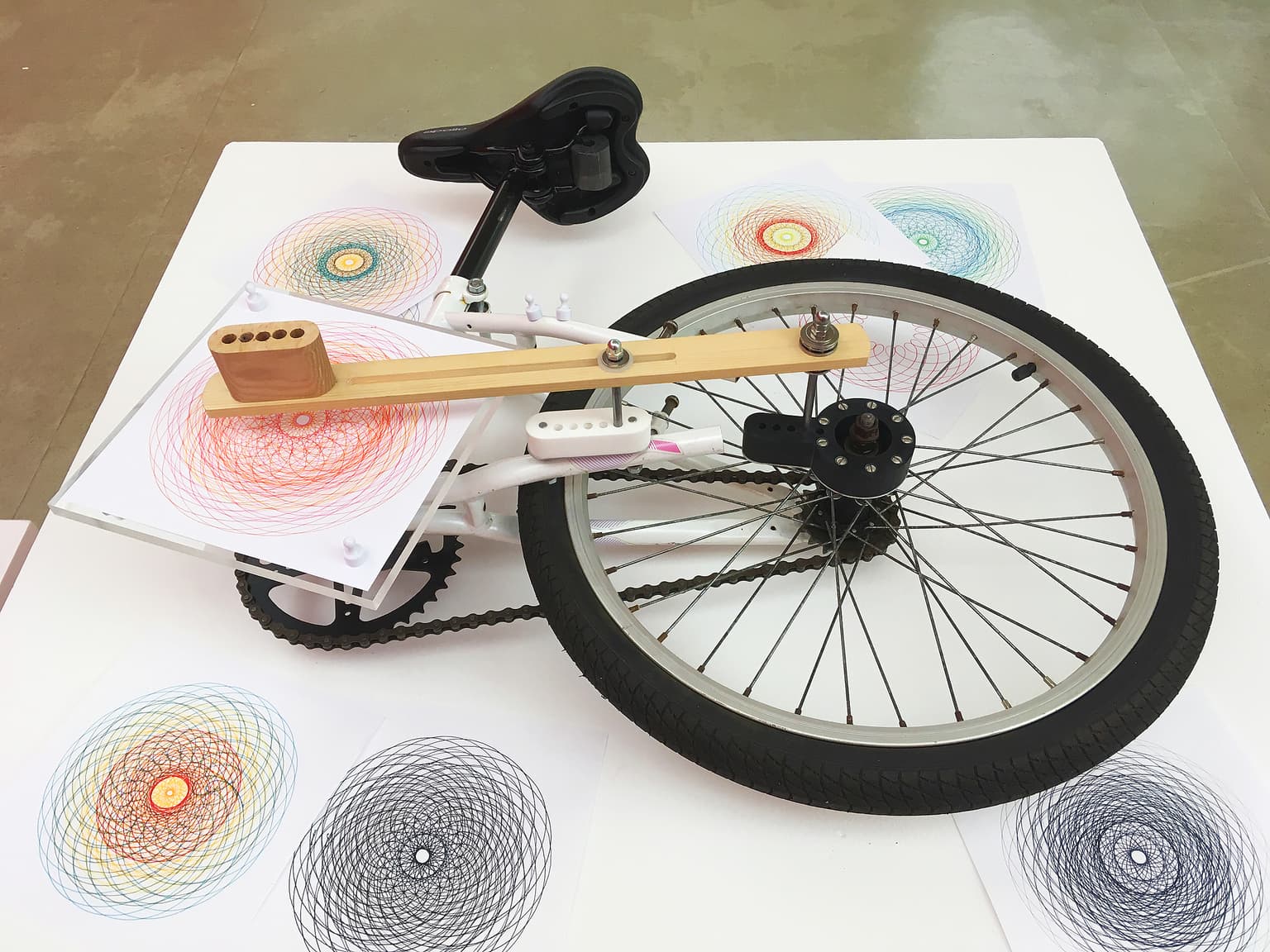
Bicycle Spirograph 4
75.0 x 68.0 x 25.0 cm
Repurposed child’s bicycle, wood, metal, plastic, felt-tip pens, paper
This is the fourth in a series of epitrochoid/hypotrochoid drawing machines I’ve made from scrap bikes. I built this one from a child’s bike, to be suitcase-sized for travel to South Korea for art exhibitions in October 2019.
As it’s made from a single-gear bike, pattern variation is created by moving the pivot pins and pens between various holes. Different sets of five felt-tip pens chosen by participants create colour palette variations. Patterns are drawn by rotating the back wheel – rotational movement is translated via a piston-like drawing arm onto the drawing mat attached to the crank (where the pedal used to be). 21cm square paper is pinned with magnets onto this drawing mat.
It has been very popular at science events.