Bridges 2026 Exhibition of Mathematical Art, Craft, and Design
Rashmi Sunder-Raj
Artists
Rashmi Sunder-Raj
Mathematical Artist
Waterloo, Ontario, Canada
Statement
I seek patterns to make sense of my world. Some of these I choose to interpret as visual images. My pieces here involve a method which I consider to be “tiling on tilings”. Starting with tilings that are edge-touching patterns of regular polygons (along with the gaps created by them), other tilings can be represented by coloring in some of the polygons to approximate the boundaries of their tiles. These pieces are the result of my attempts to represent tilings related to the aperiodic hat monotile in this fashion.
Artworks
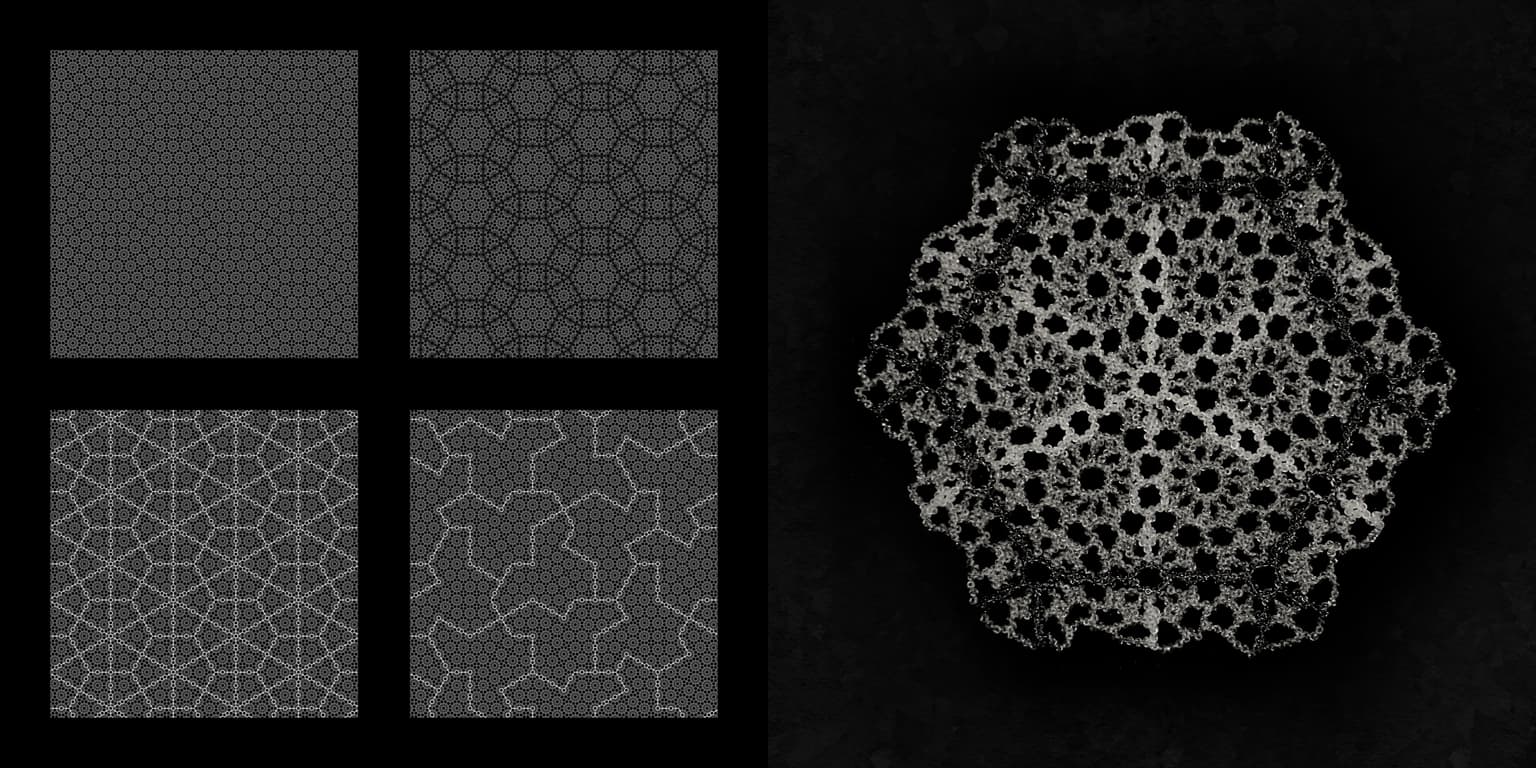
Hats and Polygons (with bead lace sample)
30.0 x 30.0 cm
Digital print and glass beads
2026
I have used a base pattern of dodecagon motifs grouped to form overlapping roughly triangular, square, and hexagonal areas arranged as in a rhombitrihexagonal tiling (3.4.6.4). Each “edge” in this tiling was formed by joining the centers of 3 collinear motifs by means of an arrangement of dodecagons (shown in black) approximating a line. The dual of this tiling consists of groupings of 6 kites which can be used to form hat or turtle aperiodic monotiles. The borders of these kites have been constructed of roughly linear arrangements of white dodecagons, some of which have been removed to show a tiling of hats.
Using round beads in place of dodecagons, I have represented a small portion of these tilings as double-sided bead lace.
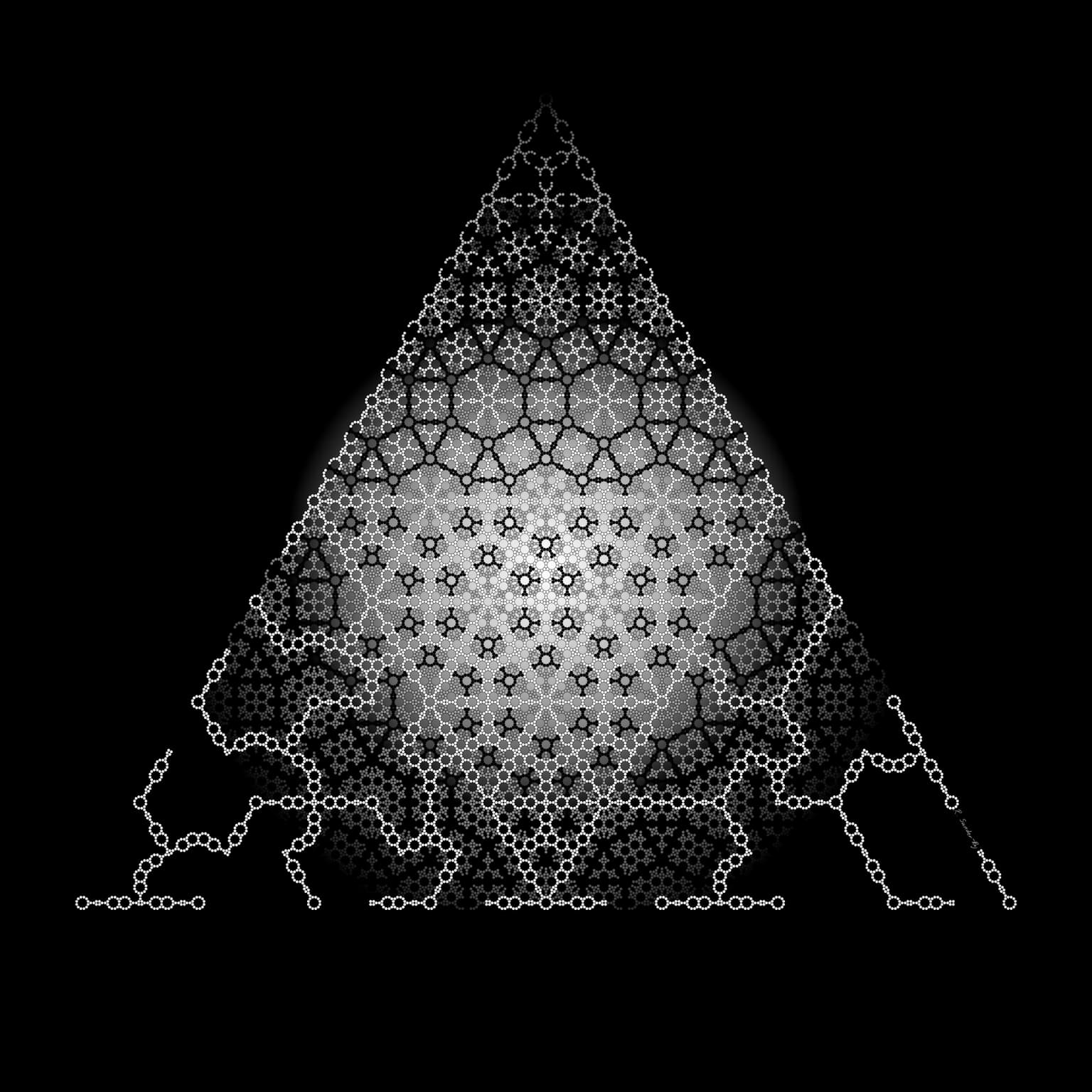
Layers
30.0 x 30.0 cm
Digital print
2026
The method used to create “Hats and Polygons” was also used here, but with smaller groupings of dodecagon motifs. In this piece, the rhombitrihexagonal tiling is shown merged with its dual tiling of kites and also with small swatches of both hat and turtle tilings, inviting the viewer to observe relationships among these tilings.