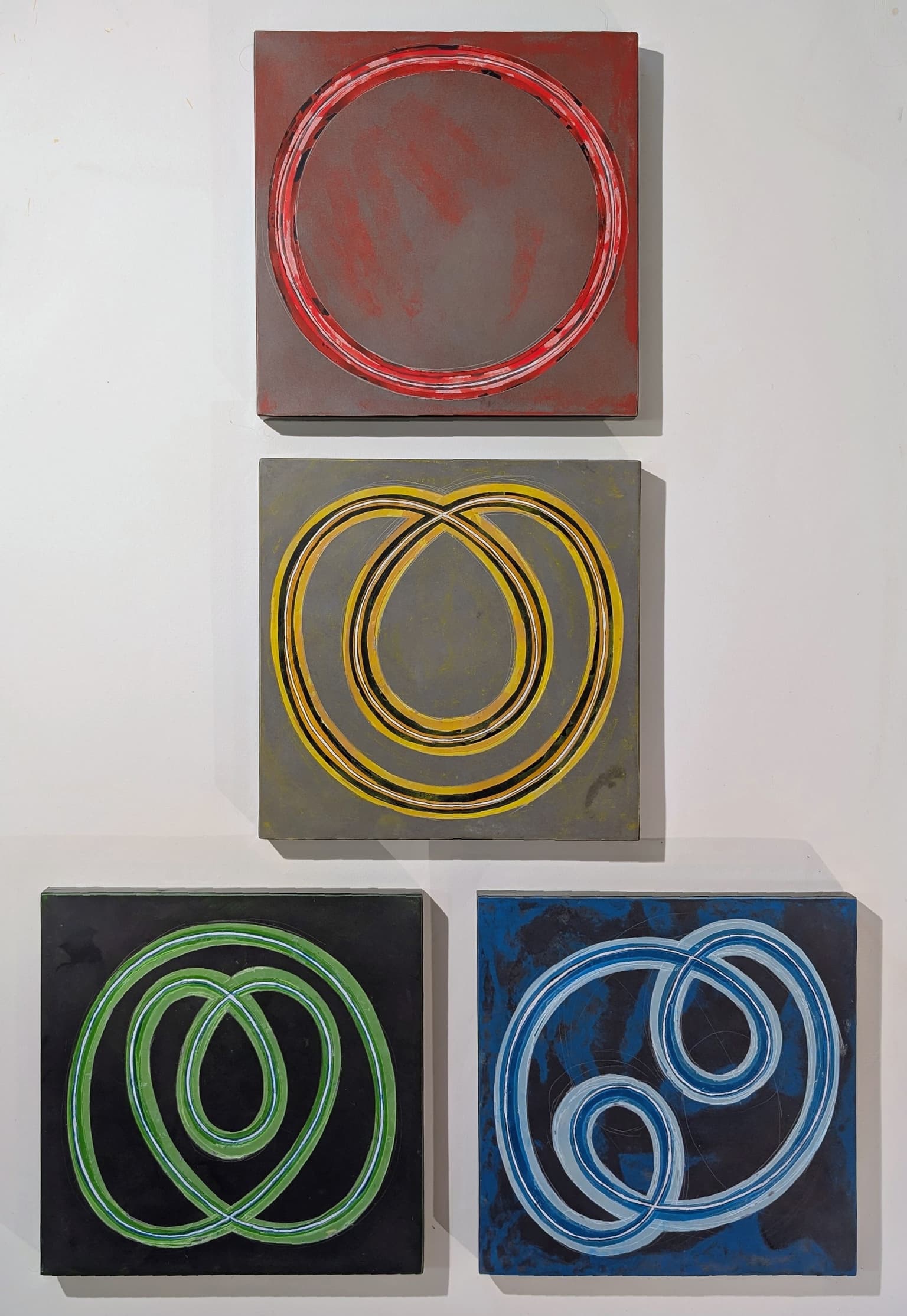
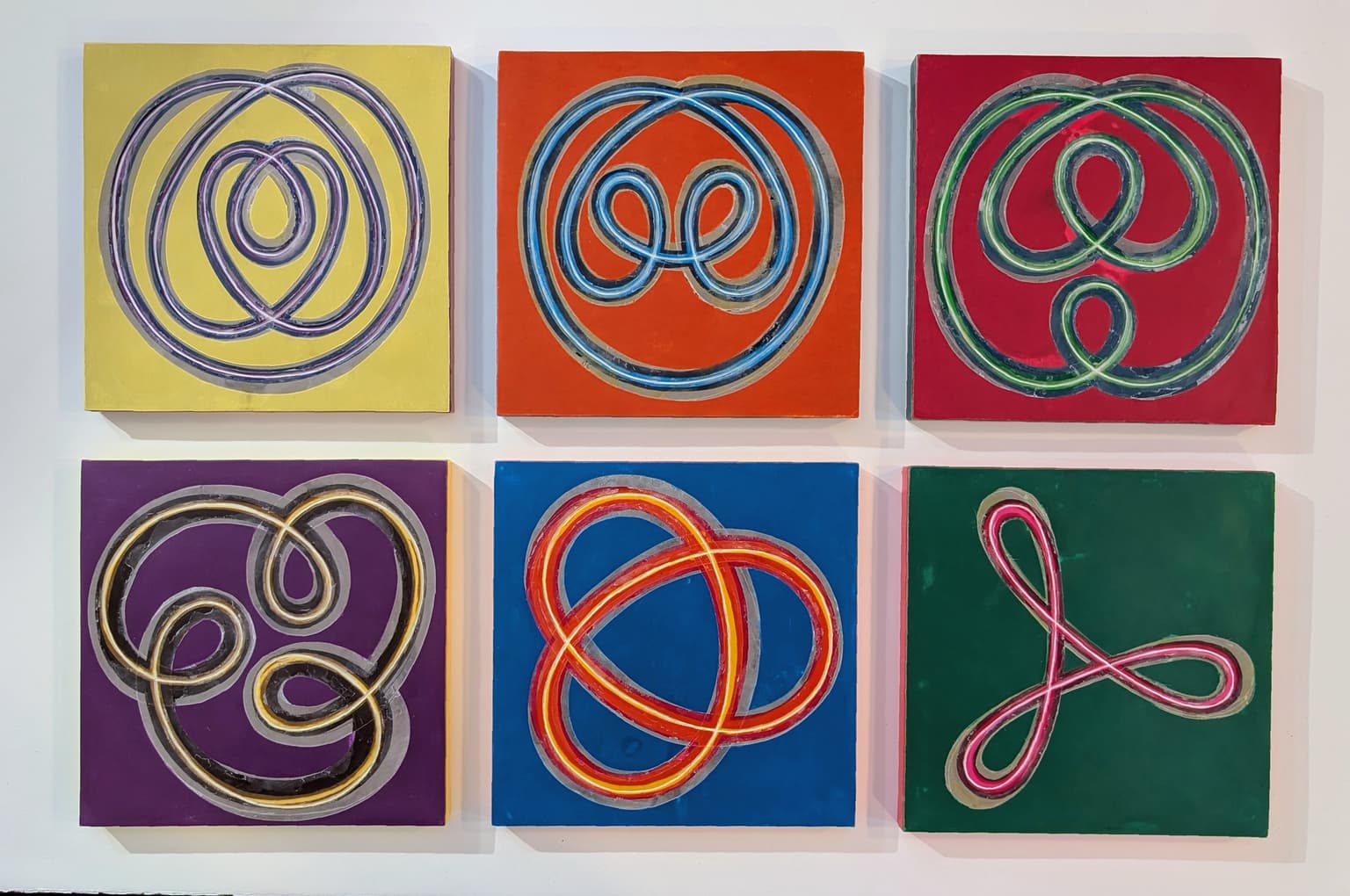
My recent creative output has been exclusively preoccupied with monotonal, simple traversal circle immersions in a plane. I laminate stacks of colored cardstock on 10x10” panels with encaustic medium. Then I cut through to expose each layer iteratively, asymptotically refining the form, the wax forgetting nothing. Each panel represents a node in a phylogenetic tree that maps the combinatorial explosion of circle immersion permutations with distinct isotopy that results from the incremental complexity introduced by each additional intersection point. I’m submitting a set of four that solve for 0-2 intersection points, and a set of six that solve for 3. 4 has 17, and 5 might be 53? I’ll know soon enough. (750 characters? Criminy!)
Artworks
Circle Immersion Primitives - Domain, Kingdom, Phyla
25.0 x 25.0 x 2.0 cm
encaustic and cardstock laminate on birch panel
2026
Dimensions are per panel. The four panels can be hung in any configuration, but with a preference for as depicted.
Counting the circle immersion permutations with distinct isotopy in each taxonomic tier results in an integer sequence that starts with 1,1,2,6,17, with the next number potentially being 53? There might be some novel discreet math potential here. Or it maps to something already accounted for in the OEIS, but almost certainly arrived at by a completely different means.
The simplicity of the geometric concepts and the crude fumbling of realizing them in physical materials resonates with me. Also, these forms feel like they would have been some of the first things to appear, nanoseconds into the big bang.
Circle Immersion Primitives - Classes
25.0 x 25.0 x 2.0 cm
encaustic and cardstock laminate on birch panel
2026
Dimensions are per panel. The six panels can be hung in any configuration, but with a preference for as depicted.
Counting the circle immersion permutations with distinct isotopy in each taxonomic tier results in an integer sequence that starts with 1,1,2,6,17, with the next number potentially being 53? There might be some novel discreet math potential here. Or it maps to something already accounted for in the OEIS, but almost certainly arrived at by a completely different means.
The simplicity of the geometric concept and the crude fumbling of realizing it in physical materials resonates with me. Also, these forms feel like they would have been some of the first things to appear, nanoseconds into the big bang.