Artists
Statement
I grow mapping cylinders with yarn by seamlessly crocheting along ribbon graphs made from foundation chains. Choosing the foundation chain graph is the most creative part of a project for me. When the final piece slowly grows and reveals its form with a little of my help, it feels like magic. Each piece is also a puzzle: the observers are invited to think about how they would make such a surface and why the surface is the one I claim.
Artworks
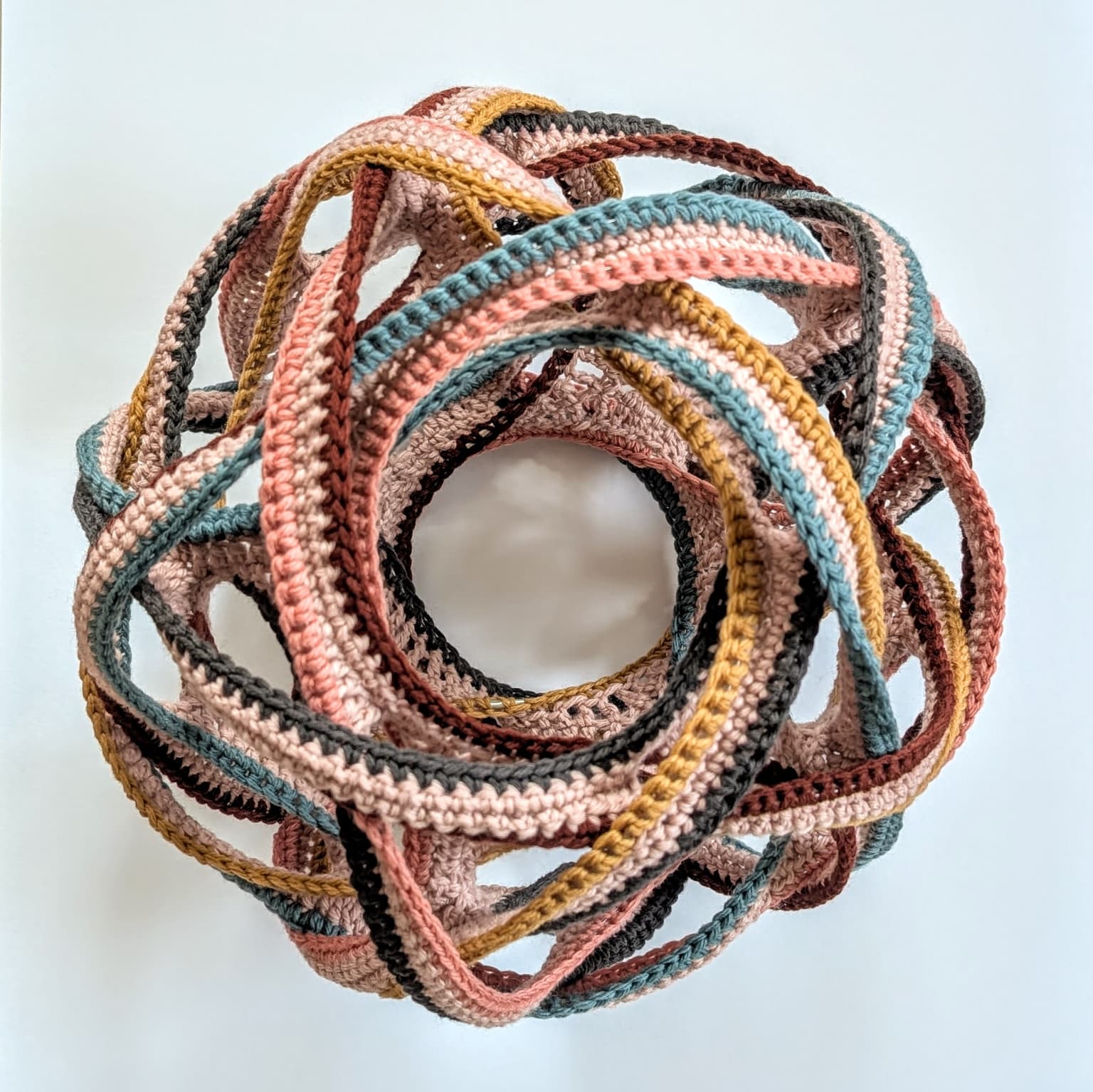
This is my first attempt at building a foundation chain from the stellation of an icosahedron. The chain is based on the five intersecting tetrahedra, in particular the carved-out version originally designed by George Hart for solid-sheet materials. In that design, the tetrahedra lock together along carefully calculated grooves in their arms. To convert it into crochet, I replaced the locking mechanisms with saddle points using a saddle method I developed. The piece reveals familiar ingredients of the icosahedron: six interlocking planar rings, and a boundary link of 15 curved digons arranged as five sets of Borromean rings. This continues my exploration of curved polylinks with chiral icosahedral symmetry.
Dihedral Rainbow
15.0 x 50.0 x 45.0 cm
wool, nylon, copper
2026
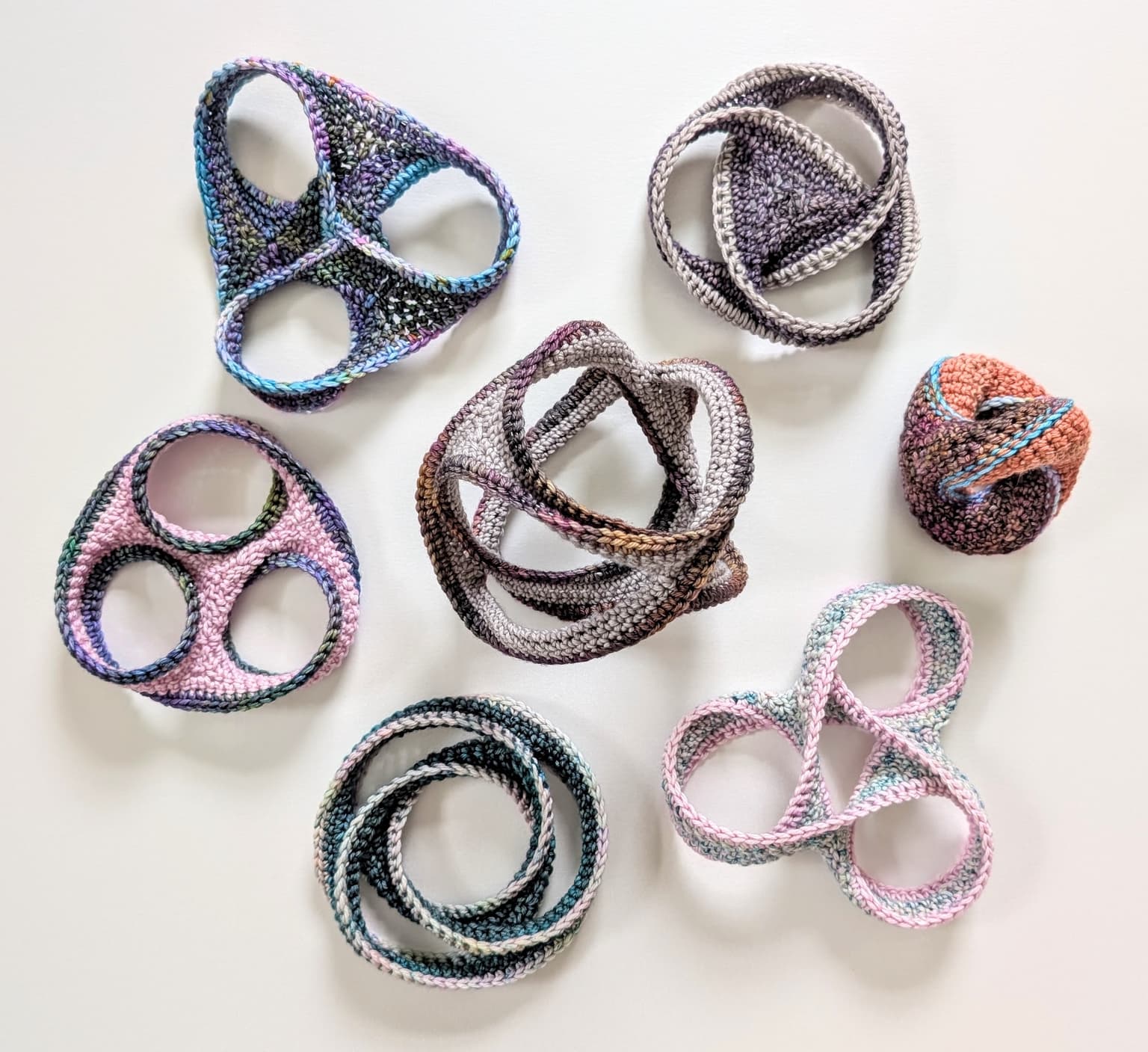
In my topological crochet journey, I have always been drawn to dihedral symmetry and low-genus surfaces. In this set, I collected seven such surfaces, all with D_3 symmetry. Starting at the lower right and moving counterclockwise, they are: a 3-punctured torus, a double torus, a 3-punctured flattened Boy’s surface, a 3-punctured Klein bottle, a punctured Dyck’s surface, and a saddle trefoil—a punctured non-orientable surface of genus 4. In the center is a punctured non-orientable surface of genus 5. Making and playing with these surfaces is enjoyable. They also make ideal candidates for workshops.